A **commutative ring** is a fundamental algebraic structure in mathematics, particularly in abstract algebra. It is defined as a set equipped with two binary operations that generalize the arithmetic operations of addition and multiplication.
Articles by others on the same topic

A commutative ring is a ring in which multiplication satisfies for every pair. The integers and the polynomial ring are examples. So is , the quotient ring whose elements are residue classes in modular arithmetic. We represent these by and reduce each sum or product to its remainder. All following calculations modulo use this convention.
In , , although neither factor is zero. Thus and are zero divisors: nonzero elements whose product with another nonzero element can vanish. Also . Removing the common factor would falsely assert . The entire row for multiplication by isThe repetitions explain the linear congruences directly. The equation has exactly the two solutions , whereas has none. A common factor can erase information, and a nonzero coefficient does not guarantee that an equation has a solution.
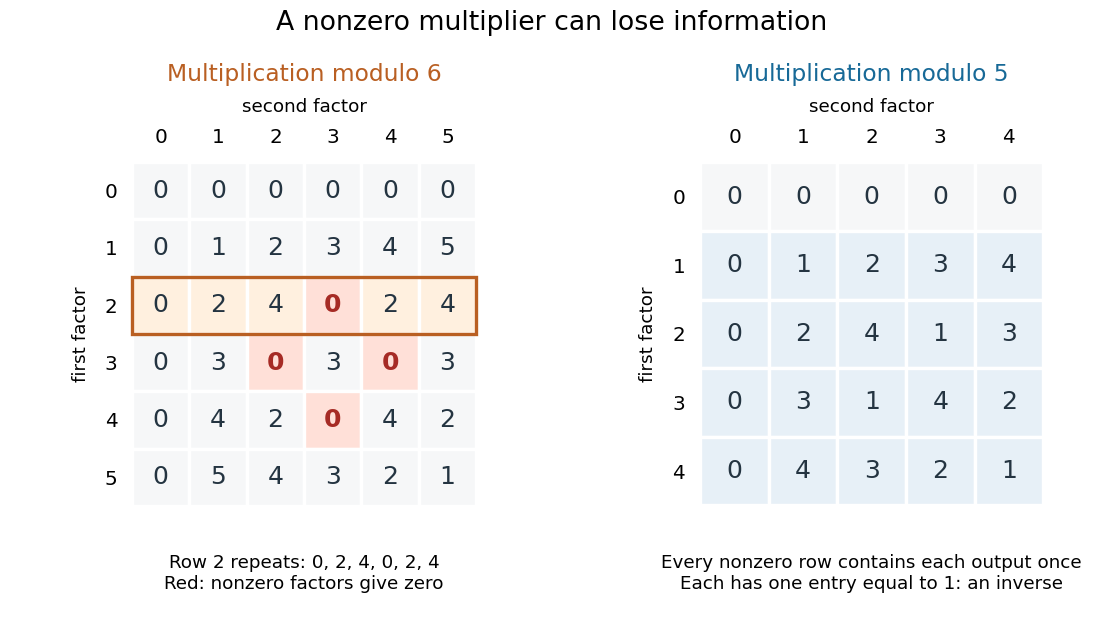
A unit in a ring is an element with a multiplicative inverse, meaning for some . In , the units are exactly and , since . The other nonzero elements, , are zero divisors; for , use . In a nonzero commutative ring, a unit cannot be a zero divisor: multiplying by its multiplicative inverse forces . But a nonzero element need not be a unit or a zero divisor: the integer is neither in .
By contrast, in , every row for a nonzero multiplier is a permutation of . Each such row contains exactly once, giving a multiplicative inverse: , , , and . Hence this commutative ring is a field. For example, now has the unique solution . Reading the tables reveals which algebraic steps the arithmetic permits.

