Coulomb's Law describes the electrostatic interaction between charged particles. Formulated by Charles-Augustin de Coulomb in the 18th century, the law states that the force \( F \) between two point charges \( q_1 \) and \( q_2 \) is directly proportional to the product of the magnitudes of the charges and inversely proportional to the square of the distance \( r \) between them.
Articles by others on the same topic

Coulomb's law gives the mutual electric force between stationary point charges in vacuum. Put electric charges and at and , and define the displacement from charge 1 to charge 2 by , with separation and unit vector . In SI units, the force on charge 2 due to charge 1 isHere is the vacuum permittivity. The magnitude is . If , the force on charge 2 points away from charge 1; if , it points toward charge 1. Interchanging the charges gives , consistent with Newton's third law in this electrostatic setting. [ref].
For a fully computed example, stipulate , , , and the approximate value . ThenThe force is attractive, of magnitude . The source electric field at charge 2 is , pointing away from the positive source. Multiplication by the negative reverses the direction to give the attractive force. This field excludes charge 2's own self-field.
Holding the electric charges fixed while changing the separation from to or gives the normalized inverse-square law valuesFor the stipulated example, separations , and give magnitudes , and . The diagram computes these ratios and uses one common arrow-length scale for both sign choices.
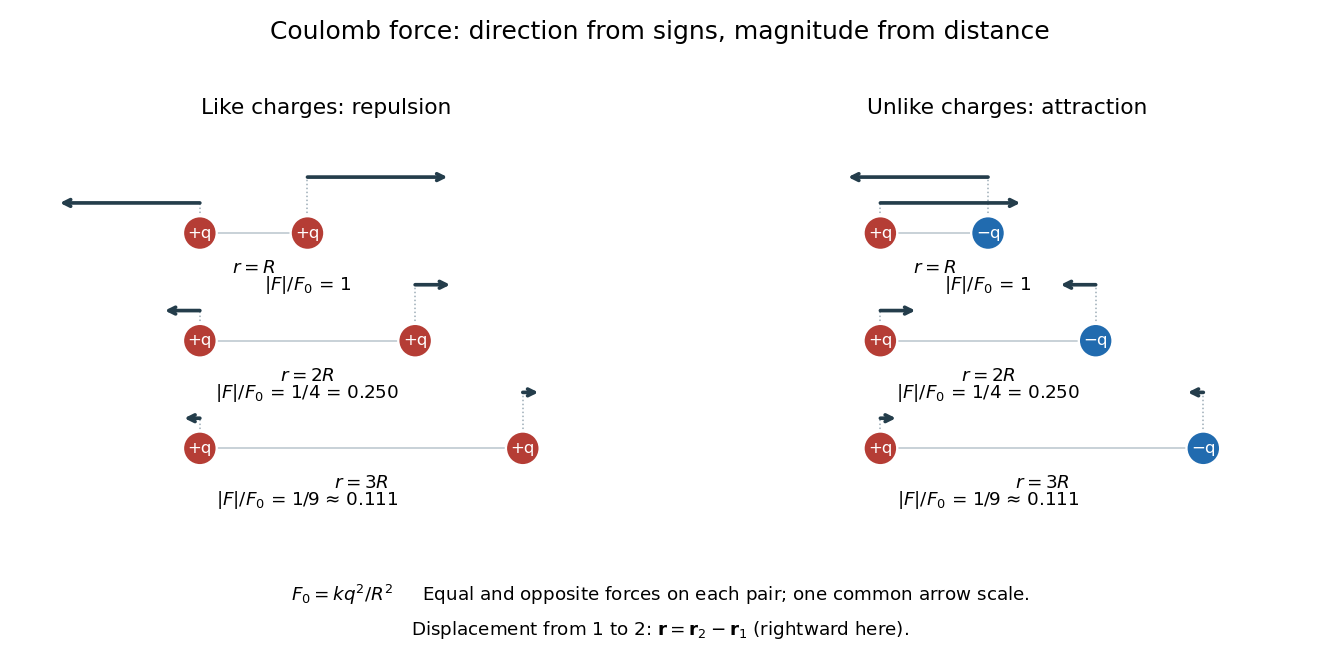
Equal and opposite Coulomb force vectors: like charges repel, unlike charges attract, and doubling or tripling separation gives one quarter or one ninth of the force
. Details. The inverse-square law has a geometric explanation through Gauss's law: a source point charge gives fixed total electric flux through a concentric sphere, whose surface area is . Dividing that flux by the area gives a radial electric field proportional to . This connects a pairwise force calculation to a global conservation-like accounting of field sources. For several stationary point charges, the superposition principle adds the individual electric fields as vectors, and uses all sources except charge itself. The Coulomb potential energy gives an alternative route when the desired quantity is work rather than instantaneous force.


Is implied by Gauss' law if Maxwell's equations: physics.stackexchange.com/questions/44418/are-the-maxwells-equations-enough-to-derive-the-law-of-coulomb
The "static" part is important: if this law were true for moving charges, we would be able to transmit information instantly at infinite distances. This is basically where the idea of field comes in.
Coulomb's Law experiment with torsion balance with a mirror on the balance to amplify rotations by uclaphysics (2010)
Source.