A Directed Acyclic Graph (DAG) is a type of graph that has the following characteristics: 1. **Directed**: The edges in the graph have a direction, meaning that they point from one vertex (or node) to another. This is often represented with arrows on the edges.
Articles by others on the same topic

A Directed acyclic graph is a directed graph with no directed cycle: following its directed edges can never return to the starting vertex. A directed edge can represent the requirement that task finish before task starts. A directed path then records a chain of prerequisites. The essential prerequisite for topological sorting is that these requirements contain no circular dependency. For finite directed graphs, this is equivalent to the existence of a topological order. [ref]
https://live.ocw.mit.edu/courses/6-006-introduction-to-algorithms-spring-2020/d9265b3b33d238ff914b0223ac8e7628_MIT6_006S20_r10.pdf. MIT, Introduction to Algorithms, Recitation 10, p. 3: directed acyclic graphs and topological sorts
Consider an invented publishing workflow with five tasks: drafts the text, draws a figure, reviews the text, lays out the text and figure, and publishes the result. Its directed edges are , , , , and . Reviewing needs the draft; layout needs both the draft and figure; publication needs both review and layout. The drawing below encodes only these prerequisites, with no measured durations or resource constraints.
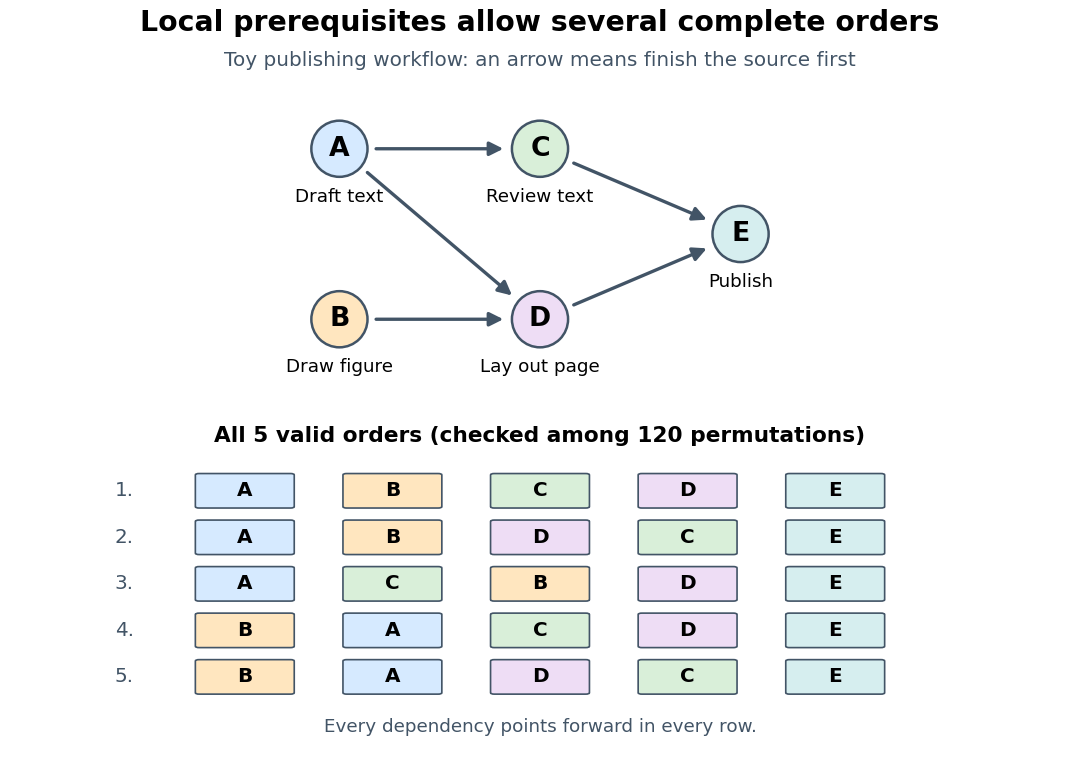
Five toy publishing tasks and all five valid topological orders
. Details. The Directed acyclic graph leaves room for choice: and can occur in either order, and after both are complete, and can occur in either order. Task may even precede , since the review does not need the figure. A topological order turns these local prerequisites into a complete executable list while retaining this freedom. It supplies a feasible sequential plan; task durations, available workers, and earliest finishing times require additional information.

