The Dulong–Petit law is a principle in physical chemistry that states that the molar heat capacity of a solid element is approximately constant and can be estimated from its atomic mass. Specifically, it posits that the molar heat capacity (\(C_m\)) of a solid element can be expressed as: \[ C_m \approx 3R \] where \(R\) is the universal gas constant (\(R \approx 8.
Articles by others on the same topic

In the classical high-temperature limit, each independent harmonic oscillator contributes to the heat capacity at constant volume, where is the Boltzmann constant. A three-dimensional crystalline solid with chemical atoms has vibrational normal modes in the bulk harmonic approximation. Its vibrational internal energy and heat capacity at constant volume therefore obeyHere is independent of temperature at fixed volume. Thus the Dulong-Petit law predicts for a real solid in this regime. Per mole of chemical atoms, rather than per mole of a compound's formula units,with molar gas constant and Avogadro constant . A formula unit containing chemical atoms consequently has a classical vibrational prediction of per mole of formula units.
For example, in this ideal classical model, one mole of chemical atoms heated at fixed volume from to gains vibrational internal energyThe heat capacity at constant volume stays the same even though the thermal part of the internal energy doubles. These temperatures illustrate the stipulated classical model; they do not assert that every real solid is classical at .
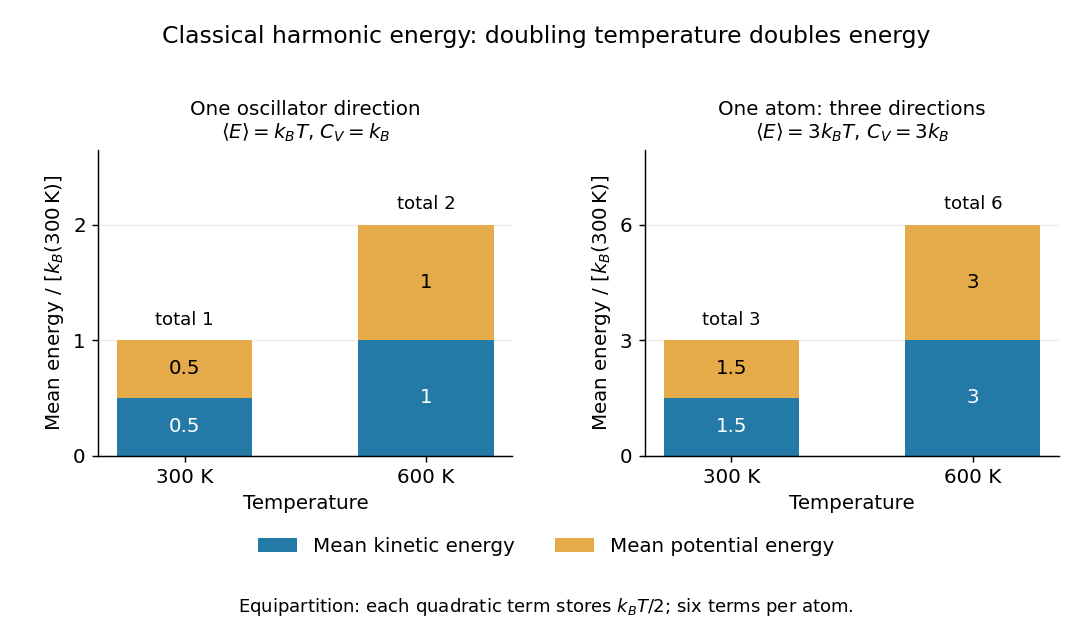
The proof outline is the equipartition theorem: one classical harmonic oscillator has a quadratic kinetic energy and a quadratic potential energy, each with mean . Their sum is , whose derivative with respect to temperature is . Summing over normal modes gives . The classical result does not require equal angular frequencies: each harmonic normal mode contributes the same amount once it is classical. Overall rigid motions give only a finite-size correction to the bulk count. This independence from the individual angular frequencies makes the Dulong-Petit law useful as a quick estimate of a solid's heating requirement.
Experiments on freely expanding solids often measure the heat capacity at constant pressure , whereas the harmonic prediction is for the heat capacity at constant volume . In a smooth single thermodynamic phase of a simple compressible material, the difference between constant-pressure and constant-volume heat capacities iswhere is the volumetric coefficient of thermal expansion and is the isothermal compressibility. Using measured as an approximation to requires this correction to be small compared with . [ref]
https://davidtong.org/teaching/statistical-physics/statmechhtml/S4#S4.SS4.SSS2. David Tong, Statistical Physics, section 4.4.2: relation between the two heat capacities
High temperature here means for the relevant vibrational normal modes, with reduced Planck constant and mode angular frequency . At low temperature, excitation across a quantum energy spacing is suppressed: modes with freeze out thermally, and the classical equipartition theorem fails. The Einstein model of a solid makes this loss of vibrational heat capacity explicit. The Dulong-Petit law is therefore an ideal high-temperature vibrational limit, not a statement that all solids have the same heat capacity at every temperature. Other contributions and departures from the harmonic approximation can matter even at high temperature. [ref]
https://davidtong.org/teaching/statistical-physics/statmechhtml/S3#S3.SS3. David Tong, Statistical Physics, section 3.3: solid vibrations, the classical limit and quantum freeze-out
Historically, Petit and Dulong's 1819 experiments compared the specific heat capacities of several elemental solids and found an approximately constant product with their relative atomic weights. Their original empirical regularity came before the classical harmonic explanation; it suggested that counting chemical atoms reveals a simpler pattern than comparing equal masses. [ref]
https://webserver.lemoyne.edu/giunta/PETIT.html. Petit and Dulong, Recherches sur quelques points importants de la Théorie de la Chaleur, Annales de Chimie et de Physique 10, 395–413 (1819), contemporary English translation hosted by Carmen Giunta


It can be seen as the limit case of an Einstein solid at high temperatures. At lower temperatures, the heat capacity depends on temperature.