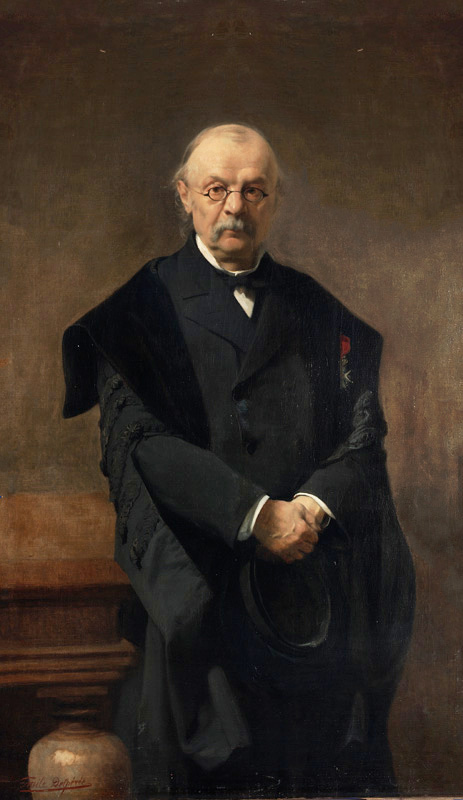
Eugène Charles Catalan (1814–1894) was a Belgian mathematician and physicist known for his contributions to number theory, combinatorics, and the study of algebraic structures. He is particularly renowned for Catalan's conjecture (now known as Mihăilescu's theorem), which states that the only two consecutive perfect powers of natural numbers are \(8\) and \(9\) (i.e.
Articles by others on the same topic

Eugène Charles Catalan studied counting problems including triangulations of a polygon, leading to the sequence now called the Catalan numbers.[ref]
https://mathshistory.st-andrews.ac.uk/Biographies/Catalan/. University of St Andrews biography, summary and triangulation work
The formula counts several apparently different families: triangulations of a convex -gon, balanced parenthesizations and plane binary-tree structures. The Catalan recurrence expresses how selecting a root operation divides such an object into two smaller objects. This illustrates why a historical counting problem can become a reusable language for combinatorics.Homepage: 200.ulg.ac.be/catalan-bio.html