Photosynthesis is a biochemical process by which green plants, algae, and some bacteria convert light energy, usually from the sun, into chemical energy stored in glucose and other organic compounds. This process is essential for life on Earth, as it is the primary means by which energy enters the ecosystem. It also generates oxygen as a byproduct, which is vital for the respiration of most living organisms.
Articles by others on the same topic

Photosynthesis captures light energy and transforms it into chemical forms that a biological cell can use. In plants, algae and cyanobacteria, this supports carbon fixation: incorporation of carbon from carbon dioxide into chemical compounds used to build living material. Capturing light and incorporating carbon are distinct processes coupled through metabolism. See OpenStax Biology 2e, 8.1: overview of photosynthesis.
For oxygenic photosynthesis, a simplified net equation writes a six-carbon sugar, glucose, as the representative product:This is net stoichiometry, not a one-step mechanism. A worked bookkeeping check counts six carbon chemical atoms, twelve hydrogen chemical atoms, and eighteen oxygen chemical atoms on each side: the product side has six oxygen chemical atoms in the sugar and twelve in molecular oxygen. The light label supplies energy, not additional chemical atoms.
Crucially, the released molecular oxygen comes from water, not carbon dioxide. Cancelling water made and consumed in different steps hides this distinction in the net equation. The Calvin cycle supplies a net three-carbon triose phosphate, such as glyceraldehyde 3-phosphate, for subsequent sugar synthesis; it does not directly export glucose. See OpenStax Biology 2e, 8.2: light-dependent reactions and OpenStax Biology 2e, 8.3: using light energy to make organic molecules.
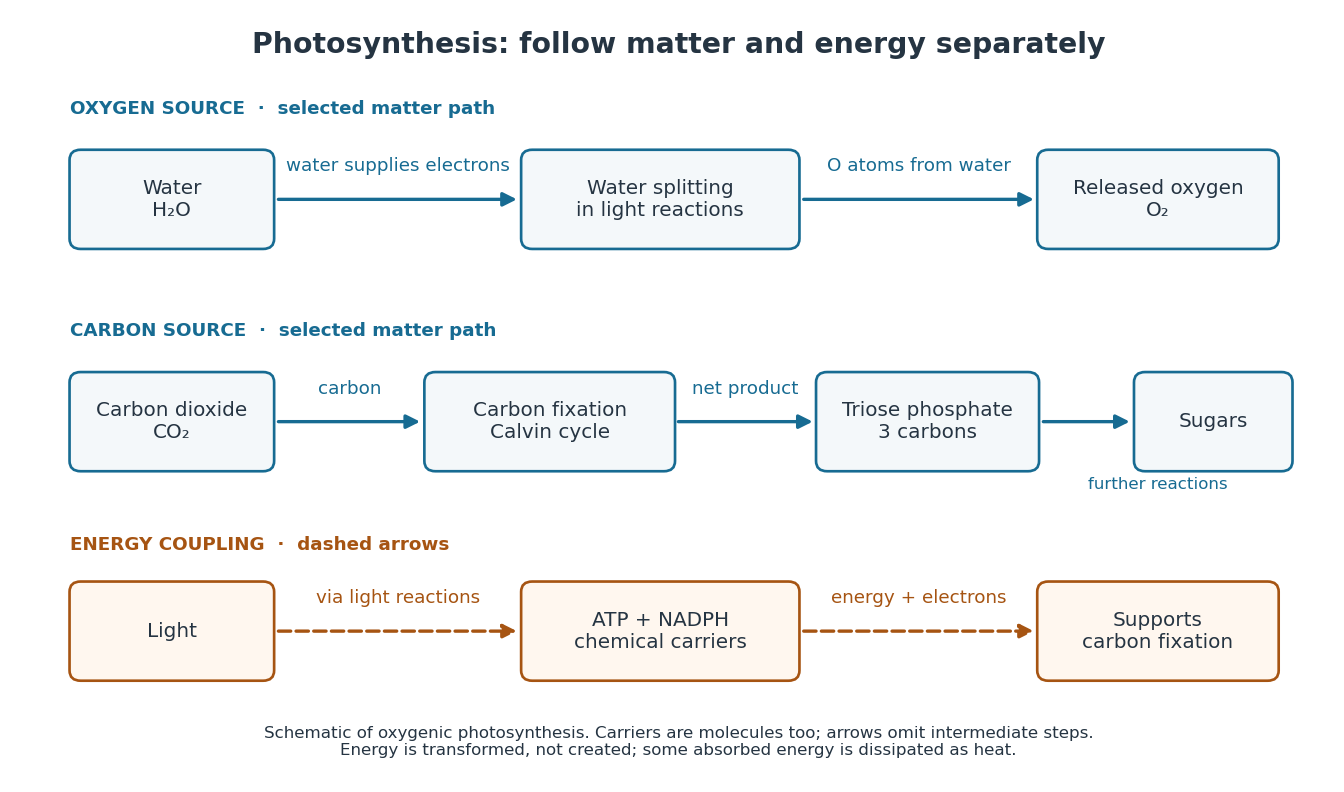
The useful achievement is connecting incoming light to both usable energy and new biological material. ATP is an immediate energy currency; NADPH supplies Electrons for synthesis; carbon dioxide supplies the carbon incorporated into carbohydrates. These roles are complementary. Conservation of energy still holds: photosynthesis transforms energy, never creates it, and some absorbed energy is dissipated as heat. A plant also carries out cellular respiration, including in biological cells that perform photosynthesis. Gas exchange reflects both processes. Oxygenic photosynthesis remains central to interpreting terrestrial molecular oxygen as an atmospheric biosignature gas. See OpenStax Biology 2e, 8.3: photosynthesis and respiration.


It is quite cool that photosynthesis works just like cellular respiration by producing a proton potential through chemiosmosis.