In group theory, a **quotient group** (or factor group) is a way of constructing a new group from an existing group by partitioning it into disjoint subsets, called cosets, that are determined by a normal subgroup. Here's how it works, step by step: 1. **Group**: Let \( G \) be a group, which is a set equipped with a binary operation satisfying the group axioms (closure, associativity, identity element, and inverses).
Articles by others on the same topic

For a group and a normal subgroup , the quotient group is the set of cosets , with operationIts identity element is the coset , and the inverse element of is . A quotient group treats all elements within one coset as the same input while retaining a consistent operation on the classes. The normal subgroup condition is what makes this operation independent of which representatives are chosen. [ref]
https://ocw.mit.edu/courses/18-703-modern-algebra-spring-2013/ecdbd211f736b3ac92379dea05b34491_MIT18_703S13_pra_l_9.pdf. McKernan, MIT 18.703, Theorem 9.1: quotient-group construction
.Take the additive group and . Since is an abelian group, is a normal subgroup. There are three elements in the quotient group:Adding two copies of gives ; adding and gives . Hence the quotient group has the addition table of . It does not select one representative and discard the others: its elements are the entire cosets.
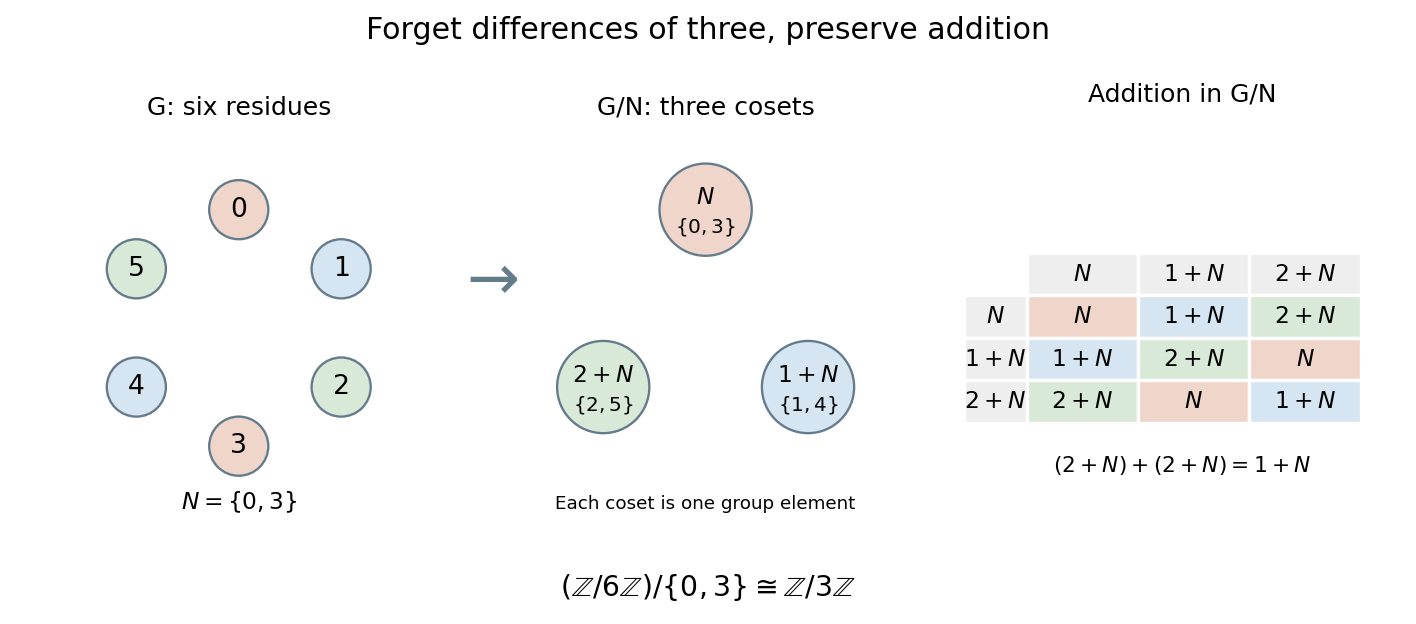
Identifying residues differing by three turns a six-element cyclic group into a three-element quotient group
. Details. This is useful whenever distinctions within a normal subgroup should be ignored. For example, the sign of a permutation retains only even or odd parity of a permutation in . Its group kernel is the alternating group , and the quotient group has two elements. The first isomorphism theorem explains why a group homomorphism's image is a quotient group of its domain.


Ultimate explanation: math.stackexchange.com/questions/776039/intuition-behind-normal-subgroups/3732426#3732426
Does not have to be isomorphic to a subgroup:
This is one of the reasons why the analogy between simple groups of finite groups and prime numbers is limited.