Réka Albert is a Hungarian-American physicist known for her work in the field of network science, particularly in the study of complex networks. She is a professor at Pennsylvania State University and has made significant contributions to the understanding of the structure and dynamics of networks, including biological, social, and technological systems. Albert is well-known for her research on scale-free networks and has co-authored influential papers in the field, helping to advance the understanding of how networks are formed and how they function.
Articles by others on the same topic

Réka Albert is a physicist whose work connects network science with biological networks. With Albert-László Barabási, she coauthored the 1999 paper introducing a growing preferential attachment model for the emergence of broad degree distributions, now called the Barabási-Albert model.[ref]
Her biological work uses logical models to connect the structure of a regulatory graph with its possible dynamical states. Such models represent interactions without requiring a measured kinetic constant for every reaction. Her institutional profile describes research on mechanisms controlling complex-network dynamics and on predictive modeling of biological systems.[ref]
Homepage: www.ralbert.me/
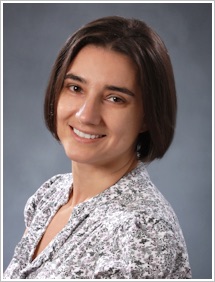
Réka Albert, portrait on her institutional homepage
.