A unit vector is a vector that has a magnitude of exactly one. Unit vectors are typically used to indicate direction without regard to magnitude. In mathematical terms, a unit vector is often denoted with a "hat" symbol, such as \(\hat{u}\). For any vector \(\mathbf{v}\), the unit vector in the direction of \(\mathbf{v}\) can be computed by dividing the vector by its magnitude (or length).
Articles by others on the same topic

A unit vector is a vector of norm one in a normed vector space. For a nonzero vector , vector normalization produces one by dividing by . In a real Euclidean space, this keeps the direction and removes the magnitude. The zero vector cannot be normalized because its norm is zero.
For with Euclidean norm , the corresponding unit vector isThe Euclidean vector can therefore be reconstructed as : size and direction are distinct pieces of information. The standard basis vectors are familiar unit vectors, but a unit vector need not point along a coordinate axis.
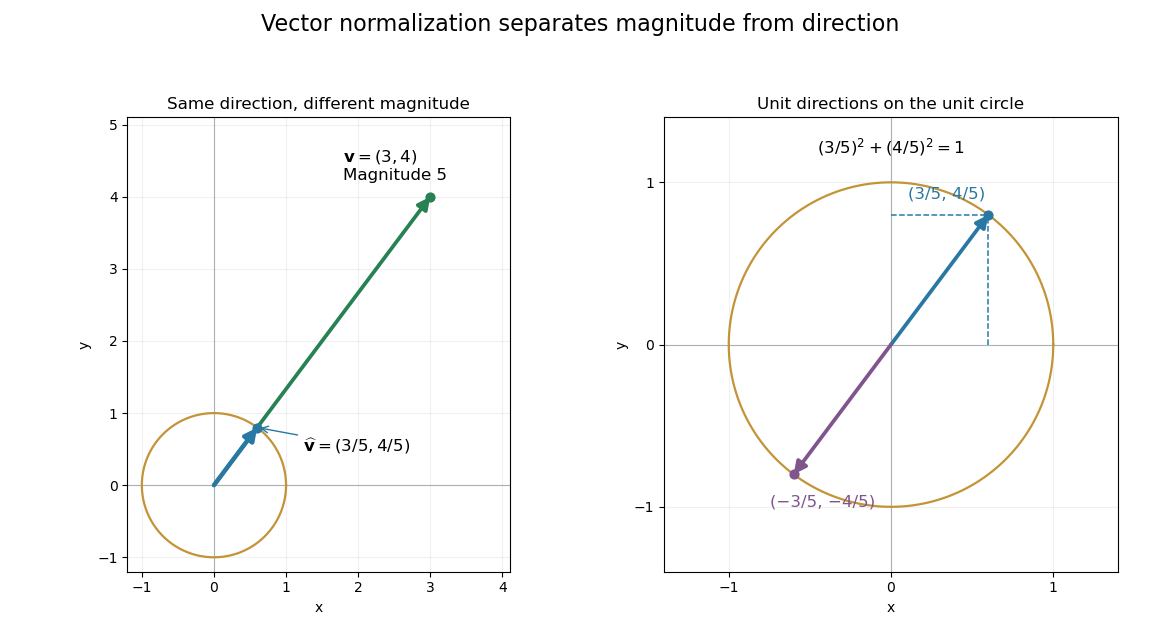
Normalization keeps direction and places the endpoint on the unit circle
. The original Euclidean vector has magnitude . Its vector normalization lies on the unit circle. The enlarged right panel also shows its negative, which has the same Euclidean norm and the opposite direction. Details.