In graph theory, a **vertex cover** of a graph is a set of vertices such that every edge in the graph is incident to at least one vertex from this set. In simpler terms, for every edge that connects two vertices, at least one of those vertices must be included in the vertex cover. The concept of a vertex cover is important in various areas of computer science, including optimization, network theory, and computational biology.
Articles by others on the same topic

A vertex cover chooses vertices that collectively touch every edge of a graph. Think of placing monitors at junctions: if a monitor watches every connection incident to its junction, a vertex cover watches all connections. The minimum vertex cover asks how few monitors suffice. This is a model of covering connections through their endpoints, rather than of monitoring distances in the drawing.
For a finite simple graph , a vertex cover is a subset satisfyingBoth endpoints may be selected; the condition requires at least one. An isolated vertex covers no edge, so a minimum vertex cover never needs it.[ref]
Graph Theory by Reinhard Diestel. Diestel, Graph Theory, fourth electronic edition, Section 2.1, definition of vertex cover
Take the cycle graph with vertices and edges . The set is a vertex cover: vertex covers and , vertex covers and , and vertex covers as well as . In particular, the closing edge is covered even though vertex is unselected.
The unselected vertices form an independent set. This is the key connection: an edge missed by would have both endpoints in , precisely what an independent set forbids. For every subset ,Here is the complement of a set within ; the graph itself keeps all its edges. The complement graph is a different construction.[ref]
https://introtcs.org/public/lec_12_NP.html. Barak, Introduction to Theoretical Computer Science, Chapter 14, vertex-cover exercise
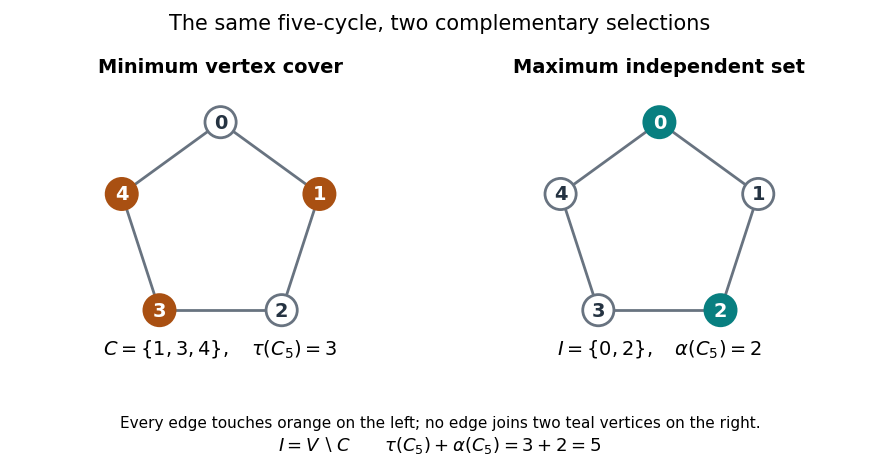
A minimum vertex cover and its maximum independent complement on the same five-cycle
. Details. 
The endpoints of any maximal matching form a vertex cover: an edge avoiding all endpoints would enlarge that matching in a graph. Consequently a graph with no matching in a graph of size has a vertex cover of size at most . This supplies a convenient vertex cover, but it need not be a minimum vertex cover.