Topics (206k) Articles (211k) Users (302) Discussions (237) Comments (383) Files (716) New article

Due to the failures of earlier generations, which believed that would quickly achieve AGI, leading to the AI winters, 21st researchers have been very afraid of even trying it, rather going only for smaller subste problems like better neural network designs, at the risk of being considered a crank.
While there is fundamental value in such subset problems, the general view to the final goal is also very important, we will likely never reach AI without it.
This is voiced for example in Superintelligence by Nick Bostrom (2014) section "Opinions about the future of machine intelligence" which in turn quotes Nils Nilsson:
There may, however, be a residual cultural effect on the AI community of its earlier history that makes many mainstream researchers reluctant to align themselves with over-grand ambition. Thus Nils Nilsson, one of the old-timers in the field, complains that his present-day colleagues lack the boldness of spirit that propelled the pioneers of his own generation:Nilsson’s sentiment has been echoed by several others of the founders, including Marvin Minsky, John McCarthy, and Patrick Winston.Concern for "respectability" has had, I think, a stultifying effect on some AI researchers. I hear them saying things like, "AI used to be criticized for its flossiness. Now that we have made solid progress, let us not risk losing our respectability." One result of this conservatism has been increased concentration on "weak AI" - the variety devoted to providing aids to human
thought - and away from "strong AI" - the variety that attempts to mechanize human-level intelligence
A (multi-user) blog is the hello world of the web, so creating one of those is the best way to quickly evaluate web technology, i.e. time to Hello World.
Some new frameworks like FeathersJS are making a chat app instead, as that highlights the push notifications a bit better.
This was the first full scale nuclear reactor in the world, and was brought up slowly to test it out.
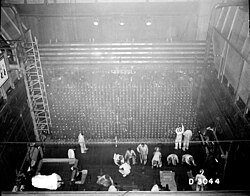

Hanford B Reactor tour by Studio McGraw
. Source. 2016.- youtu.be/8rlVHEY7BF0?t=335 good description of the fuel element. It uses uranium metal, not Uranium dioxide
- youtu.be/8rlVHEY7BF0?t=652 N Reactor and F Reactor were identical, and came up 2 months later, but much faster because of what they learned on the B
composite particle made up of an even number of elementary particles, most commonly one particle and one anti-particle.
This can be contrasted with mesons, which have an odd number of elementary particles, as mentioned at baryon vs meson vs lepton.
Pinned article: Introduction to the OurBigBook Project
Welcome to the OurBigBook Project! Our goal is to create the perfect publishing platform for STEM subjects, and get university-level students to write the best free STEM tutorials ever.
Everyone is welcome to create an account and play with the site: ourbigbook.com/go/register. We belive that students themselves can write amazing tutorials, but teachers are welcome too. You can write about anything you want, it doesn't have to be STEM or even educational. Silly test content is very welcome and you won't be penalized in any way. Just keep it legal!
Intro to OurBigBook
. Source. We have two killer features:
- topics: topics group articles by different users with the same title, e.g. here is the topic for the "Fundamental Theorem of Calculus" ourbigbook.com/go/topic/fundamental-theorem-of-calculusArticles of different users are sorted by upvote within each article page. This feature is a bit like:
- a Wikipedia where each user can have their own version of each article
- a Q&A website like Stack Overflow, where multiple people can give their views on a given topic, and the best ones are sorted by upvote. Except you don't need to wait for someone to ask first, and any topic goes, no matter how narrow or broad
This feature makes it possible for readers to find better explanations of any topic created by other writers. And it allows writers to create an explanation in a place that readers might actually find it.
Figure 1. Screenshot of the "Derivative" topic page. View it live at: ourbigbook.com/go/topic/derivativeVideo 2. OurBigBook Web topics demo. Source. - local editing: you can store all your personal knowledge base content locally in a plaintext markup format that can be edited locally and published either:This way you can be sure that even if OurBigBook.com were to go down one day (which we have no plans to do as it is quite cheap to host!), your content will still be perfectly readable as a static site.
- to OurBigBook.com to get awesome multi-user features like topics and likes
- as HTML files to a static website, which you can host yourself for free on many external providers like GitHub Pages, and remain in full control

Figure 2. You can publish local OurBigBook lightweight markup files to either OurBigBook.com or as a static website.
Figure 3. Visual Studio Code extension installation.
Figure 5. . You can also edit articles on the Web editor without installing anything locally. Video 3. Edit locally and publish demo. Source. This shows editing OurBigBook Markup and publishing it using the Visual Studio Code extension. 
- Infinitely deep tables of contents:




All our software is open source and hosted at: github.com/ourbigbook/ourbigbook
Further documentation can be found at: docs.ourbigbook.com
Feel free to reach our to us for any help or suggestions: docs.ourbigbook.com/#contact