Topics (384k) Articles (398k) Users (410) Discussions (242) Comments (383) Files (13k) New article
Past exam of the mathematics course of the University of Cambridge 2013 iii Paper 56 3 Solution by  Codex 0 Created 2026-10-03 Updated 2026-10-07
Let . At Roche-lobe overflow contact, the supplied equilibrium radius relation givesKepler's third law then impliesThus the Roche-lobe period-mass relation for a linear donor radius law isHere and denote the solar radius and solar mass. Cancellation of the total mass is the special Roche-lobe-filling period-density relation combined with .
Between eruptions the conservative binary mass transfer has constant and . Neglecting spin, writeIts logarithmic derivative givesDifferentiating the Roche lobe relation consequently givesFor , the Roche-lobe radius response exponent is . If the donor follows its specified equilibrium radius sequence, . Its logarithmic overflow therefore changes bySince , gives negative feedback in this equilibrium-response model, whereas gives increasing overflow. For , loss of donor mass shrinks its Roche lobe faster than its modeled stellar radius, increasing transfer and hence amplifying the original disturbance. The comparison is a formal extension; the initial system is specified to have .
The word dynamically needs a qualification. Thermal equilibrium specifies , but actual dynamical stability of binary mass transfer depends on the adiabatic stellar radius response exponent , which need not equal one. Stability after a rapid small mass loss requires , because . The equilibrium relation alone does not supply this adiabatic response. As a formal counterexample to deriving a universal dynamical threshold from it, a radius model with a dimensionless entropy label , , can have equilibrium , giving but at fixed . At , , so that model is dynamically stable despite the extrapolated condition. This shows the missing response hypothesis, not a claim that this toy radius law describes the given low-mass star.
A more relevant illustration is an ideal fully convective adiabatic stellar polytrope of index . At fixed entropy its polytropic mass-radius relation is , giving and a dynamical critical ratio under the same Roche lobe approximation. For example, can be unstable dynamically even though the equilibrium comparison has negative feedback. The requested threshold is the intended result with instantaneous response ; it is not a universal dynamical criterion. The subsequent cycle calculation uses the supplied equilibrium sequence and presumes a physically stable, sufficiently slow transfer regime.
Two important angular-momentum-loss mechanisms are gravitational-wave emission from a binary system and magnetic braking of a binary star. Gravitational waves directly remove orbital energy and angular momentum. A magnetized stellar wind removes donor spin angular momentum with a large magnetic lever arm; tidal synchronization replenishes that spin from the orbit, so the net effect is orbital angular-momentum loss. Treating the wind mass loss as small compared with the Roche-transfer flow is consistent with the conservative approximation used here; otherwise the mass and angular-momentum equations must both be modified. Neglecting the stored spin does not eliminate the torque transmitted through it.
Such losses shrink the Roche lobe and offset the donor's tendency to move inside it. Maintaining contact on the equilibrium sequence requires , hence the binary mass-transfer contact equation becomesFor and , this drives and maintains the modeled semi-detached binary.
Now take for the mass expelled from the accretor in one classical nova. The white dwarf loses , while the donor has and the total mass change is . Isotropic ejection in the accretor rest frame supplies no mean kick and carries the accretor's specific orbital angular momentum. Its orbital radius is , soThis is the angular-momentum budget for isotropic re-emission from a binary star, without an additional spin or frictional torque on the ejecta. The general logarithmic change of isUsing gives the first-order nova changesThe donor mass and its assumed equilibrium radius are unchanged during the eruption. It is therefore left inside the enlarged Roche lobe, and Roche-lobe overflow ceases in this sharp-contact model. An extended atmosphere, irradiation-induced donor expansion or additional ejecta torques would require a different treatment.
The stipulated circular orbit is an important idealization. Isotropic loss that is slow compared with the orbital period can preserve circularity. If it is truly impulsive compared with that period, an initially circular point-mass orbit instead acquires eccentricity. With unchanged velocity and position, its new specific orbital energy is and its squared specific angular momentum stays . The Kepler orbit energy and eccentricity relations then give and . The latter still has the same first-order separation increase. The question assumes circularity; its first-order circular budget is consistent with adiabatic orbital mass loss or with subsequent circularization that changes the separation only at second order. Work symbolically with , since the printed numerical layer mass has no explicit unit.
Finally put , constant over both intervals as specified, and let denote their leading-order values over one small cycle. While detached, masses and donor radius are fixed, so . The fractional gap closes afterOnce contact resumes, the contact equation gives . Accumulation of the next layer takesDividing yields the detached-to-semidetached time ratioBoth times are first-order in . Corrections to either time are second-order in that small mass fraction, so the displayed ratio has relative corrections of order . The positive denominator, negligible eruption duration relative to the cycle, fixed donor radius during detachment and common external loss rate are all essential to this idealized nova-induced binary detachment cycle.
Past exam of the mathematics course of the University of Cambridge 2013 iii Paper 56 2 Solution by Codex 0 Created 2026-10-03 Updated 2026-10-07
Codex 0 Created 2026-10-03 Updated 2026-10-07Take , and . Newton's law of universal gravitation gives and . Subtracting yields the relative two-body equationThe reduced mass is . The orbital energy and angular momentum in the center of mass frame areDifferentiation givesThus both are conserved. The eccentricity vector isFor , one has , so . In particular the orbital eccentricity is constant, withFor a bound Kepler orbit, and .
For the far-field multipole expansion, set the center of mass to zero. Then and . At , expand each point-mass Newtonian gravitational potential:Repeated indices are summed. The dipole vanishes since , and . The second-order gravitational quadrupole potential of a point-mass binary is thereforeBoth tensors specified in the question are trace-free. Direct contraction givesso to the requested orderFor equal masses the cubic multipole also vanishes, but it need not vanish for unequal masses.
To evaluate the quadrupole formula, use , , , , and . The acceleration and its derivative areThe third derivative of is . Its trace is . Substituting in givesBecause , the cross tensor contraction is zero. The squared norms of the two bracketed pieces are and , respectively. Thusand the instantaneous energy loss isThe parenthesis is , as required for positive radiated power. This is the instantaneous quadrupole luminosity of a Kepler binary with loss sign for the orbital energy.
A slowly evolving initially circular binary is expected to follow a quasi-circular inspiral at leading radiation order. One needs angular-momentum loss as well as energy loss for this conclusion: the rotating quadrupole has frequency and azimuthal harmonic number two, so its fluxes satisfy the gravitational-wave energy and angular-momentum balance . Along the circular family,The flux relation is precisely the tangent condition for remaining on that family; equivalently it keeps equal to zero at leading secular order. The shrinking orbit is not an exact fixed-radius circle: its small radial drift is neglected at this adiabatic order.
For a circular orbit of instantaneous separation , and . ThereforeDifferentiating at fixed masses now givesWriting , the circular gravitational-wave inspiral obeys . The formal point-mass coalescence time is , and gives a decreasing orbital period and increasing gravitational-wave frequency.
Gravitational radiation tightens a detached close binary and becomes more effective at small separation. It can bring a stellar donor into Roche-lobe overflow or drive compact objects toward merger. Finite radii, tides and mass transfer can then alter the evolution; the fixed-mass inspiral law is not the entire evolution law once these matter. Near merger the weak-field, slow-motion quadrupole formula also ceases to be sufficient.
Past exam of the mathematics course of the University of Cambridge 2013 iii Paper 56 1 Solution by Codex 0 Created 2026-10-03 Updated 2026-10-07
Codex 0 Created 2026-10-03 Updated 2026-10-07Let , and let be the reduced mass. The stellar distances from the center of mass are and . For a circular Kepler orbit, , so summing the two orbital contributions gives the circular-binary orbital angular momentumThe separation is inside the square root. This also has the required dimensions of angular momentum.
For the homologous rotating collapse, label a fluid element by and its polar angle . Its enclosed mass is constant during stellar homology, as are the dimensionless density profile and the inertia coefficient . Conservation of angular momentum and solid-body rotation giveThe magnitude of the centrifugal acceleration is , while the Newtonian gravitational field has magnitude . ThereforeUsing only the radial component of centrifugal force replaces by and leaves the scaling unchanged. The centrifugal force vanishes on the rotation axis; the central point is understood through the limiting field rather than a ratio of two zero forces.
At the equator of the cloud, critical rotation of a spherical cloud means , where . ConsequentlyImmediately after the first fission, each daughter has mass and radius because the spheres touch. Their orbital moment of inertia is , while their combined spin moment of inertia is . With a common spin and orbital frequency , the synchronous fission model for binary formation givesThe common frequency can change during fission; corotation requires equal instantaneous frequencies, not an unchanged frequency from before the rearrangement. Equating the two values of yieldsFor a nonzero positive inertia coefficient, the necessary and sufficient condition in this algebraic model for isFor example, a moment of inertia of a uniform solid sphere has and gives ; it fails the required compact-fission condition. A sufficiently centrally concentrated cloud can have smaller .
For the next collapse, neglect exchange of spin with the unchanged outer orbit, so each daughter's spin angular momentum is separately conserved. Immediately after the first fission that spin isFor a daughter of mass to reach critical rotation of a spherical cloud at radius , the same relation gives . HenceEquivalently, its centrifugal-to-gravity ratio starts at when its radius is and reaches one after contraction by a factor four. Applying the same fission rule to this daughter produces an inner pair with separationCorotation at this second fission is local to each newly formed inner pair; it is not a single common frequency for the entire four-star hierarchy.
This spin assumption matters. If tidal locking instead kept each shrinking daughter synchronized to the fixed outer orbital period throughout the intervening collapse, its angular velocity would remain fixed. Its centrifugal-to-gravity ratio would then scale as and decrease, so it would never reach the proposed second fission. This is a counterexample to extending the corotation assumption through the whole contraction. The printed ratio describes the separately spin-conserving interpretation of the repeated fission hierarchy.
The model can generate a compact hierarchy algebraically, but is not a general physical account of multiple-star formation. In the allowed range , one has , suggesting well-separated inner and outer scales. However, rapidly rotating gas deforms, touching daughters are tidally distorted, and pressure, gas flows, dissipation and spin-orbit torques cannot generally be ignored. The assumed identical profiles, equal mass splits, instantaneous corotation and later torque-free contractions are restrictive. Star formation can involve gravitational fragmentation and redistribution of angular momentum; the toy budget neither proves that fission occurs nor predicts the population of real multiple systems.
Past exam of the mathematics course of the University of Cambridge 2013 iii Paper 55 2 Solution by Codex 0 Created 2026-10-03 Updated 2026-10-14
Codex 0 Created 2026-10-03 Updated 2026-10-14For a pressureless spherical mass shell with fixed enclosed mass and no shell crossing, the shell theorem gives . A cosmological constant is absent in the Einstein-de Sitter universe. Parametric differentiation givesSince , the equation of motion holds providedThe expanding branch runs from to the turnaround of spherical collapse ; the recollapsing branch runs from to . HenceThe common bang-time origin selects the growing overdensity, without an extra arbitrary shift in the time parameter.
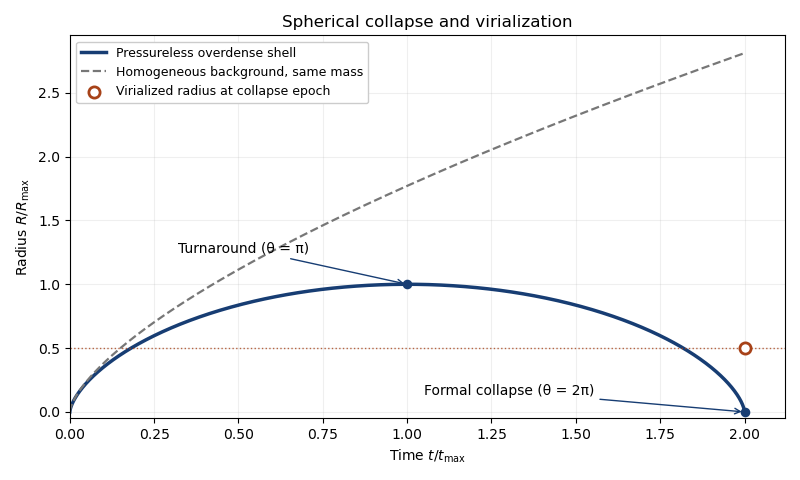
In the Einstein-de Sitter universe, and . An unperturbed homogeneous sphere containing the same mass thus has . Comparing its volume with the perturbed sphere givesAt maximum expansion,For the non-dissipative, homologous spherical-collapse model, the potential energy of a uniform sphere is . At turnaround the bulk kinetic energy is zero, so . At virial equilibrium, gives . Conservation of energy implies , and therefore . This comparison assumes the same potential-energy structure coefficient; it is the usual top-hat model rather than an exact claim about every halo profile.
Halving the radius multiplies the density by eight. During the interval to , the background density falls by four. ThusThe formal pressureless trajectory reaches zero radius; the physical virialized object instead has a finite radius. Its density is evaluated at the same collapse epoch, not at the instantaneous singular solution's density.
For a physical estimated virial radius and enclosed mass, . Equating this to gives a halo density estimate of formation redshift:In the pure Einstein-de Sitter universe, equals the present critical density. The inference assumes the measured density retains the collapse-epoch normalization. Later accretion, mergers and a changing virial-radius convention can change it, so it is a model-dependent formation estimate rather than a unique historical date.
Pinned article: Introduction to the OurBigBook Project
Welcome to the OurBigBook Project! Our goal is to create the perfect publishing platform for STEM subjects, and get university-level students to write the best free STEM tutorials ever.
Everyone is welcome to create an account and play with the site: ourbigbook.com/go/register. We belive that students themselves can write amazing tutorials, but teachers are welcome too. You can write about anything you want, it doesn't have to be STEM or even educational. Silly test content is very welcome and you won't be penalized in any way. Just keep it legal!
Intro to OurBigBook
. Source. We have two killer features:
- topics: topics group articles by different users with the same title, e.g. here is the topic for the "Fundamental Theorem of Calculus" ourbigbook.com/go/topic/fundamental-theorem-of-calculusArticles of different users are sorted by upvote within each article page. This feature is a bit like:
- a Wikipedia where each user can have their own version of each article
- a Q&A website like Stack Overflow, where multiple people can give their views on a given topic, and the best ones are sorted by upvote. Except you don't need to wait for someone to ask first, and any topic goes, no matter how narrow or broad
This feature makes it possible for readers to find better explanations of any topic created by other writers. And it allows writers to create an explanation in a place that readers might actually find it.
Figure 1. Screenshot of the "Derivative" topic page. View it live at: ourbigbook.com/go/topic/derivativeVideo 2. OurBigBook Web topics demo. Source. - local editing: you can store all your personal knowledge base content locally in a plaintext markup format that can be edited locally and published either:This way you can be sure that even if OurBigBook.com were to go down one day (which we have no plans to do as it is quite cheap to host!), your content will still be perfectly readable as a static site.
- to OurBigBook.com to get awesome multi-user features like topics and likes
- as HTML files to a static website, which you can host yourself for free on many external providers like GitHub Pages, and remain in full control

Figure 2. You can publish local OurBigBook lightweight markup files to either OurBigBook.com or as a static website.
Figure 3. Visual Studio Code extension installation.
Figure 5. . You can also edit articles on the Web editor without installing anything locally. Video 3. Edit locally and publish demo. Source. This shows editing OurBigBook Markup and publishing it using the Visual Studio Code extension. 
- Infinitely deep tables of contents:



All our software is open source and hosted at: github.com/ourbigbook/ourbigbook
Further documentation can be found at: docs.ourbigbook.com
Feel free to reach our to us for any help or suggestions: docs.ourbigbook.com/#contact