Topics (195k) Articles (197k) Users (296) Discussions (237) Comments (383) Files (715) New article

PNG reference implementation. Ahh, if feels good to have a dominating open source reference implementation.
Demo of using it by Ciro Santilli: stackoverflow.com/questions/1362945/how-to-decode-a-png-image-to-raw-bytes-from-c-code-with-libpng/36399711#36399711


Also known as: Quantitative PCR (qPCR).
This describes one possible concentration detection method with fluorescent molecules that only become fluorescent when the DNA is double stranded (SYBR Green)
Polymerase Chain Reaction (PCR) - Quantitative PCR (qPCR) by Applied Biological Materials (2016)
Source. This allows you to predict the exact initial concentration by extrapolating the exponential curve backwards.
Isothermal means "at fixed temperature".
This is to contrast with the more well established polymerase chain reaction, which requires heating and cooling the sample several times.
E.g. showing live data from a scientific instrument! TODO:
- superuser.com/questions/825588/what-is-the-easiest-way-of-visualizing-data-from-stdout-as-a-graph
- unix.stackexchange.com/questions/190337/how-can-i-make-a-graphical-plot-of-a-sequence-of-numbers-from-the-standard-input
- stackoverflow.com/questions/44470965/how-can-you-watch-gnuplot-realtime-data-plots-as-a-live-graph-with-automatic-up
- stackoverflow.com/questions/14074790/plotting-a-string-of-csv-data-in-realtime-using-linux
- stackoverflow.com/questions/11874767/how-do-i-plot-in-real-time-in-a-while-loop-using-matplotlib
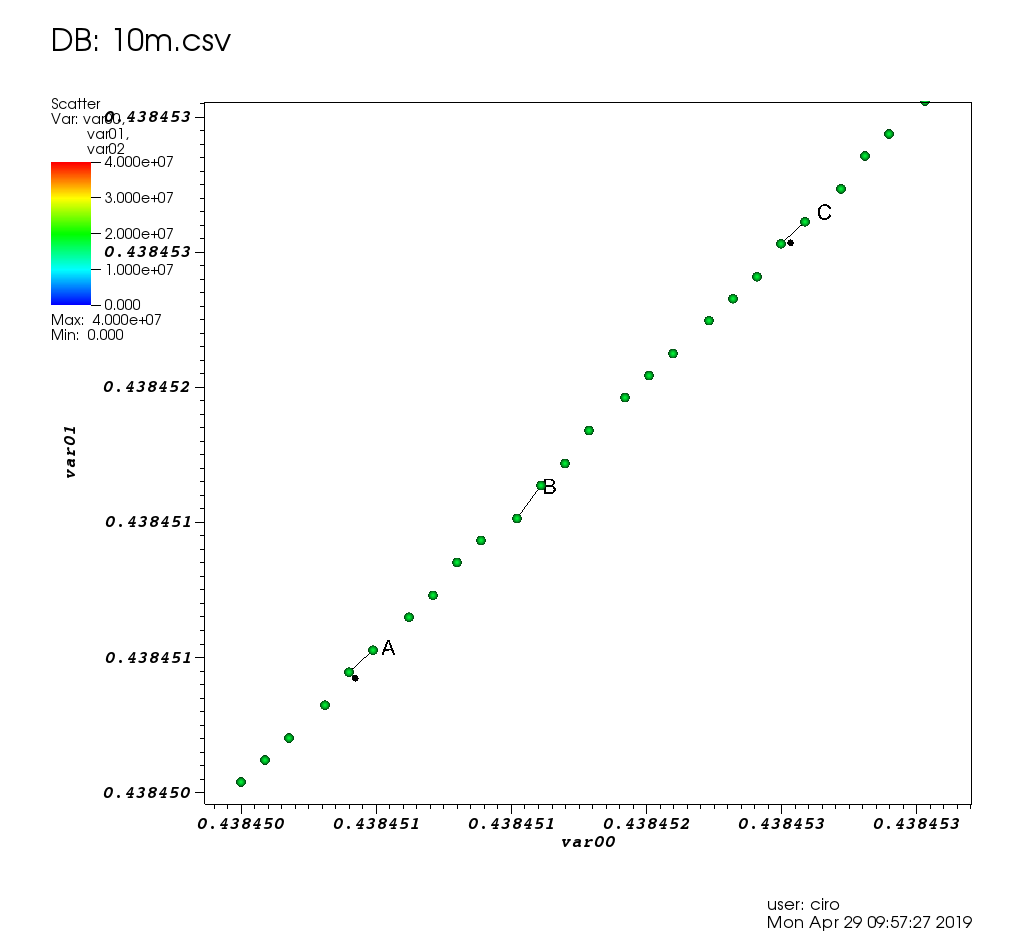
Tends to be Ciro's pick if gnuplot can't handle the use case, or if the project is really really serious.
Couldn't handle exploration of large datasets though: Survey of open source interactive plotting software with a 10 million point scatter plot benchmark by Ciro Santilli
Examples:
- matplotlib/hello.py
- matplotlib/educational2d.py
- matplotlib/axis.py
- matplotlib/label.py
- Line style
- Subplots
- matplotlib/two_lines.py
- Data from files
- Specialized
Tends to be Ciro Santilli's first attempt for quick and dirty graphing: github.com/cirosantilli/gnuplot-cheat.
When it doesn't, you Google for an hours, and then you give up in frustration, and fall back to Matplotlib.
Couldn't handle exploration of large datasets though: Survey of open source interactive plotting software with a 10 million point scatter plot benchmark by Ciro Santilli
Only many many years after playing it, after Ciro started getting more interested, did he learn that it was actually an adaptation of the Chinese mega-classic Water Margin.
"Suikoden" is the actual Japenese transliteration for the Chinese name of the original Water Margin novel.
The game puts great emphasis on the concept of the 108 Stars of Destiny, which never left Ciro's mind: making 108 allies, the main collectible of the game, allows you to make a more powerful alliance, and unlock better endings.
This feels good.
One problem though is that Heroku is very opinionated, a likely like other PaaSes. So if you are trying something that is slightly off the mos common use case, you might be fucked.
Another problem with Heroku is that it is extremely difficult to debug a build that is broken on Heroku but not locally. We needed a way to be able to drop into a shell in the middle of build in case of failure. Otherwise it is impossible.
Deployment:
git push heroku HEAD:masterView stdout logs:
heroku logs --tailPostgreSQL database, it seems to be delegated to AWS. How to browse database: stackoverflow.com/questions/20410873/how-can-i-browse-my-heroku-database
heroku pg:psqlDrop and recreate database:All tables are destroyed.
heroku pg:reset --confirm <app-name>Restart app:
heroku restartThis looks a lot like the beans that Brazilians venerate and can be easily found in the United Kingdom as of 2020.
The more exact type seems to be pinto bean, but this is close enough.
2021-02-10: attempt 3: 500g 1 hour 30 minutes no pressure, uncontrolled water. Salt with one chorizo: put 3 teaspoons, it was a bit too much, going to do 2 next time and see.
2020-11-30: attempt 2: 275ml of dry beans, about 50% of 500g bag, putting 1650 ml (6x) of water on pressure cooker Still had to throw out some water.
Therefore, to the maximum 2.5L of the cooker with 8x dry volume water from this recipe I can use:and so:which is about 227 / 580 = 40% of the 500 g bag.
2500 = volume expanded bean + volume water = 3 volume dry bean + 8 volume dry bean = 11 volume dry beanvolume dry bean = 2500/11 = 227mlEdit: after buying it, not 100% sure. This one felt smaller than what Ciro had in Brazil, borlotti beans might be closer. Pinto beans are smaller, and creamier, and have softer peel, possibly produced less natural gas.
2021-04: second try.
2021-03: did for first time, started with same procedure as borlotti beans 2021-03. Maybe 1h30 is too much. Outcome was still very good.
As mentioned at Section "Plancherel theorem", some people call this part of Plancherel theorem, while others say it is just a corollary.
This is an important fact in quantum mechanics, since it is because of this that it makes sense to talk about position and momentum space as two dual representations of the wave function that contain the exact same amount of information.
Pinned article: Introduction to the OurBigBook Project
Welcome to the OurBigBook Project! Our goal is to create the perfect publishing platform for STEM subjects, and get university-level students to write the best free STEM tutorials ever.
Everyone is welcome to create an account and play with the site: ourbigbook.com/go/register. We belive that students themselves can write amazing tutorials, but teachers are welcome too. You can write about anything you want, it doesn't have to be STEM or even educational. Silly test content is very welcome and you won't be penalized in any way. Just keep it legal!
Intro to OurBigBook
. Source. We have two killer features:
- topics: topics group articles by different users with the same title, e.g. here is the topic for the "Fundamental Theorem of Calculus" ourbigbook.com/go/topic/fundamental-theorem-of-calculusArticles of different users are sorted by upvote within each article page. This feature is a bit like:
- a Wikipedia where each user can have their own version of each article
- a Q&A website like Stack Overflow, where multiple people can give their views on a given topic, and the best ones are sorted by upvote. Except you don't need to wait for someone to ask first, and any topic goes, no matter how narrow or broad
This feature makes it possible for readers to find better explanations of any topic created by other writers. And it allows writers to create an explanation in a place that readers might actually find it.
Figure 1. Screenshot of the "Derivative" topic page. View it live at: ourbigbook.com/go/topic/derivativeVideo 2. OurBigBook Web topics demo. Source. - local editing: you can store all your personal knowledge base content locally in a plaintext markup format that can be edited locally and published either:This way you can be sure that even if OurBigBook.com were to go down one day (which we have no plans to do as it is quite cheap to host!), your content will still be perfectly readable as a static site.
- to OurBigBook.com to get awesome multi-user features like topics and likes
- as HTML files to a static website, which you can host yourself for free on many external providers like GitHub Pages, and remain in full control

Figure 2. You can publish local OurBigBook lightweight markup files to either OurBigBook.com or as a static website.
Figure 3. Visual Studio Code extension installation.
Figure 5. . You can also edit articles on the Web editor without installing anything locally. Video 3. Edit locally and publish demo. Source. This shows editing OurBigBook Markup and publishing it using the Visual Studio Code extension. 
- Infinitely deep tables of contents:


All our software is open source and hosted at: github.com/ourbigbook/ourbigbook
Further documentation can be found at: docs.ourbigbook.com
Feel free to reach our to us for any help or suggestions: docs.ourbigbook.com/#contact