2D IR diagonal-peak overlap
ID: 2d-ir-diagonal-peak-overlap

2D IR diagonal-peak overlap is the contribution of extended diagonal spectral features to regions where an off-diagonal signal might be assigned in two-dimensional infrared spectroscopy. A nonzero value at an off-diagonal coordinate is not sufficient evidence for a separate 2D IR cross peak.
Peak orientation matters as well as width. An original positive-envelope model for a diagonal feature centered at isHere specifies 2D IR line-shape correlation. It is a shape parameter in this illustrative model, not automatically a measured population correlation. Let for two diagonal features, with . At the off-diagonal coordinate ,For original values , and , all in , the off-diagonal amplitude is approximately 0.0879 at , but only 0.000340 at . Both models have the same individual marginal width. An overlap estimate based only on that width can therefore miss a substantial shape dependence.
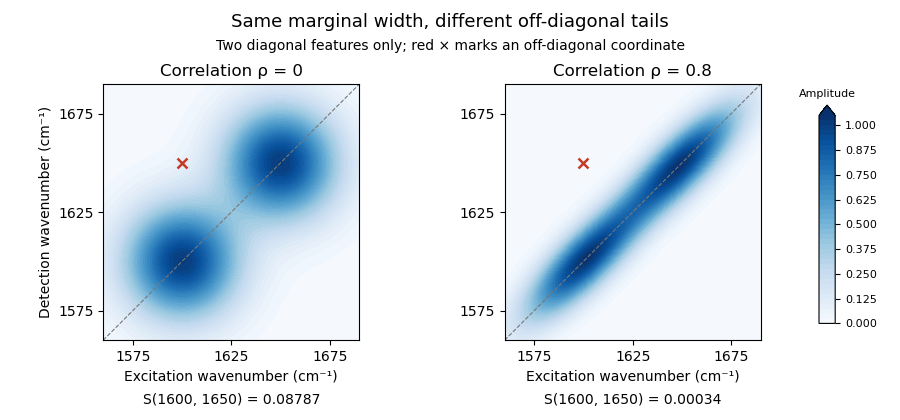
Original two-diagonal-feature model: changing 2D IR line-shape correlation changes off-diagonal tails without adding a 2D IR cross peak
. Details. 
The toy envelope is positive. Actual coherent spectra can contain signed features, so fitting and subtraction must respect the measured response and phase convention. The primary phase-controlled peptide experiment used phase and amplitude information to interpret mode-coupling cross peaks.[ref]
Useful tests vary the fit region, include plausible neighboring features and compare the proposed cross signal across 2D IR waiting times and other controlled conditions. A residual can indicate a missing feature, an unsuitable diagonal line shape or an unmodeled background. Its persistence alone does not uniquely select one molecular explanation.
New to topics? Read the docs here!