A divergent factorial series can approximate a convergent integral
ID: a-divergent-factorial-series-can-approximate-a-convergent-integral

For real , defineThe integrand is positive and at most , so and the improper integral converges. Substituting also gives in terms of the exponential integral; the original representation makes positivity and the large- behavior transparent.
Apply the exact finite geometric series identity inside the integral, without assuming that an infinite series can be integrated term by term:The Gamma integral gives . Therefore, with retained terms,This remainder formula proves the asymptotic expansion at every fixed order: as . Its sign also gives alternating bounds: an odd overestimates , and an even underestimates it.
At , an independent evaluation of the integral gives . Three retained terms giveFive retained terms give with error bounded by . The actual errors are about and , respectively. The error bound is conservative, but established without relying on the numerical integral evaluation.
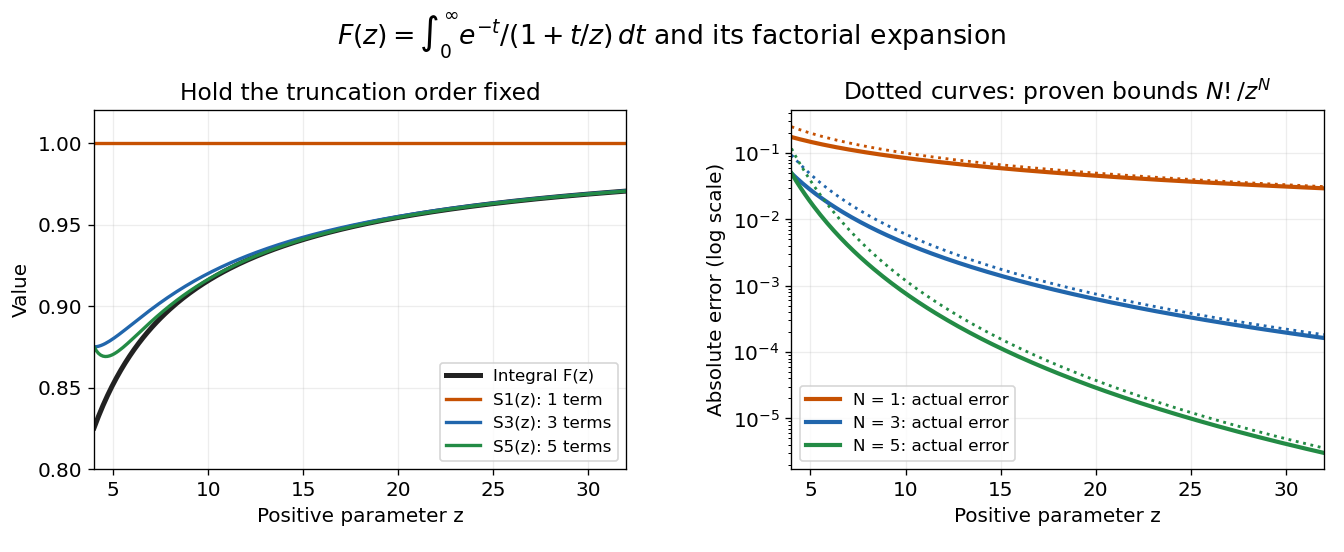

Nevertheless, the formal infinite series diverges at every fixed . The magnitudes satisfy , so they eventually increase without bound. In particular, the terms fail the necessary zero-term condition for a convergent series. The finite remainder identity remains valid after convergence has failed; this is precisely what makes the example useful.
New to topics? Read the docs here!