An improper integral is defined by taking a limit when an integration endpoint is infinite or the integrand is unbounded. Its convergence must be established before ordinary integral manipulations are applied.
Let be measurable, integrable over a positive period , and have mean zero there. Its positive and negative parts have equal integrals . On the -th period the signed integral of has absolute value at mostThis follows by bounding the positive and negative weighted integrals between and . The bounds are summable, so the integrals at period endpoints converge. A leftover partial period has absolute integral at most , tending to zero, which proves convergence for arbitrary upper endpoints too.
In contrast, each full-period integral of is at least . It diverges in total unless , equivalently almost everywhere. Thus a nonzero mean-zero periodic function gives a convergent improper integral here but no Lebesgue integrability.
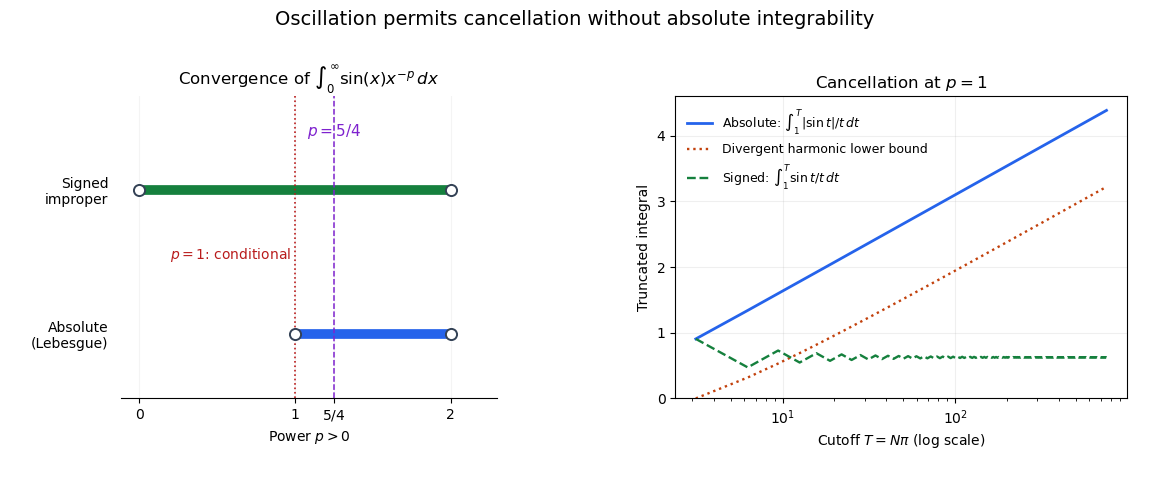
For , the function is Lebesgue integrable on exactly when . Near zero, , so absolute integrability is equivalent to that of , which requires . At infinity, gives the upper bound . For , on each interval ,and the corresponding P-series diverges.
The signed improper integral nevertheless converges for every : near zero the same local comparison applies, and at infinity the Dirichlet test for improper integrals uses the bounded antiderivative of sine and the decreasing factor . Thus gives conditional convergence, while gives absolute integrability. In particular, substituting turns into the divergent tail .

For a locally integrable real or complex function, the displayed tail condition is equivalent to ordinary convergence of its improper integral at infinity. Apply the Cauchy criterion for a function limit to its truncated integrals, using completeness of the real or complex numbers. The necessity follows by subtracting two nearby-to-limit truncations; sufficiency follows by first taking a convergent sequence of truncations and then bounding all other late truncations against it. The analogous criterion applies at a finite singular endpoint. Bounding the modulus of every tail by its absolute-value integral proves that an absolutely convergent improper integral converges ordinarily.
An improper integral whose absolute-value integral is finite. The triangle inequality for an integral bounds each truncated tail by the corresponding tail of , so the Cauchy criterion for an improper integral gives ordinary convergence. Absolute convergence is stronger than a Cauchy principal value, which may exist only because two divergent sides cancel. The continuous sine-product integrand has a removable value at zero and an integrable tail; its auxiliary complex contour integrand can nevertheless require a principal value.
If is bounded and is a nonnegative differentiable decreasing function tending to zero, then converges as an improper integral. Integration by parts bounds the tail by a constant multiple of , because is bounded and . In particular converges for every , even though absolute integrability of that tail requires .
A logarithmic divergence grows like a logarithm as a cutoff is removed. For example as . An integrand near zero gives . This behavior distinguishes logarithmic sensitivity to an infrared or ultraviolet cutoff from power-law divergence.
A function has an integrable singularity at a point if it becomes unbounded there but its absolute value has a finite improper integral over a sufficiently small surrounding interval, one-sided at an endpoint. The endpoint behavior of the arcsine distribution's probability density function is an example.
An endpoint integrable singularity with as , for finite nonzero . It is an integrable singularity because . One common origin is a stationary change of variables: if with and a smooth nonzero probability density for at zero, the two inverse branches give a probability density for proportional to .
Articles by others on the same topic
There are currently no matching articles.