Analytic continuation
ID: analytic-continuation

An analytic continuation extends a holomorphic function beyond its original domain without changing its existing values. Formally, if are domains and is holomorphic on , a holomorphic function on with is an analytic continuation. More locally, holomorphic functions on overlapping open sets continue one another when they agree on the overlap, allowing a chain of patches along a path. The identity theorem for holomorphic functions forces agreement throughout a connected overlap once they agree on a nonempty open set in it. It also makes an extension to a fixed connected domain unique. [ref]
https://ocw.mit.edu/courses/18-04-complex-variables-with-applications-spring-2018/af8c9c78c3915aaf3fd1695f8d32a3b3_MIT18_04S18_topic13.pdf. Orloff, MIT 18.04 Topic 13, section 13.2 and Theorem 13.2
The geometric series illustrates why a formula can reach farther than the power series that first represents it. For , its partial sum isWhen , , so the series converges to . The rational function is holomorphic on and agrees there with the sum on the unit disc. It therefore continues to every point except its simple pole at . In particular,Thus analytic continuation gives a value at without making the original geometric series converge there. Its radius of convergence remains : on the terms do not even tend to zero.
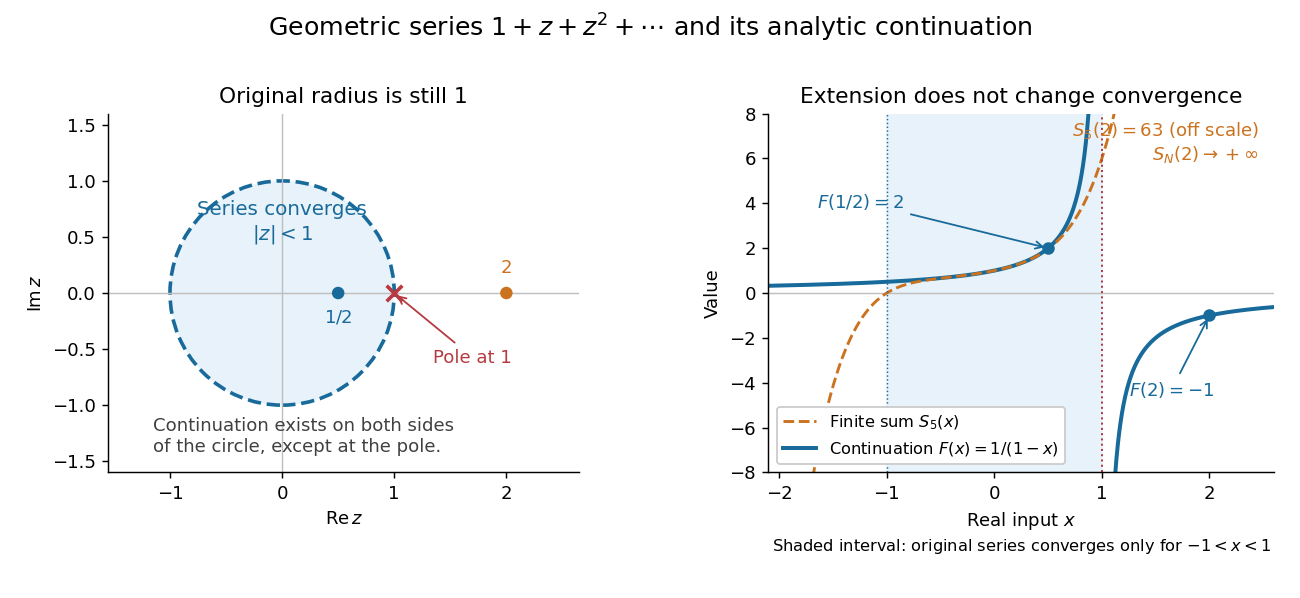
The original geometric series converges only inside the unit circle, while its rational continuation exists everywhere except the pole at 1
. Details. The pole at limits the original Taylor series, although most points of its convergence circle are regular for . Recentring at gives another genuinely convergent power series,At this yields , even though the original powers of grow. This is the useful idea: overlapping local descriptions can represent one holomorphic function on a larger region.
Uniqueness on a connected overlap does not imply that every path leads to the same terminal germ of a holomorphic function. Continuing a complex logarithm around changes its value by , giving monodromy; the return patch can carry a different branch of a multivalued function. If two patches have a disconnected overlap, agreement on one component imposes no agreement on the others. [ref]
https://ocw.mit.edu/courses/18-04-complex-variables-with-applications-spring-2018/af8c9c78c3915aaf3fd1695f8d32a3b3_MIT18_04S18_topic13.pdf. Orloff, section 13.2.1, Example 13.4
Continuation using the rational function is single-valued: any path avoiding gives the same terminal germ of a holomorphic function, even if it winds around the pole.

visualizing the Riemann hypothesis and analytic continuation by 3Blue1Brown (2016) is a good quick visual non-mathematical introduction is to it.
The key question is: how can this continuation be unique since we are defining the function outside of its original domain?
The answer is: due to the identity theorem.
New to topics? Read the docs here!