Monodromy records how a germ of a holomorphic function changes after analytic continuation around a closed path. The source point returns to itself, but the continued germ of a holomorphic function need not. For , , starting with holomorphic square root value gives and hence ; starting with complex logarithm value gives and hence . After counterclockwise turns the values are and . Thus monodromy exchanges the two square-root branches of a multivalued function, whereas it shifts through infinitely many logarithm branches of a multivalued function. [ref]
Branch Points and Branch Cuts by Rodolfo R. Rosales. Rosales, Branch Points and Branch Cuts, section 1 and Example 2.4
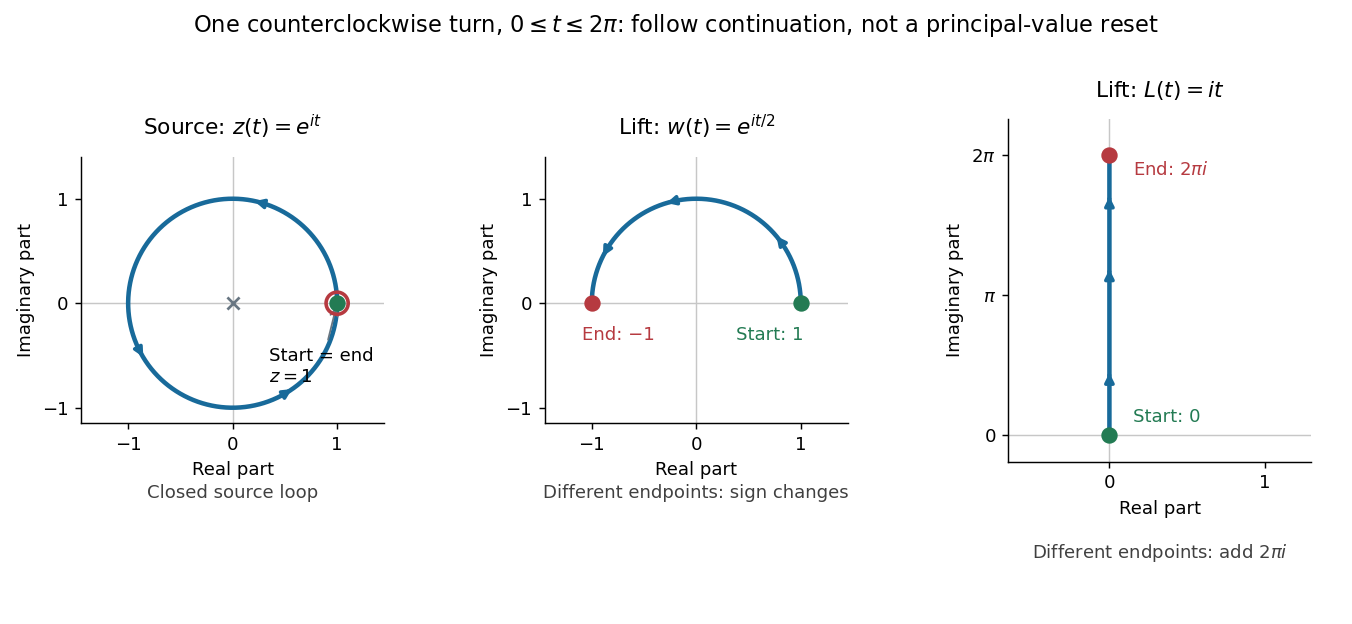
One closed loop in the source plane lifts to an open semicircle for the square root and an open vertical segment for the logarithm
. Details. The three panels use the same parameter . They show analytic continuation through local holomorphic patches, including across a chosen branch cut; repeatedly evaluating the principal logarithm would instead reset its imaginary part at the cut. Monodromy makes the obstruction to a global branch of a multivalued function visible and motivates the use of Riemann surfaces as domains on which continued values stay distinct.
A parameter deformation preserves generalized monodromy data, including Stokes matrices and formal monodromy at irregular points. If normalized sectorial matrices have parameter-independent jumps, agrees across overlaps. Its finite singularities and growth at infinity determine it by complex analytic arguments. Compatibility of and is precisely the displayed zero-curvature identity, obtained by differentiating both equations and subtracting.
An unramified formal fundamental matrix acquires the right factor on a positive turn of the logarithm branch. This is formal monodromy. It can be nontrivial even when the true equation has an entire fundamental matrix and trivial actual monodromy, because Stokes matrices compensate for it.
When Stokes factors act on solution coefficient vectors, a full positive turn gives their ordered product equal to the inverse of formal monodromy for a polynomial system with no finite singularities. The true fundamental matrix is entire, so its actual monodromy is trivial, but its normalized formal branch changes by . Indeed, write ; then , whereas normalized continuation after the positive turn gives . Cancelling the invertible fundamental matrix proves the identity. The uncorrected product is identity only when . For a cubic-exponential two-by-two system with , the formal exponent is , so and the Stokes product is .
For a linear ordinary differential equation with holomorphic coefficients on a punctured disc, analytic continuation of a basis gives an invertible monodromy matrix. A nonzero eigenvector with eigenvalue selects a solution for which is single-valued and holomorphic. Its Laurent series gives . No regular-singular hypothesis is needed; infinitely many negative powers may occur.
Articles by others on the same topic


Monodromy is a concept from algebraic geometry and differential geometry that describes how a mathematical object, such as a fiber bundle or a covering space, behaves when you move around a loop in a parameter space.