
Andrew Philip Carter contributed to structural explanations of bacterial translation initiation. His own MRC-hosted curriculum vitae directly links that full name to the 2001 paper credited to A. P. Carter, which determined a complex of bacterial initiation factor IF1 and the 30S ribosomal subunit.[ref]
Curriculum vitae of Andrew Philip Carter. Page1, full name; page9, publication54
The X-ray crystallography structure showed IF1 occupying the ribosomal A site. It also revealed displacement of bases A1492 and A1493 of 16S ribosomal RNA, along with changes extending beyond the immediate binding region. A localized protein interaction can therefore influence the conformation of a much larger RNA–protein assembly.[ref]
Crystal structure of an initiation factor bound to the 30S ribosomal subunit by A. P. Carter and others. Abstract, A-site occlusion and long-range conformational changes; associated structure PDB1HR0
For an original occupancy example, imagine 100 otherwise identical snapshots in a model where IF1 and a second ligand cannot occupy the same A-site region. If IF1 occupies that region in 70 snapshots, at most 30 permit that other ligand's simultaneous occupancy. This geometric exclusion does not imply that 70 percent of biological translation is prevented: productive initiation places the initiator transfer RNA at the distinct ribosomal P site, and the actual pathway includes further steps. Site identity matters more than a generic statement that a factor blocks RNA binding.
The structural result supplies a concrete physical mechanism to compare with functional assays. Binding location, conformational rearrangement and eventual protein synthesis remain different observations.
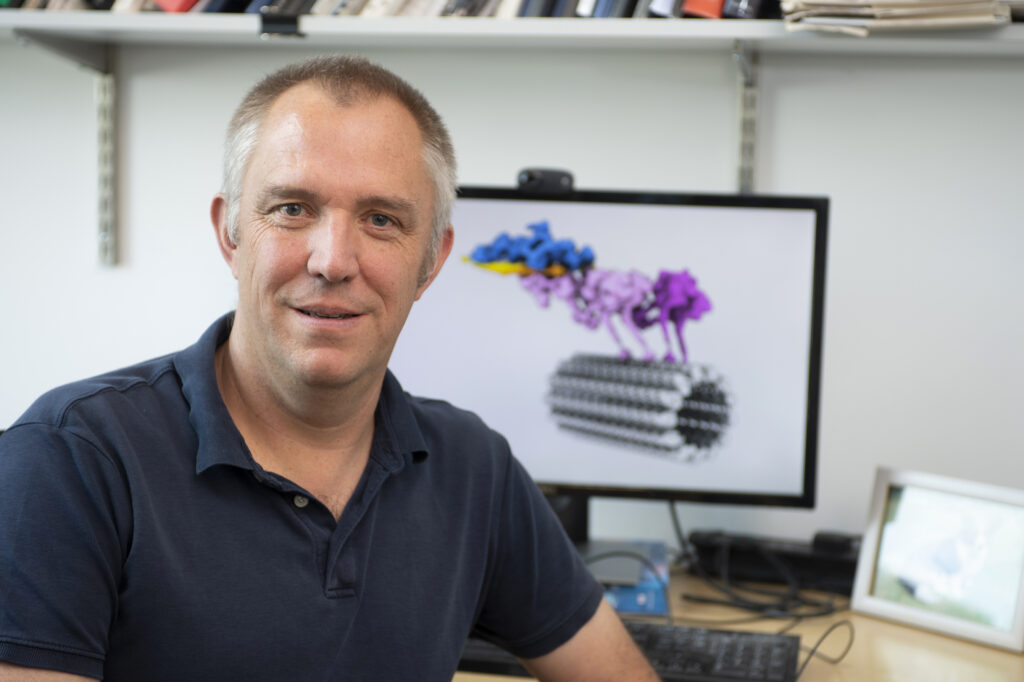
Andrew Carter, named portrait on the MRC Carter Laboratory People page
. New to topics? Read the docs here!