Beam collection at fixed radiant flux
ID: beam-collection-at-fixed-radiant-flux

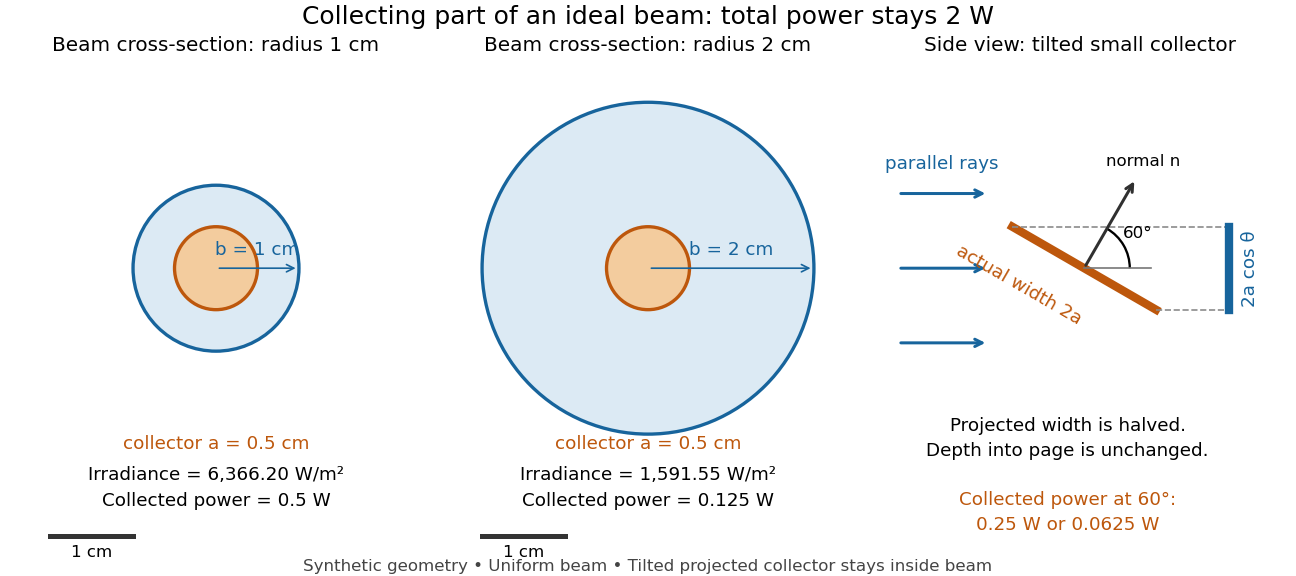
Consider an ideal parallel circular beam with uniform irradiance inside radius , zero outside, and total radiant flux . A centred circular collector of radius , perpendicular to the light rays, interceptsFor and , and the collected radiant flux is . Expanding the beam to while keeping fixed divides irradiance and the same collector's radiant flux by four: and . A collector covering either entire beam still receives .
Tilting a flat collector of actual area by an angle to the beam direction gives if its entire projected area remains inside the uniform beam. At the small collector's radiant flux halves. A collector large enough to intercept the whole beam after tilting still receives : the footprint on its surface grows as and cancels the irradiance factor. This model ignores diffraction, beam-edge structure, and changes in absorption with incidence angle; it counts incident rather than absorbed power.

New to topics? Read the docs here!