Radiant flux is the power carried by electromagnetic radiation: radiation energy transferred per unit time, measured in watts, . Specify what is counted: all radiation emitted by a source, radiation within one beam, or radiation intercepted by a photodetector. Writing for the cumulative energy crossing the specified boundary givesThe first expression is an instantaneous derivative; the second is an average over the stated time interval. If arrives during , the mean radiant flux is . The photodetector's absorbed power equals this incident radiant flux only if it absorbs all of the incident radiation.
Keeping radiant flux fixed while widening a beam reduces its irradiance, the incident power per receiving area. Radiance additionally resolves the propagation direction and has units ; an optical camera can collect different radiant fluxes from sources with the same radiance but different apparent solid angles. Luminous flux, measured in lumens, weights the optical spectrum by the human eye's standardized response instead of counting energy equally at every wavelength. Equal radiant fluxes need not give equal luminous fluxes.[ref]
Radiant power also differs from the optical power of an optical lens, which is reciprocal focal length in dioptres. Likewise, astronomical radiative flux is power per area. Stating the units prevents these shared words from hiding different physical quantities.
In geometrical optics, suppose radiation has a nonnegative radiance whose directional contributions add as power. Here is the actual propagation unit vector, is a solid angle element, and the collecting oriented surface has chosen unit normal . Assume the following integrals exist. The outward and inward radiant fluxes areBoth quantities are nonnegative; their difference is the signed net radiant flux. The dot product supplies the cosine of the angle with the unit normal, hence the projected area. For incoming radiation the outward unit normal gives a negative dot product; the minus sign makes the collected power positive. Measuring the incoming angle from a source-facing unit normal instead gives the familiar positive . The units check is .
Equivalently, the incoming surface integral is with local irradiance ; the emitted part of is with radiant exitance . For a small flat patch and a narrow accepted cone, nearly constant radiance and angle give . This approximation requires uniformity across the patch and cone. Direction-independent outgoing radiance over a whole hemisphere gives the different exact result , by Lambert's cosine law and the spherical coordinates calculation in radiant exitance. Replacing the cosine-weighted integral by the hemisphere's solid angle would double the answer.[ref]
These radiance formulas presume a description in additive directional power; they do not reconstruct arbitrary coherent wave interference from separate ray contributions. For general electromagnetic fields, the signed instantaneous power crossing an oriented surface is , using the Poynting vector ; optical measurements commonly average over many wave periods. A zero net radiant flux can conceal equal nonzero incoming and outgoing radiant fluxes.
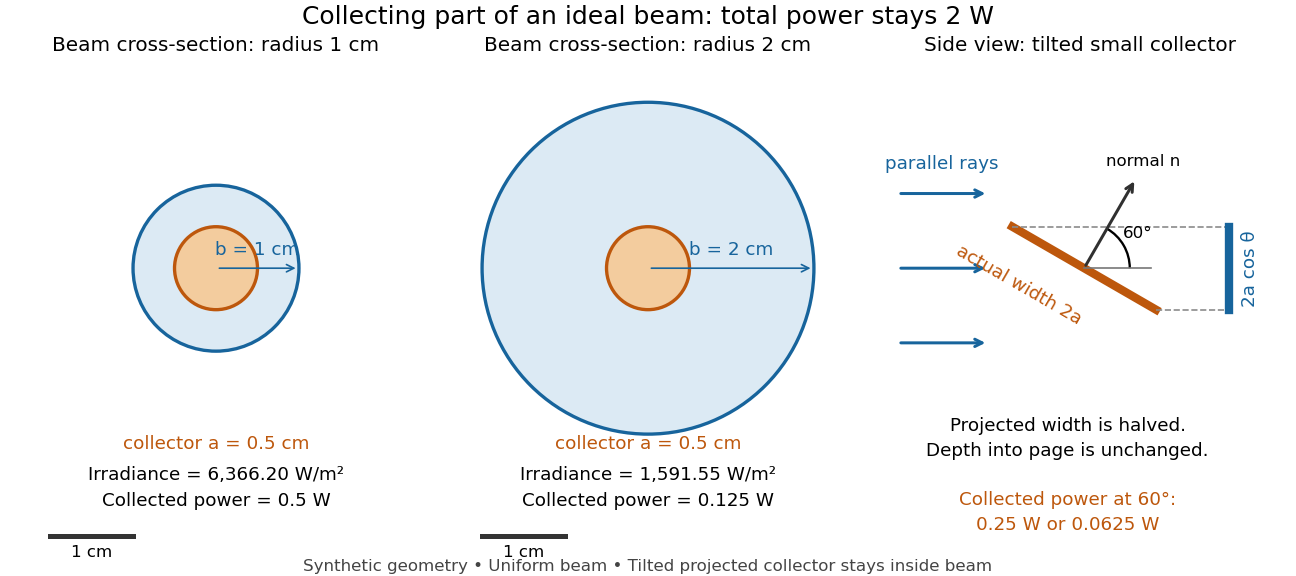
Consider an ideal parallel circular beam with uniform irradiance inside radius , zero outside, and total radiant flux . A centred circular collector of radius , perpendicular to the light rays, interceptsFor and , and the collected radiant flux is . Expanding the beam to while keeping fixed divides irradiance and the same collector's radiant flux by four: and . A collector covering either entire beam still receives .
Tilting a flat collector of actual area by an angle to the beam direction gives if its entire projected area remains inside the uniform beam. At the small collector's radiant flux halves. A collector large enough to intercept the whole beam after tilting still receives : the footprint on its surface grows as and cancels the irradiance factor. This model ignores diffraction, beam-edge structure, and changes in absorption with incidence angle; it counts incident rather than absorbed power.
Spectral radiant flux resolves radiant flux by wavelength or frequency:Its units are per metre of wavelength or per hertz of frequency. A density quoted per nanometre must be integrated with wavelength intervals in nanometres; its numerical value is times the per-metre density. The frequency and wavelength spectral radiance conversion applies equally to spectral radiant flux, through the change of variables formula:with the speed of light in vacuum and expressed per metre. The Jacobian determinant preserves integrated power rather than the height or location of an optical spectrum's peak.
For two explicitly synthetic optical spectra, let and quote the following densities in :The triangle under and the rectangle under both have area : . Their band radiant fluxes differ: – contains of , while – contains of . These are specified functions, not measured source spectra.
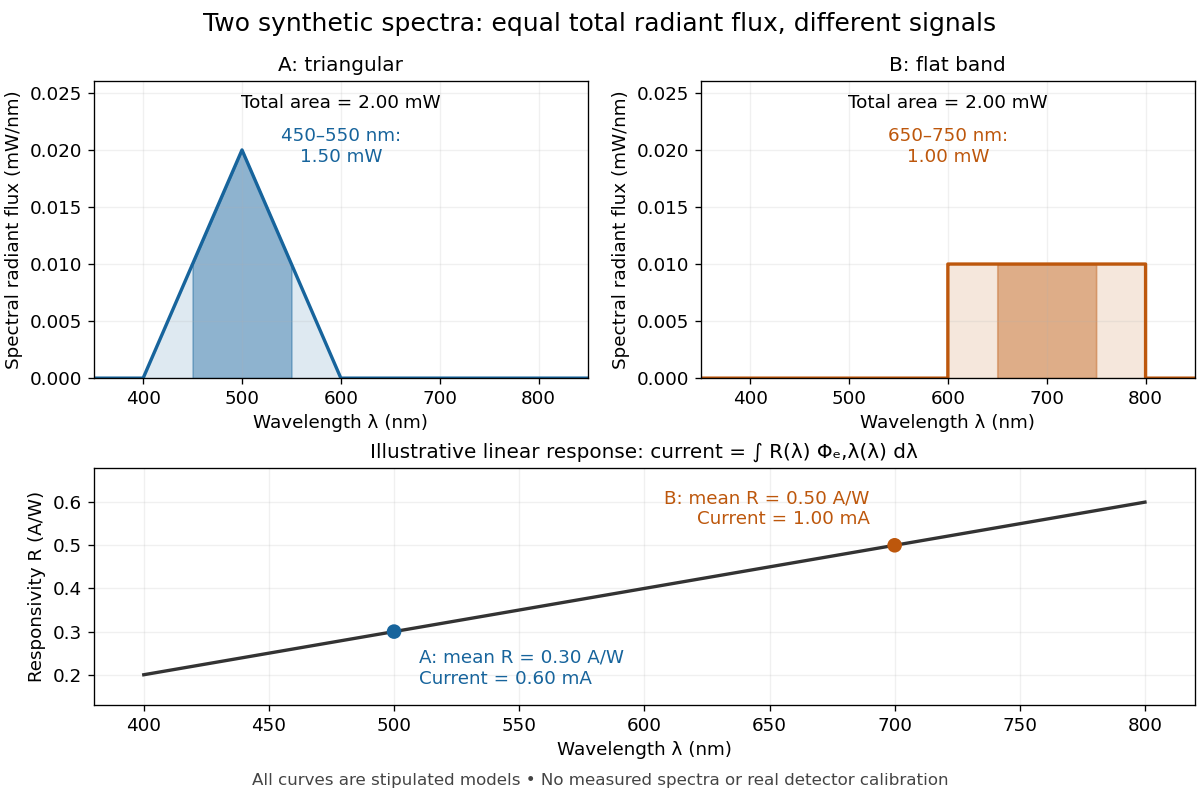
The dark-subtracted electric current of a linear photodiode isusing its spectral responsivity. The figure's stipulated gives and despite equal total radiant flux. Symmetry places 's mean wavelength at and 's at ; a linear averages to its value at that mean. A single electric current therefore cannot determine an unknown broadband radiant flux without additional spectral information or a sufficiently flat calibrated response.
An optical power meter makes the definition operational: collect a specified beam on a calibrated photodiode, measure its electric current, and infer incident radiant flux using spectral responsivity. In the manufacturer-authored Model 1830-R Series Optical Power Meters User's Manual by Newport Corporation, §5.5.1 specifies a concrete sequence: connect the detector and its calibration module, select watt mode and the source wavelength, block the beam and press ZERO, then unblock it and read the display. The stored background includes dark current and ambient light present during zeroing. For narrowband radiation,The electric current difference divided by spectral responsivity has units . For a stipulated and difference , the inferred radiant flux is ; these numbers illustrate the inference and are not reported measurements. The entire beam must hit the active area, and §5.6 calls for correct wavelength, background subtraction, and operation below detector saturation. If an optical attenuator is fitted, §5.4 requires the calibrated detector–attenuator pair and the matching meter setting.
The calibration itself must connect electric current to independently known incident power. NIST's Spectroradiometric Detector Measurements: Ultraviolet, Visible, and Near-Infrared Detectors for Spectral Power by Thomas C. Larason and others describes this chain. A cryogenic radiometer, an electrical substitution radiometer, compares temperature changes from absorbed light with those from known Joule heating (§5.2). Transfer and working detectors carry that watt scale to a spectral comparator (§5.1). A source, monochromator, focusing optics, shutter, beam splitter, and monitor photodiode illuminate a standard and test detector in turn; calibrated current-to-voltage electronics and voltmeters provide the readout (§§3.2.2–3.2.4, 4.3.1). At each wavelength, subtract blocked-beam signals and normalize each detector signal by the simultaneously sampled monitor signal. Comparison with the standard yields the test detector's spectral responsivity. NIST uses two working standards and alignment normal to the beam (§6.1.1).
Controls distinguish a smaller collected radiant flux from a faulty conversion: block and unblock the beam to check the baseline; check that its footprint fits the active area; verify the calibrated optical attenuator configuration; and test proportional response within the specified operating range. Source drift faster than monitor sampling is not removed. NIST discusses finite spectral bandwidth, stray light, temperature, and spatial response variations (§§3.1.1, 6.2, 7.2). A broadband optical spectrum requires the weighted integral in spectral radiant flux, rather than dividing by an arbitrary single spectral responsivity. These limitations explain why the meter's displayed watts need a stated collection boundary, spectral assumptions, and calibration conditions.
Articles by others on the same topic



Radiant flux, also known as radiant power, is the measure of the total optical power of electromagnetic radiation emitted, transmitted, or received per unit time. It is expressed in watts (W) and accounts for all wavelengths across the electromagnetic spectrum, not just those in the visible range.