
Bond polarization is unequal sharing of electron density across a chemical bond. An electronegativity difference is a heuristic for its direction and tendency, not a unique partial atomic charge.
A simple two-site model makes the notation explicit. Represent each site by effective positive electric charge , and allocate expected electron populations to and to , with . Here is the elementary charge; these effective sites omit the internal structure of real chemical atoms. Subtraction givesFor the stipulated illustration , the populations are and , and the effective partial atomic charges are and . Fractional expected populations do not split an individual electron into pieces. The total population remains two, and the pair remains neutral. No formula connecting to has been assumed; many electron density distributions and partitioning conventions can share one qualitative electronegativity ordering.
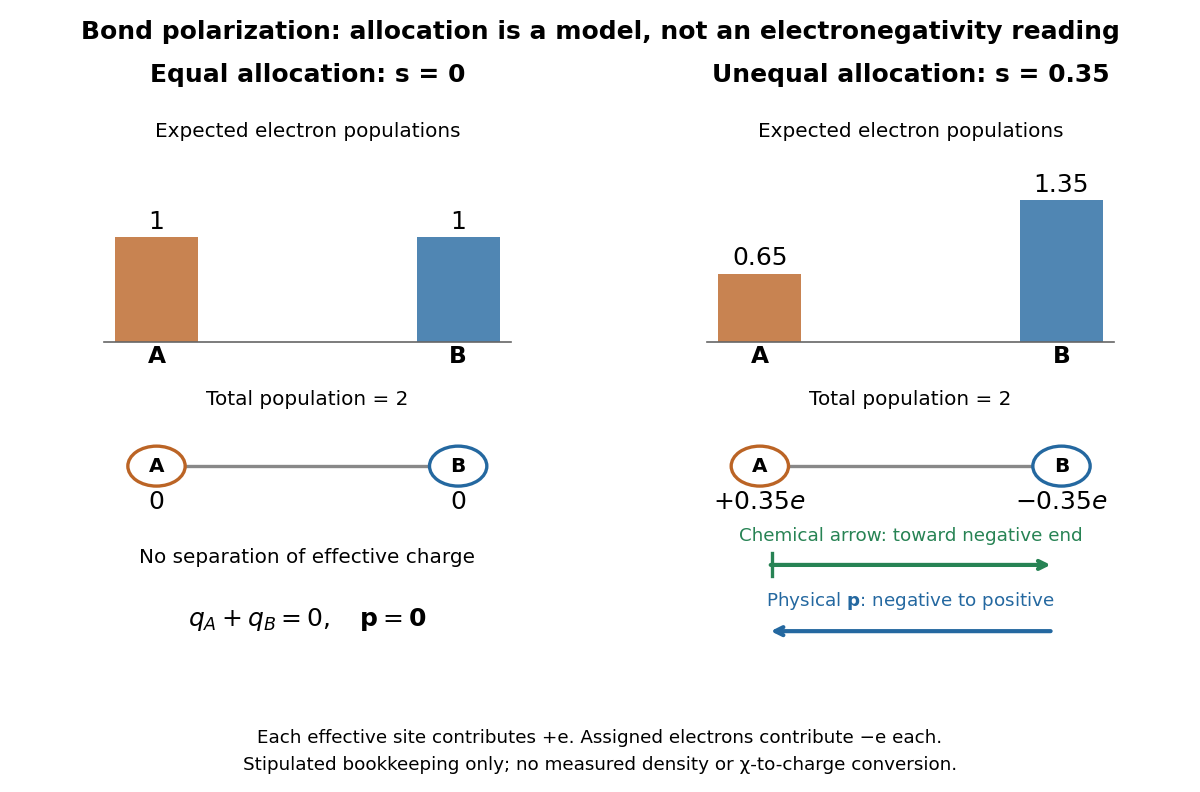
Stipulated two-site bond polarization: expected electron populations, effective partial atomic charges, and opposite chemical and physical arrow conventions
. Original model with and , effective positive site charges , and two expected electrons in total. The population bars are bookkeeping weights, not a measured electron density map. Arrow lengths illustrate direction only; no empirical electronegativity values or charge calibration are implied. Details.
New to topics? Read the docs here!