
Let a charged particle travel along at constant speed , with . For a plane electromagnetic wave with wave phase , two points along the track separated by time contribute with phase differenceHere is the angle between the wave's wave vector and the forward particle track. Constructive addition along a long uniform track requires . ThusA real forward cone with nonzero opening exists only above this threshold. At the cone closes and the ideal Frank-Tamm formula gives zero yield. For there is no allowed angle, rather than an imaginary observable cone. The requirement is phase matching; substituting the group refractive index would describe a different condition.
There is a second geometric derivation when is constant. In time , the charge advances , while an earlier spherical phase front has radius . Its tangent envelope passes through the current position . The radius is normal to the envelope, so the right triangle gives . Rotating about the track makes a cone. Its surface half-angle is complementary to the emission angle , not equal to it.
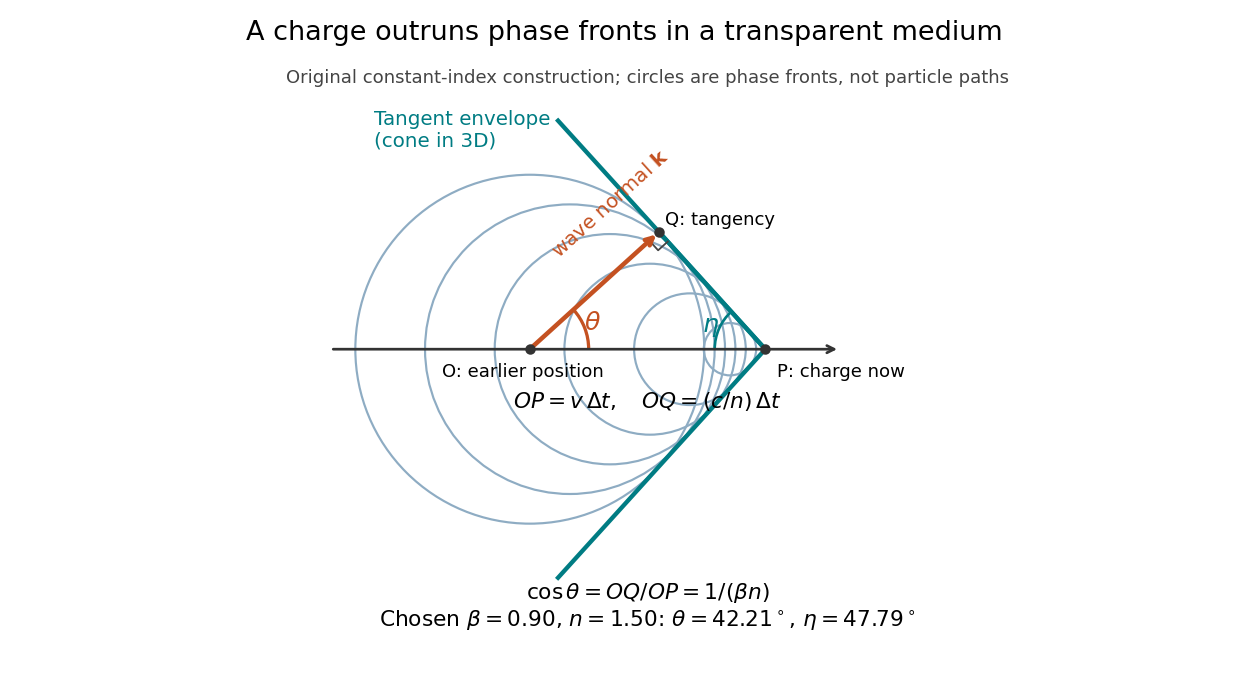

In a dispersive medium, apply the phase matching derivation separately at each angular frequency. The circle construction uses one fixed phase speed; it does not determine the envelope of a broadband wave packet. In particular, group velocity controls packet propagation under its usual narrow-band assumptions, and the simple complementary-angle construction need not describe a dispersive pulse front. A finite track also broadens the ideal directional selection: adding contributions over duration gives a factor proportional to , with , rather than an infinitely sharp direction.
New to topics? Read the docs here!