Christenson-Cronin-Fitch-Turlay kaon CP violation experiment
ID: christenson-cronin-fitch-turlay-kaon-cp-violation-experiment

James H. Christenson, James Watson Cronin, Val Logsdon Fitch and René Turlay reported the result in 1964. At Brookhaven's AGS, 30 GeV protons struck beryllium; collimators selected a neutral particle beam at 30 degrees. A downstream helium decay volume reduced interactions.[ref]
Evidence for the 2π Decay of the K₂⁰ Meson by James H. Christenson and others. p.138, preparation and helium volume
The flight distance suppressed the short-lived kaon component. Each arm of a two-arm magnetic spectrometer had spark chambers before and after its magnet. Cherenkov detectors and scintillation counters triggered photographic recording in coincidence.[ref]
https://www.nevis.columbia.edu/~haas/documents/physics_nobel_lectures/physics71-80-3.pdf. Fitch, The Discovery of Charge-Conjugation Parity Asymmetry, pp.598–600, apparatus and reconstruction
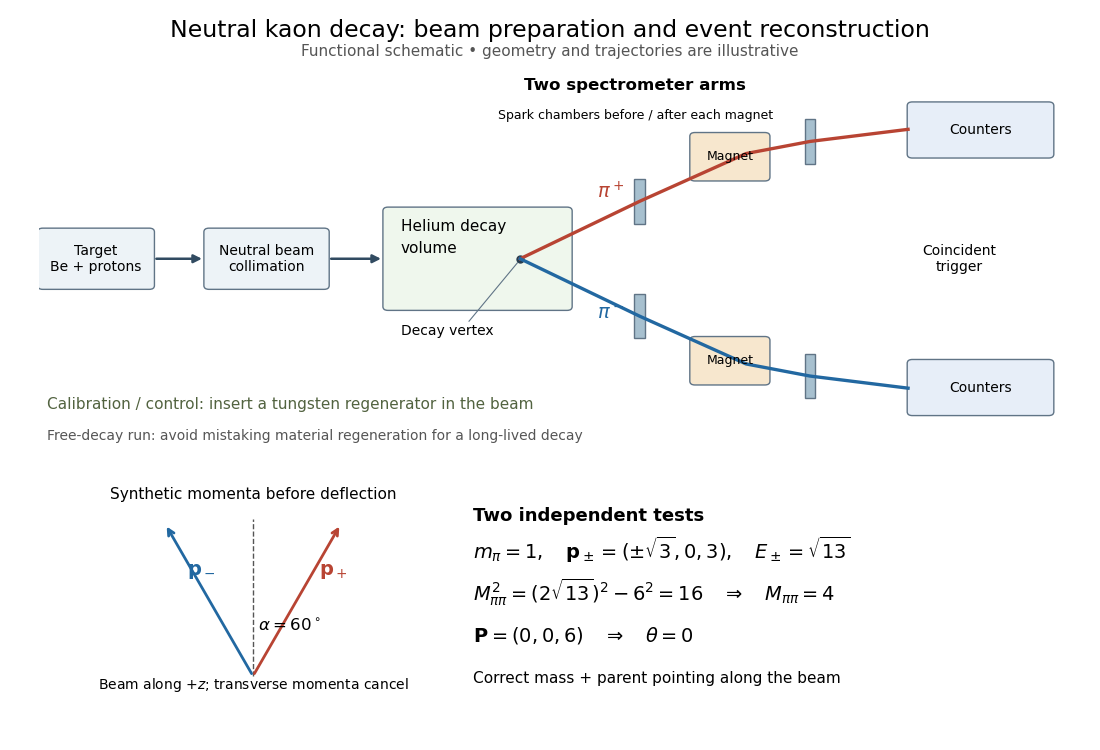

The helium sample yielded signal events; was the ratio to all charged decay channels.[ref]
Evidence for the 2π Decay of the K₂⁰ Meson by James H. Christenson and others. pp.139–140, forward peak and charged-mode ratio
That denominator must be retained when comparing this result with a total branching fraction.The evidence was kinematic. Later regenerated-beam quantum interference established that the short- and long-lived states reached the same two-pion final state, excluding alternatives such as distinct pion-like particles.[ref]
https://www.nevis.columbia.edu/~haas/documents/physics_nobel_lectures/physics71-80-3.pdf. Cronin, CP Symmetry Violation — The Search for Its Origin, pp.570–573, original inference and subsequent interference
The 1964 observation established evidence for CP violation; it did not determine every parameter of the CKM matrix. Inferring time-reversal symmetry violation from CP violation invokes CPT symmetry, rather than a direct comparison of time-reversed transitions in that experiment. New to topics? Read the docs here!