How can a detector establish that an unseen particle changes identity? The Super-Kamiokande atmospheric-neutrino experiment compares different travel paths; the Sudbury Neutrino Observatory compares different interaction channels. Both infer neutrino flavor from reaction products and calibrated responses. Their complementarity connects particle detection to neutrino oscillation, neutrino mass and neutrino astronomy.
Takaaki Kajita and Arthur B. McDonald shared the 2015 physics Nobel Prize. These were collaboration achievements: Yoichiro Suzuki's Super-Kamiokande work included the solar neutrino analysis, and George Ewan helped establish and lead the Sudbury Neutrino Observatory.[ref]
ICRR’s Takaaki Kajita to share Breakthrough Prize in Fundamental Physics by Institute for Cosmic Ray Research, University of Tokyo. Research contributions of Kajita and Suzuki; shared 2015 prize
[ref]https://www.queensu.ca/gazette/stories/queen-s-remembers-professor-emeritus-george-ewan/. 17 December 2020: founding and joint leadership of SNO
The older Kamiokande account explains water Cherenkov neutrino reconstruction; Raymond Davis Jr.'s Homestake experiment explains why a deficit in an electron neutrino channel alone leaves a source-versus-propagation ambiguity. Complementary channels can break that ambiguity.
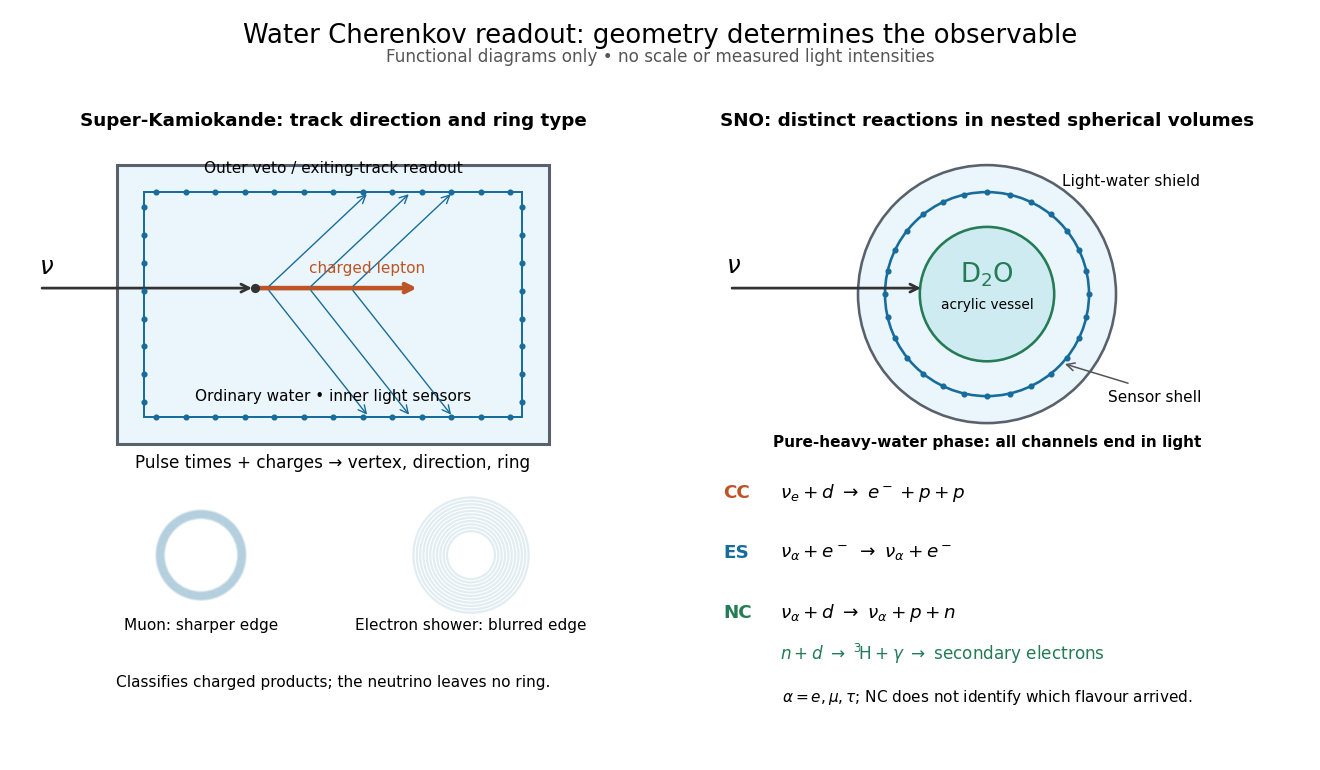

Super-Kamiokande used days ( kiloton-years) and fiducial kilotons of water. Inner photomultiplier times and charges reconstructed interactions; the outer anticoincidence detector vetoed entering particles and marked exits. Contained single-ring events used likelihood classification: Electron particle showers blur rings; muons give sharper edges. The visible-energy sample division is not a universal detection threshold. Simulation estimated classification efficiency above about , distinct from total detection efficiency; stopping muons and decay Electrons checked classification.[ref]
Evidence for oscillation of atmospheric neutrinos by Y. Fukuda and others. PDF pp. 2–3, Table I: apparatus and classification
Downward neutrinos travel about ; upward ones about . The multi-GeV muon-like up/down asymmetry was ; Electron-like events lacked a comparable effect. Calibration constrained directional bias. This was disappearance evidence; tau neutrino appearance was untagged and sterile conversion remained possible.[ref]
Writing and for the selected upward and downward populations, the asymmetry is : a negative value means fewer upward events. An absolute source-normalization error alone rescales both populations and leaves this ratio unchanged. A direction-dependent response error need not cancel.
For a deliberately simplified neutrino oscillation calculation, take two neutrino flavors related to two mass eigenstates by a real rotation matrix with angle . A quantum superposition acquires different phases during propagation; projecting back onto the initial neutrino flavor gives the probabilityHere is path length and is neutrino energy; the numerical coefficient incorporates unit conversion.
The path dependence has a geometrical origin. In an original spherical-Earth model, let be the radius and a fixed production height, neglecting detector depth. Let be the zenith distance of the direction in the sky from which the neutrino arrives, so means downward propagation. The backward ray from detector to production obeys . Its positive solution isThus and . The calculation explains why opposite directions test very different baselines, rather than attributing every observed direction to the same travel distance. Actual production heights and the angle between the outgoing charged lepton and incoming neutrino smear that relationship.
For an original chosen example, set and . At , gives , while gives . The first minimum is at . These are stipulated inputs, not a fit to the 1998 data. A broad distribution of true , together with energy and directional uncertainty, smooths the sharp minima.
A direct amplitude check makes the mechanism explicit. DefineThen . Taking its squared absolute value yields the displayed survival formula because . Unitarity gives : disappearance from one channel becomes conversion to the other within this closed model.
This illustration does not describe all solar neutrino propagation. Coherent forward scattering in matter changes the effective propagation operator, and three active neutrino flavors require a larger mixing description. Even in the simplified model, neutrino oscillation measures a squared-mass difference; it does not determine the absolute neutrino mass.
The SNO Collaboration used tonnes of heavy water in a acrylic sphere, surrounded by ordinary water shielding and photomultipliers. Weak charged current (CC) breakup of a deuteron selects electron neutrinos; weak neutral current (NC) breakup measures all active neutrino flavors; Electron elastic scattering (ES) has reduced non-electron sensitivity.[ref]
In 2001, live days, reconstructed radius below and effective Electron kinetic energy above gave a CC neutrino flux of for the assumed boron-8 spectrum. Source calibrations measured instrumental-cut signal loss. SNO's own CC–ES difference was ; comparison with Super-Kamiokande's precise ES flux gave evidence for non-electron active neutrinos. This was not an NC measurement.[ref]
In 2002 the pure-heavy water analysis used live days and a reconstructed kinetic-energy threshold. NC neutrons captured on deuterons emitted gamma rays, producing secondary Electron light. The NC reaction threshold was , a different quantity. Californium-252 calibrated capture efficiency, but only detection efficiency after fiducial and energy cuts. Assays constrained backgrounds from radioactive decay and photodisintegration.[ref]
Direct Evidence for Neutrino Flavor Transformation from Neutral-Current Interactions in the Sudbury Neutrino Observatory by Q. R. Ahmad and others. PDF pp. 2–3: neutron calibration, thresholds and backgrounds
Energy, radius and direction relative to the Sun statistically separated channels. Assuming the standard boron-8 spectral shape, the NC total active neutrino flux was , consistent with stellar structure predictions. The non-electron active component differed from zero by . This established active flavour conversion, without individually tagging muon neutrinos and tau neutrinos. It did not exclude every sterile admixture.[ref]
Why compare inferred neutrino fluxes rather than raw event counts? For channel , exposure time , target population , cross section , and detection efficiency including reconstruction and selection, a forward model isHere is expected background; on the left counts events, while counts targets. Distinct cross sections, target numbers, thresholds and detection efficiencies prevent a direct CC/NC count ratio from being an electron neutrino fraction. Channel populations themselves can be correlated estimates from overlapping event patterns.
An original reduced linear algebra model isolates the inference. Assume specified spectral shapes and divide each background-corrected channel rate by its own calibrated electron neutrino response. Put and let be the spectrum- and response-weighted non-electron/electron ES sensitivity ratio. ThenThe equal and responses determine their sum, not their separate neutrino fluxes. Changing the assumed spectra generally changes the integrated coefficients; with arbitrary unknown spectra this small matrix is insufficient.
Choose illustrative inputs, not historical measurements: , and , with every neutrino flux in the same arbitrary unit. The forward prediction is . CC and NC independently invert to , ; substituting into ES returns . Alternatively, CC and ES give . Thus the third channel tests the response model and the inferred mixture.
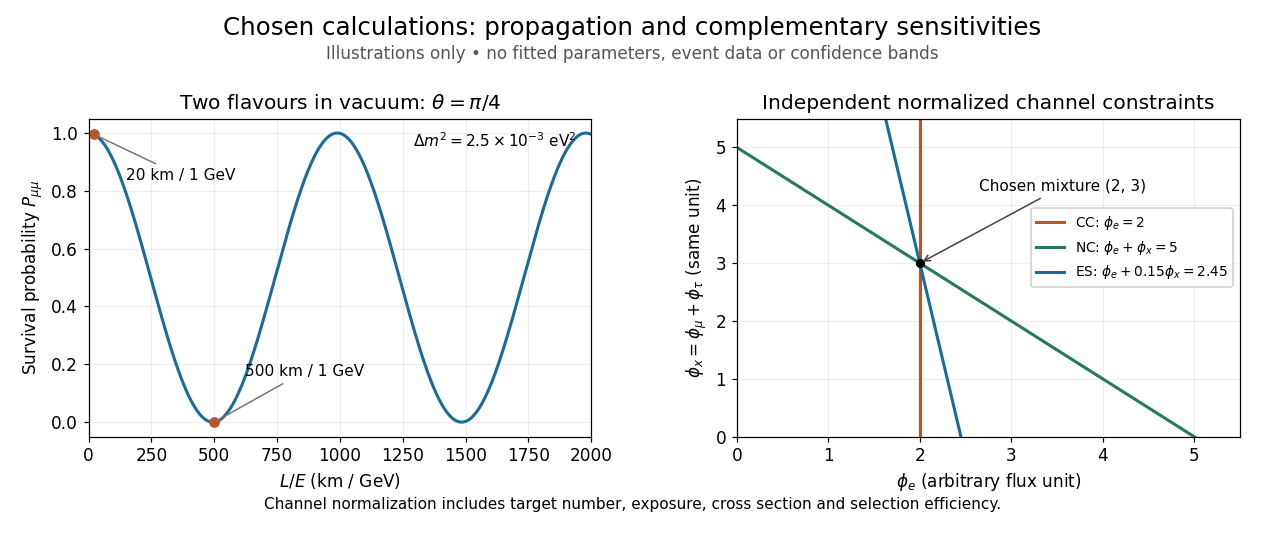

CC alone admits any nonnegative . CC and ES lose the second independent constraint when ; for small positive , an ES-minus-CC error is amplified by . With chosen independent errors , their propagated standard deviation is . If CC and NC instead have those independent errors, the difference has standard deviation . Actual analyses must retain covariances, including those introduced by statistical channel separation. Complementarity supplies information; calibration establishes what information each channel carries.
IceCube turns Antarctic ice into a Cherenkov detector: digital optical modules on strings span depths of –. Hot-water drilling allowed deployment before refreezing. Neutrino interactions produce charged particles; their Cherenkov radiation, rather than the incoming neutrino, supplies the optical readout.[ref]
Neutrino astronomy asks where the incoming neutrino originated. A Cherenkov detector asks how its reaction products make measurable light. Connecting these questions requires track reconstruction, detection efficiency and background tests. An astronomical messenger and the light carrying information inside the apparatus are different stages of one inference.
A glass-enclosed photomultiplier with local digitization: pulse times and charges enter event reconstruction. Reciprocal electrical pulses synchronize module clocks to the surface time base.[ref]
The IceCube Neutrino Observatory: Instrumentation and Online Systems by IceCube Collaboration. Sections 2.1, 3.3: module and reciprocal timing
Weak charged current interactions of muon neutrinos usually give extended muon tracks. Compact particle showers occur in other channels, including weak neutral current interactions of every neutrino flavor. Tracks generally constrain direction better; escaping particles complicate energy inference.[ref]
The IceCube Neutrino Observatory: Instrumentation and Online Systems by IceCube Collaboration. Section 1.1.1: tracks and showers
In the 2013 calibration study, six horizontal light-emitting diodes per module on string 63 flashed sequentially; other strings recorded charges and photon arrival times. A global fit inferred depth-dependent scattering of light and absorption coefficients. Dust-logger measurements checked layer structure; independent muon events tested simulated time patterns. Photomultiplier response and refrozen ice near modules remained limitations. Thus a late hit need not imply a late interaction: scattering of light changes the path.[ref]
Measurement of South Pole ice transparency with the IceCube LED calibration system by IceCube Collaboration. Sections 3, 8–11; Figs. 14, 20–23: flashing, cross-checks and limitations
An original limiting calculation isolates this issue. Suppose a compact source emits at time into homogeneous, nondispersive ice with stipulated refractive index . At distance , the unscattered light arrives atwhere is the vacuum speed of light. For chosen , the delay is . A scattered path longer adds even with perfect clocks. These chosen values are not calibration measurements. Real ice requires wavelength-dependent propagation, module response and a spatially varying light-transport model; replacing that response by one arrival time discards information.
The 2013 selection rejected early boundary light. Tagged muons checked leakage; air shower companion muons also vetoed downward atmospheric neutrinos.[ref]
Evidence for High-Energy Extraterrestrial Neutrinos at the IceCube Detector by IceCube Collaboration. Event Selection; Atmospheric Muon Background
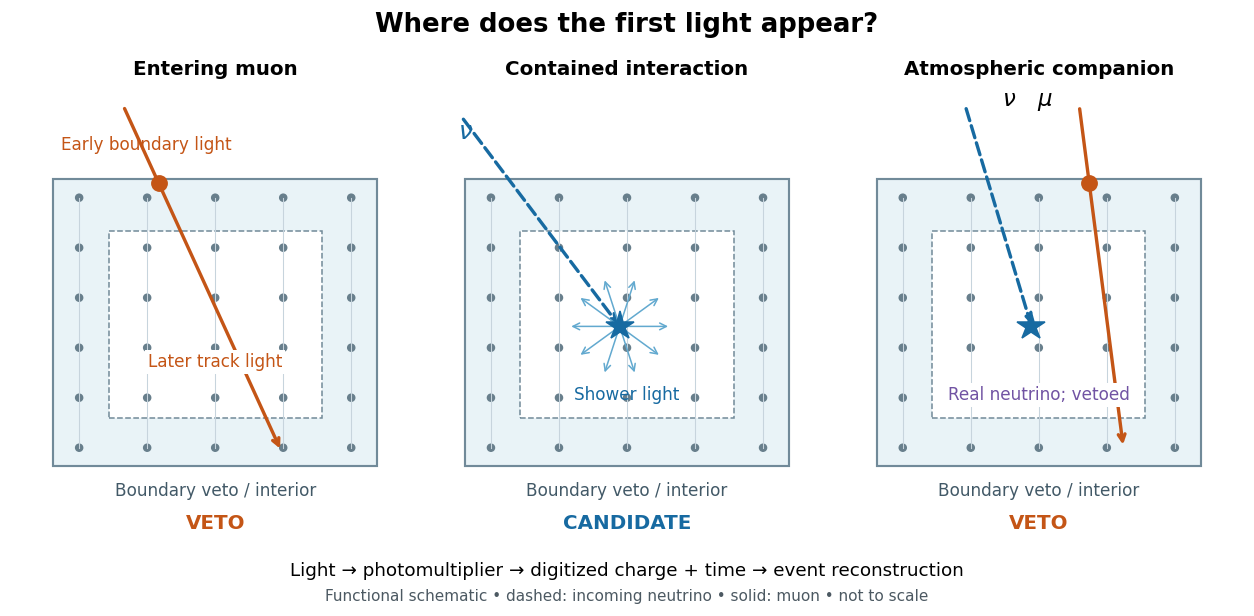
Entering tracks, contained interactions and an accompanying-muon veto
. Original schematic, not to scale or measured data. Dots: optical modules. Dashed arrows: unseen neutrinos; solid arrows: muons. Details.
A simple original conditional probability model explains why a veto changes the selected mixture. Let mean that an atmospheric neutrino interaction would pass all other cuts, that an accompanying muon reaches the veto, and that the veto fires. Set and , and neglect unrelated veto hits. The law of total probability givesFor chosen and , the passing fraction is . Neither this value nor either input is an IceCube measurement. With equal incident candidate populations, this mechanism alone reduces the atmospheric contribution relative to a hypothetical population having . It does not make every surviving event astronomical: or gives no suppression, while removes the entire chosen atmospheric population. If unrelated light vetoes a surviving event independently with probability , its passing fraction becomes ; independence is an additional assumption.
In live days during 2010–2012, events exceeded the expected atmospheric events. Energy, direction and topology supported an extraterrestrial component. Combined searches gave with additional benchmark charm background; uncertain charm production affected significance. No source clustering was established.[ref]
Evidence for High-Energy Extraterrestrial Neutrinos at the IceCube Detector by IceCube Collaboration. Results; Discussion; Search for Neutrino Sources
A diffuse excess and an identified source answer different questions. The first compares populations against a background hypothesis; the second needs an association in direction, perhaps also in time.
How much does a small directional uncertainty help? Consider an original idealized model: a source direction fixed in advance, uniform background directions over the full sphere, and circular acceptance radius . The accepted solid angle and single-event background probability areThe derivation integrates the area element on a unit sphere. For small in radians, : halving the radius quarters the accidental acceptance, to leading order. At acceptance vanishes; at it covers the full sphere. The solid angle has units of steradians; is dimensionless.
For , take a deliberately crude point spread function: stipulate that every signal direction lies uniformly inside that cap. The signal and background probability density functions per steradian are inside the cap and zero outside, and everywhere. Both integrate to one. For an event inside the cap their likelihood ratio isThis ratio compares two specified directional models; it is not the probability that the event came from the source. Such a conditional probability would additionally require prior source odds and the other selection information. For fixed source fraction among selected events, a normalized mixture distribution has density . For independent events the likelihood is the product of those densities; its ratio to background alone isOutside-cap events contribute factors rather than being silently discarded. At , ; for a full-sky cap, and every gives . A directional model that cannot distinguish source from background carries no directional evidence.
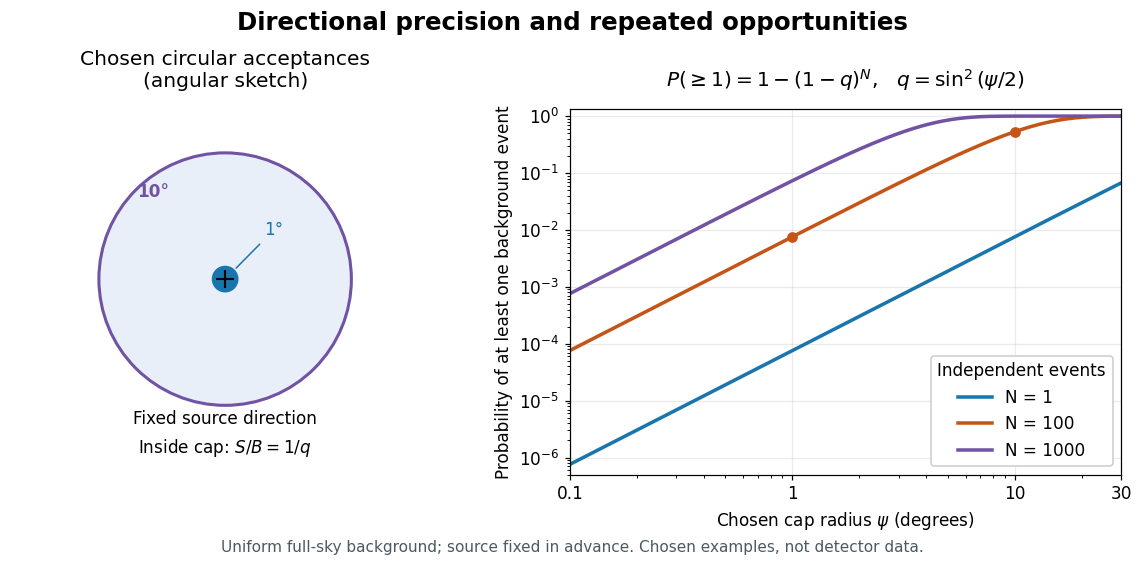
Chosen angular acceptance, directional likelihood and repeated background opportunities
. Original exact spherical-cap calculation and uniform-cap signal model. Radii and event counts are chosen illustrations, not IceCube angular resolutions or discovery data. The fixed source direction and independent uniform background assumptions are essential. Details.
As an original numerical example, radii and give and , respectively: nearly a hundredfold difference. For a fixed number of independent background events, the binomial distribution givesWith chosen , those radii give approximately and . A small single-event acceptance can become a common coincidence after many opportunities. This probability concerns a fixed cap, rather than a scan for the most favorable cap anywhere. For independent searches with common local tail probability , the corresponding global tail probability is ; overlapping sky searches generally violate that independence. Actual source tests must include directional response, nonuniform exposure, energy information and the look-elsewhere effect in their null calibration.
The 2018 collaboration paper associated the 22 September 2017 neutrino alert with the flaring blazar TXS 0506+056 through directional and multiwavelength observations. Its approximately evidence included trial corrections and assumed relationships between neutrino and gamma ray emission. A single association did not establish a production mechanism or explain the entire diffuse neutrino flux.[ref]
Multi-messenger observations of a flaring blazar coincident with high-energy neutrino IceCube-170922A by IceCube Collaboration and others. The neutrino alert; Neutrino-blazar coincidence analysis; Discussion, PDF pp. 2–3, 11–13, 62–66
Articles by others on the same topic
There are currently no matching articles.