CKM unitarity triangle
ID: ckm-unitarity-triangle

Column orthogonality of the CKM matrix gives three complex numbersDrawing these as successive vectors in the complex plane produces a closed triangle. Its area is , because unitarity identifies this imaginary quartet with a signed Jarlskog invariant. A nonzero area therefore detects physical CP violation for nondegenerate quark masses.
For a worked example, choose the exact parametrization of the CKM matrix with , , and . These are illustrative choices, not fitted quark mixing parameters. They give . The unscaled triangle has area approximately .
Divide the closure relation by , assuming , and define the complex numberThe normalized triangle has vertices , with for these choices. Dividing each side by divides area by : its area is , approximately . The familiar normalized picture therefore does not itself have area .
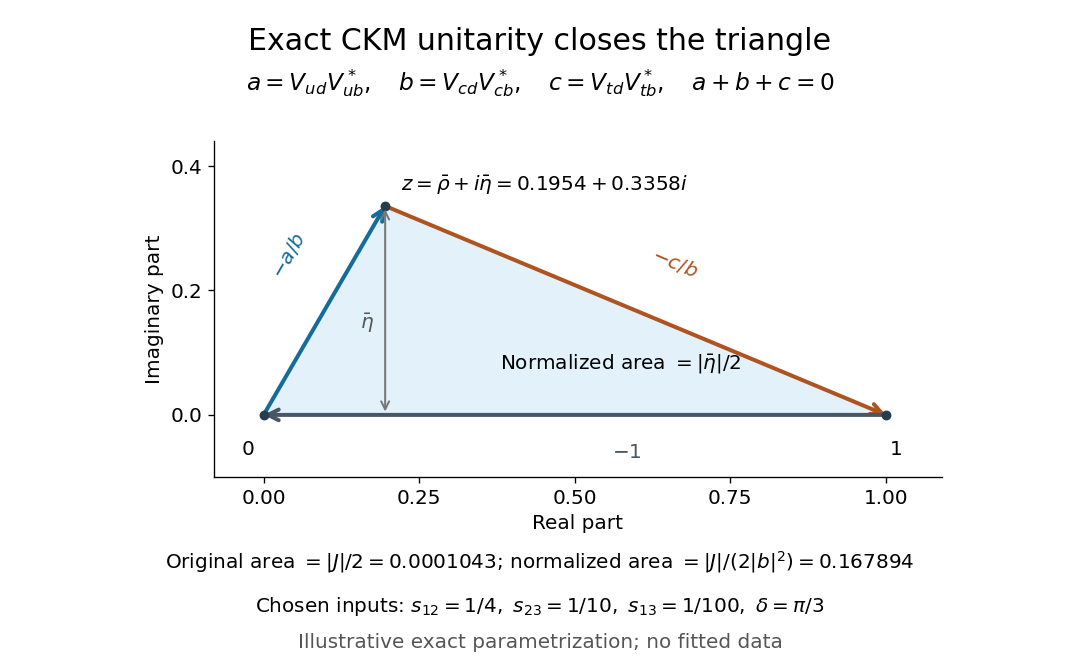

Under quantum field rephasings, all acquire the same phase, so the original triangle merely rotates and stays fixed. Ratios and angles can thus compare quark mixing measurements without dependence on field conventions. If the Jarlskog invariant vanishes, the triangle collapses; additional quark mass degeneracies require extra care in interpreting the converse.
New to topics? Read the docs here!