A triangle is the convex hull of three noncollinear points: the three vertices must not lie on one line. Its boundary consists of the three joining line segments; depending on context, "triangle" can mean this boundary or the filled region it encloses. Here a triangle's area refers to the filled region. The noncollinearity assumption excludes a collapsed shape with zero area, for which ordinary interior angles are not defined.
For example, the positions , and form a right triangle with a right angle at the origin. Taking the side of length as its base gives perpendicular height , so its area is . The height is measured at a right angle to the chosen base; it is not generally the length of another side. In this example it happens to be a side because the triangle is a right triangle.
By contrast, side lengths define a valid triangle: each side is shorter than the sum of the other two, as required by the strict triangle inequality. But , so this is not a right triangle and the Pythagorean theorem cannot calculate its longest side from the other two. The law of cosines instead gives the opposite interior angle throughThis example separates the definition of a triangle from the additional assumption of a right angle.
Every triangle in the Euclidean plane has interior angles summing to radians, a result proved in Euclid's Elements I.32.[ref] It lets two measured angles determine the third, and underlies the angle-angle criterion for similar triangles. The qualification "Euclidean plane" matters: the earlier spherical triangle demonstrates a different sum.
Two triangles are similar if a Euclidean similarity maps one onto the other. Their corresponding angles agree, and corresponding side lengths have a common positive ratio.
Specify the correspondence first: matches , matches and matches . For similar triangles, the common scale factor satisfiesThe ratios compare matching sides in the same order. A Euclidean similarity can also move, turn or reflect the triangle; its orientation on the page is irrelevant. In the Euclidean plane, matching just two interior angles is enough: their sums force the third to match, and equal corresponding angles force the side ratios to agree. This is the angle-angle (AA) criterion for similar triangles. Matching just one angle is insufficient.
Scale the right triangle with vertices , and by . Its new vertices are , and , and its side lengths are . The matching side ratios are . Both triangles have a right angle and the same two other interior angles, approximately and . However, their areas are and : doubling lengths multiplies area by four.
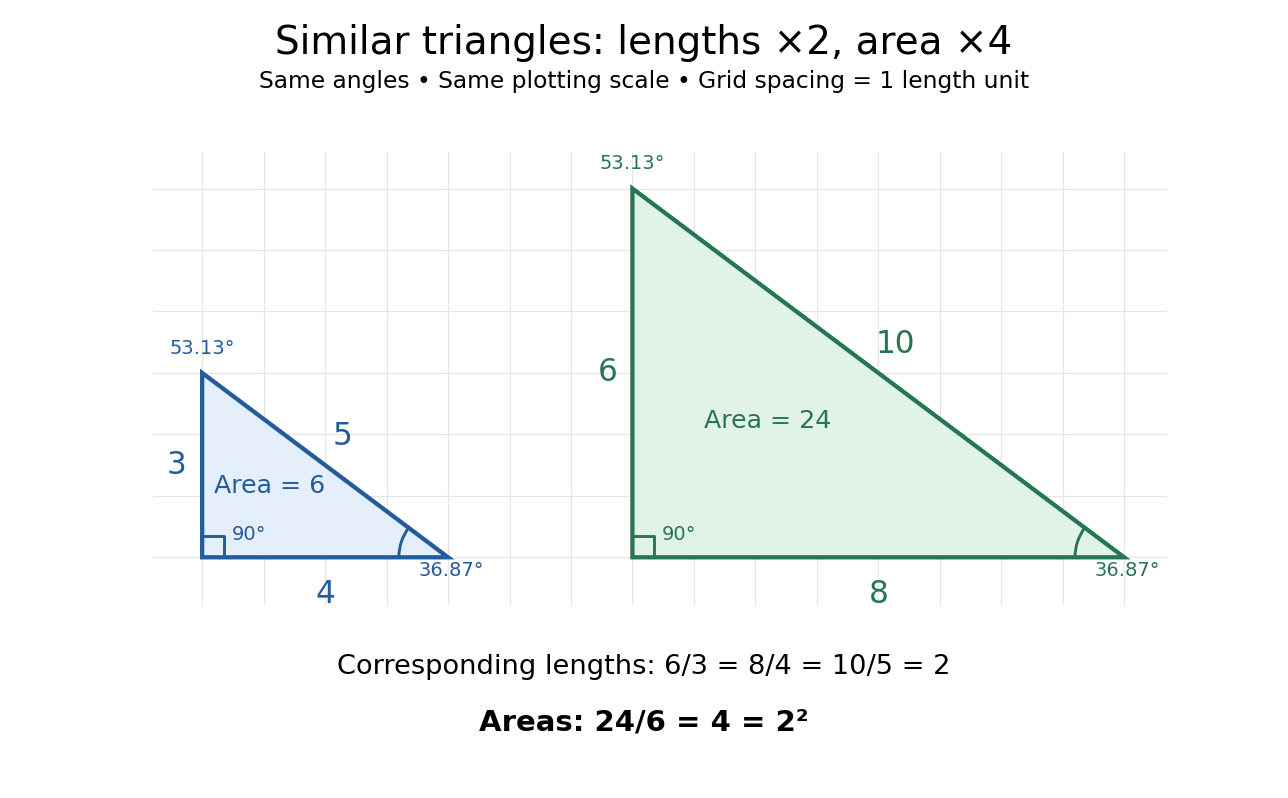
Generally, a Euclidean similarity multiplies both a base and its perpendicular height by , so the area becomes . This explains why an enlarged drawing needs four times as much surface when each length doubles. It also enables indirect measurement: under assumptions of level ground, vertical objects and parallel light rays, an object of height casting a shadow of length provides a right triangle. Another object's shadow of length gives a similar triangle and height . The shared angles justify the inference; visual resemblance alone does not.
Euclid's Elements VI, Definition 1 describes similarity using corresponding angles and proportional sides. VI.4 establishes the implication from matching angles to matching side ratios, while VI.19 states the squared relation between side ratios and areas. These are documented ancient formulations of the principles used above, without establishing a first discoverer.[ref][ref][ref]
https://mathcs.clarku.edu/~djoyce/elements/bookVI/propVI19.html. Euclid, Elements VI.19
The incircle of a triangle is the circle inside the triangle tangent to all three sides. Its center is the intersection of two internal angle bisectors; its radius is , where is the area and the semiperimeter. To prove it is the largest contained circle, let any candidate have center , radius and distances from the three side lines. Splitting the triangle into three triangles with vertex gives . The tangent circle attains equality, proving maximality. For a right triangle with legs and hypotenuse , , since and .
The circumcircle of a nondegenerate triangle is the unique circle through its three vertices. Its center is the circumcenter, found by intersecting two perpendicular bisectors; equality of distances to all three vertices proves existence, and subtracting the squared-distance equations proves uniqueness. For a right triangle, the midpoint of its hypotenuse is equidistant from all vertices, so its circumradius is half the hypotenuse length.
An equilateral triangle has three equal side lengths.
The hypotenuse is the side opposite the right angle in a right triangle. Its length is determined by the Pythagorean theorem.

