
Coaptation area is the area of the contact region formed when opposing valve leaflet surfaces meet during coaptation. The measurement must specify the valve, phase and surface convention. Counting the same interface once is different from summing the apposed faces of both leaflets, and a projected image area is different from the area measured along a curved surface.
A primary investigation examined quantitative assessment of mitral coaptation using three-dimensional transesophageal echocardiography.[ref]
Quantitative assessment of mitral valve coaptation using three-dimensional transesophageal echocardiography by Frederick C. Cobey and others. Title and indexed Abstract, three-dimensional coaptation-zone assessment
This provides an experimental context for defining the zone before assigning it one scalar area. The observed or reconstructed leaflet geometry remains part of the measurement.For a specified contact patch on one reference face,If a planar patch is viewed at angle between its normal and the viewing direction, its projected area is . A true area of 20 mm viewed at therefore projects to 10 mm. This is an original geometrical example, not an echo calibration rule for all curved leaflets.
Area also omits the arrangement of the contact. In an ideal 10 mm by 10 mm gap map, a 10-by-2 mm contact strip spanning the full width has the same area as a 2-by-10 mm strip running along its height. If flow is constrained to travel from the bottom edge to the top edge within this two-dimensional map, the first strip blocks every path while the second leaves open side paths. Both contact areas are 20 mm.
Real valves have three-dimensional fluid gaps, deformation and changing pressure. The map is a counterexample to inferring closure from area alone, not a prediction of leakage magnitude. The location of contact, any remaining connected gaps and the surrounding heart valve mechanics matter alongside the reported coaptation area.
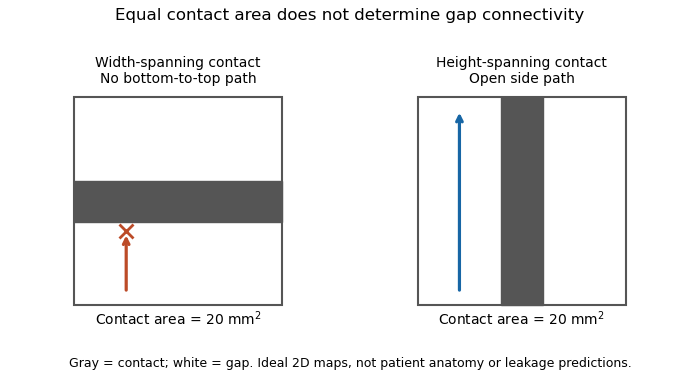
Equal coaptation area need not determine gap connectivity
. Original ideal two-dimensional contact maps. Each 10 mm square has a 20 square-millimetre contact strip. With paths confined inside the map, the horizontal strip blocks bottom-to-top passage, while the vertical strip leaves side paths. This illustrates geometric information lost by a scalar area, not measured valve leakage or patient anatomy. Details.
New to topics? Read the docs here!