Pressure measures the compressive normal force per unit surface area. For a uniformly loaded surface of surface area , the magnitude of the perpendicular force is ; locally, . Its SI unit is the pascal, . A force parallel to the surface contributes shear stress, rather than pressure. In a gas, the steady macroscopic force comes from many microscopic transfers of momentum; ideal gas pressure from wall collisions makes this connection explicit. [ref]
https://openstax.org/books/university-physics-volume-2/pages/2-2-pressure-temperature-and-rms-speed. OpenStax University Physics Volume 2, section 2.2: microscopic origin of pressure
For a computed example, a uniform pressure of on a piston of surface area produces a perpendicular force of . If the opposite face is exposed to , the net force due to the two pressures is , directed toward the lower-pressure side. The pressure on either face and their difference answer different questions; gauge pressure records a difference from a specified reference, often atmospheric pressure.
A scalar pressure describes a gas in local thermodynamic equilibrium with isotropic random particle velocities: every wall orientation has the same normal force per unit surface area. Without this isotropy, normal stresses can depend on direction and a pressure tensor is needed. Thus random motion alone is insufficient; a preferred direction matters.
In thermodynamics, pressure and volume are thermodynamic conjugate variables. For a simple compressible system, reversible expansion delivers work , and at fixed entropy and particle number ,where is internal energy. A large pressure therefore means both a large wall force per unit surface area and a large amount of expansion work per small increase in volume.
A pressure sensor converts a pressure into a recorded signal. An absolute pressure sensor uses a vacuum reference; a gauge pressure sensor uses a specified reference pressure. A closed gas syringe and an absolute pressure sensor can test Boyle's law after allowing the temperature to stabilize.
Atmospheric pressure often provides the reference for a gauge pressure measurement: . The absolute pressure is measured relative to an ideal vacuum, whereas zero gauge pressure means equality to the chosen reference. The actual atmospheric pressure can vary; it must be specified when converting between these descriptions. [ref].
Dividing a pressure disturbance by the constant reference mass density gives a quantity whose gradient enters the Boussinesq equations directly as an acceleration. Its units are squared velocity. Distinguish this convention from physical pressure when calculating energy flux or comparing wave polarization formulae.
In the local rest frame of a gas, the pressure tensor is the directional momentum flux , where is the phase-space distribution function per unit momentum volume and is particle velocity. For an isotropic distribution, , recovering the kinetic pressure of an isotropic gas. An anisotropic distribution can exert different normal pressures along different directions.
Gas pressure is the mechanical pressure contributed by material particles. For a classical ideal gas, .
Radiation pressure is the normal momentum flux transferred by electromagnetic radiation to a surface. A photon travelling in vacuum carries momentum , where is its energy, its frequency, the Planck constant and the speed of light. Photon absorption transfers that momentum; specular reflection reverses its normal component. This lets light exert a force even when almost no energy becomes heat in the receiver.
Two useful formulas describe different preparations. A directed beam normally incident on a stationary perfect absorber gives pressure , and on a stationary perfect mirror gives . Here is light intensity, the incident power per beam cross-sectional area perpendicular to propagation, in . An isotropic photon gas has pressure , where is its radiation internal energy per volume, in . Stored energy density and travelling energy flux must be distinguished: an isotropic field can have zero net energy flux and positive radiation pressure.
The physical appeal is that the same momentum conservation connects a single photon collision, a mirror's measurable force, and a radiation-filled cavity's equation of state. The directional calculation below complements radiation pressure on a perfectly absorbing surface; the equilibrium spectrum and its temperature dependence belong to blackbody radiation and the photon gas.
For normal incidence in vacuum, a uniform beam delivers energy to an illuminated surface area during time . A perfect absorber receives momentum , so force divided by surface area gives . A perfect stationary mirror sends the photons back with reversed momentum, so momentum conservation gives twice the normal transfer, . These are time-averaged pressures; the microscopic arrivals need not be uniform.
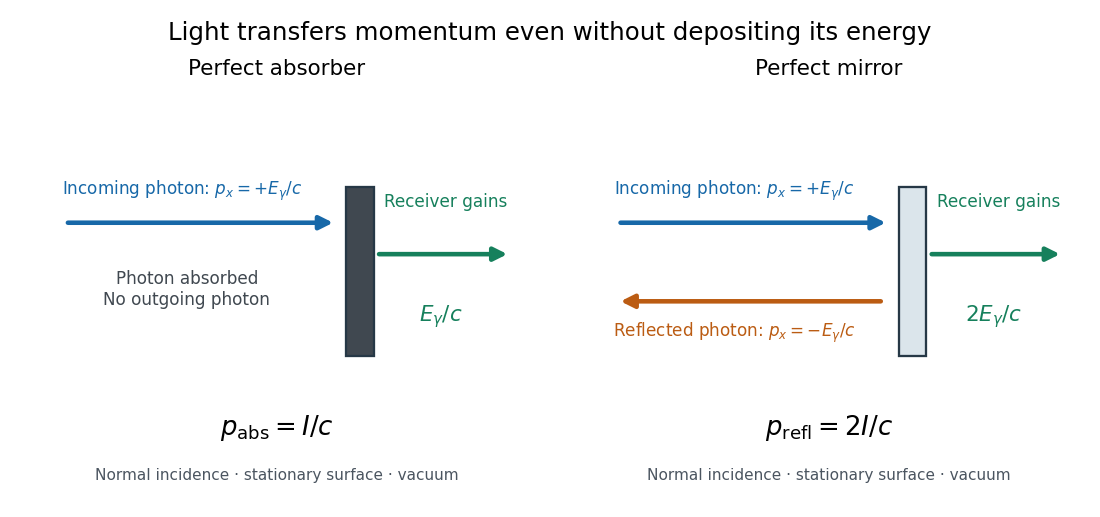
For a stipulated model light intensity and the exact SI speed of light ,These are computed predictions, not measured data or a universal sunlight value. If the beam fully covers a normally oriented surface area , the intercepted radiant flux is and the absorber's force is . Using the total source power would be wrong if only part of its beam reaches the receiver. The absorption prediction assumes complete photon absorption, while the reflection prediction assumes complete specular reflection; transmission, scattering of light and directed thermal photon emission require their own outgoing momentum accounting.
Measure the angle of incidence between the incoming path and the surface's normal line, with . There are two separate cosine factors. A fixed actual surface area intercepts only its projected area , so . Each incoming photon supplies normal momentum on absorption, or twice that on specular reflection. Thus, for radiometric absorptance and reflected power fraction ,This model assumes transmitted light continues straight in the same medium and carries away its original momentum. It omits thermal recoil and assumes a stationary receiver. At , fixed beam light intensity therefore gives one quarter of the normal-incidence pressure. For fixed intercepted radiant flux , however, the normal force has only one cosine factor. Equivalently, if the given quantity is receiving-surface irradiance , then . The distinction matters when interpreting an experiment's angle scan. [ref]
Use of radiation pressure for measurement of high-power laser emission by Paul A. Williams and others. Williams and collaborators, Use of radiation pressure for measurement of high-power laser emission, equation (1): force expressed using intercepted optical power and the incidence-angle cosine
Absorption also transfers a tangential momentum component at oblique incidence. It contributes a tangential force, rather than normal pressure. Ideal specular reflection preserves the tangential momentum component, so it transfers only normal momentum.
For radiation in vacuum with isotropy, energy is distributed equally per solid angle: write for energy density per unit solid angle. Let be the angle between a ray's path and the wall normal. Its normal velocity determines the arrival rate, while normal momentum per energy is . Their product is . For a perfectly reflecting cavity wall,The leading two is the normal momentum reversal; the incoming hemisphere contains half of the field's directional energy density. This is also the normal component of the bulk pressure tensor, . Isotropy makes all three diagonal components equal, while their sum is because the squared direction components sum to one. The factor one third therefore depends on three-dimensional angular geometry, not on the shape of the blackbody radiation spectrum.
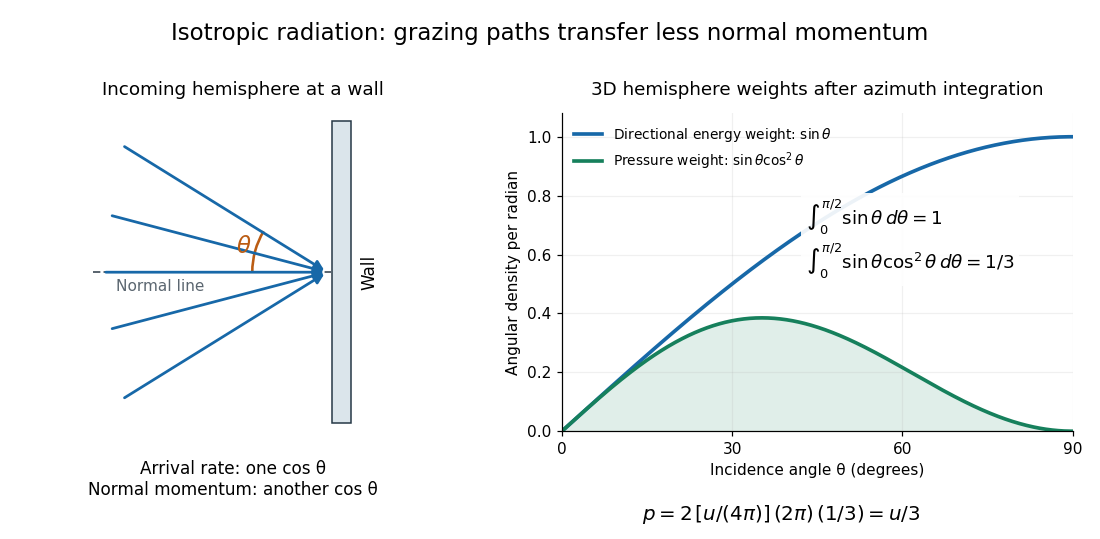
A perfectly absorbing wall exposed to this incoming hemisphere receives only from absorption. If it is in thermal equilibrium with the isotropic radiation, its outgoing emission supplies another of recoil, recovering . A cold absorber before equilibrium is a different boundary condition. Similarly, the one-way incident energy flux is , whereas the net energy flux across a plane in the undisturbed isotropic field is zero. Dividing by misses the extra normal-momentum projection and does not give the cavity pressure.
For a stipulated isotropic radiation energy density , the bulk pressure is regardless of its spectral shape. In thermal equilibrium, blackbody radiation supplies with radiation constant , so ; Stefan–Boltzmann law defines . The equilibrium photon gas derives this same equation of state from its free energy.[ref]
A 2013 experiment by Paul A. Williams and collaborators mounted a 25-mm dielectric mirror on a commercial force-restoration balance. Removing its pan-weight compensation spring allowed horizontal force sensing with a horizontal laser path. They measured mirror optical reflectance and varied incidence from about to . A 1071-nm laser, capable of 530 W, was switched at 0.1 Hz. Digitized mass-equivalent readings were converted to force using ; quadrature demodulation isolated the switched signal from drift. [ref]
Measurement calibration used a 20-g mass, with checks down to 1 mg. The optical forces lay below that checked range, limiting the accuracy claim. An angle scan tested the predicted cosine dependence at fixed intercepted power. Replacing the mirror with a carbon nanotube coated absorber increased absorbed power while reducing the predicted optical force; no modulation peak was detected. This bounded gas-heating artifacts under those conditions, rather than proving their universal absence. The fitted slope was about 7% below . Inferring laser power requires calibrated force, optical reflectance, radiometric absorptance and angle of incidence, with measurement uncertainty for each. [ref]
An equation of state is a relation among thermodynamic state variables such as pressure, volume, temperature, energy, and particle number.
A perfect fluid in general relativity stellar model in which pressure depends only on energy density, . A positive derivative makes this relation locally invertible and turns outward-decreasing pressure into outward-decreasing density. This general relation need not have the constant ratio used for a constant cosmological fluid parameter.
A Clausius gas with covolume parameter obeys . It is the repulsive-volume part of a Van der Waals equation without the attractive term.
The Van der Waals equation is a simple real gas equation of state that can also describe a liquid-gas critical point. With particle count fixed, write the volume per particle as :or equivalently . Here is pressure, is absolute temperature, and is the Boltzmann constant. In SI, and have units per particle, has units , and has units ; the particle count is dimensionless. The pole at excludes smaller volume values from this model.
The correction represents excluded volume; the attraction term lowers pressure at fixed temperature and particle number density . This is a mean-field theory, replacing detailed intermolecular structure by two parameters. At with , it approaches the ideal gas law . It supplies a useful qualitative route from a dilute gas to phase coexistence, without a claim of quantitative accuracy for every fluid.[ref]
Van der Waals Gas. opening explanation and equation 6.156: excluded volume and attractive pressure correction; Fitzpatrick uses molar volume
Do not mix this particle convention with the molar volume convention elsewhere in this article. With amount of substance , Avogadro constant , and molar gas constant , one has , , and , so . The molar parameters have units and , respectively.
Johannes Diderik van der Waals introduced this equation of state in 1873, connecting molecular attraction with departures from the dilute ideal gas law. Its historical significance is the unified treatment of gases and liquids, rather than a universally exact fit.[ref]
Johannes Diderik van der Waals, Facts by Nobel Prize Outreach. Nobel Prize Outreach, Johannes Diderik van der Waals, Work: equation introduced in 1873 and molecular attraction
The Van der Waals equation becomes independent of its material parameters when pressure, temperature and molecular volume are divided by their critical values: . This explains the common reduced isotherms within this model, without claiming exact agreement for all real fluids.
A Van der Waals isotherm is the pressure–particle volume curve at a fixed temperature. Put , , and , using the Van der Waals critical point values below. Then the existing Van der Waals law of corresponding states becomesAll curves in the figure are calculations in this reduced model.
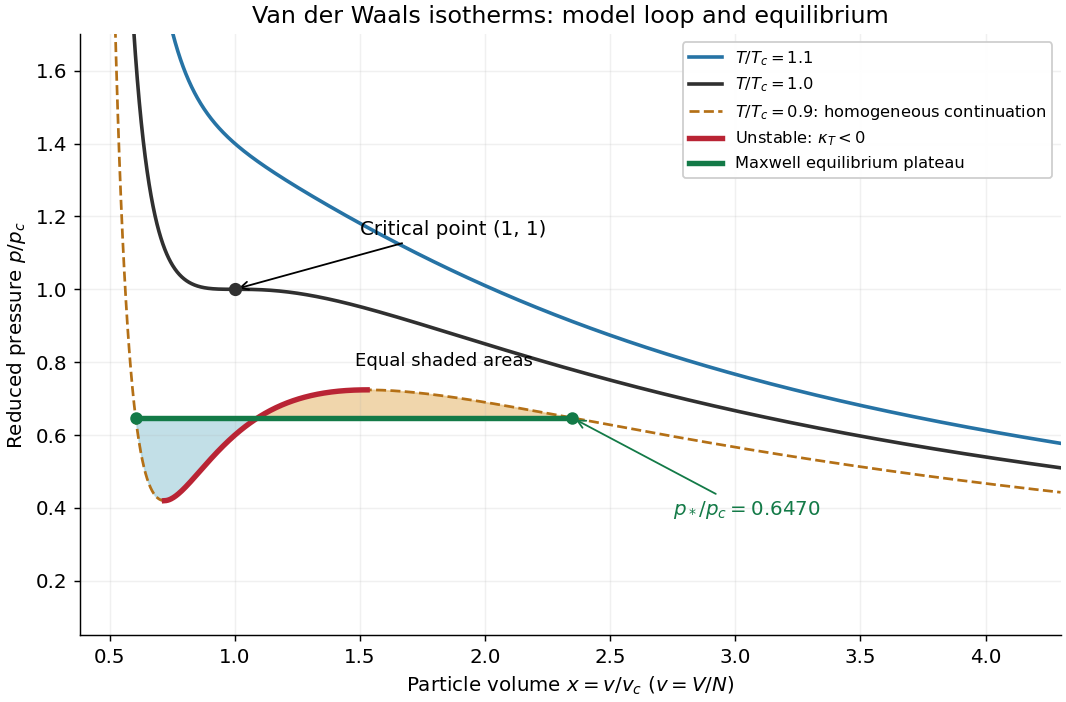
Van der Waals isotherms below, at and above the Van der Waals critical point
. The dashed subcritical homogeneous continuation contains an unstable red segment. The green Maxwell construction plateau describes equilibrium phase coexistence; the two shaded areas are equal. Curves are model calculations, not carbon dioxide measurements. Details.For a uniform thermodynamic phase, the isothermal compressibility isThus the upward-sloping portion of a subcritical Van der Waals isotherm has : compression would reduce pressure, allowing a density disturbance to grow. It is mechanically unstable. The spinodal points bound that portion; setting the derivative to zero gives their curve . Negative slope alone guarantees only local mechanical stability: portions between the spinodal and the phase coexistence endpoints have metastability. Equilibrium replaces the entire interval between those endpoints, including these metastable portions, by a Maxwell construction plateau.[ref]
Statistical Physics by David Tong. §5.1, equation 5.3 and §5.1.1, Maxwell Construction and Meta-Stable States: unstable middle branch and coexistence versus spinodal
The liquid-gas critical point of the Van der Waals equation occurs where its two subcritical stationary points merge into a horizontal inflection point. The conditions are . The short calculation isDividing these relations gives , henceSubstitution gives the Van der Waals law of corresponding states and the parameter-independent ratio . That ratio belongs to this equation of state; reducing a real fluid's variables does not enforce it.[ref]
Statistical Physics by David Tong. §5.1.3, equations 5.7–5.8: critical values, reduced equation and compressibility ratio
An exact rearrangement of the reduced critical Van der Waals isotherm makes its flatness visible:The first nonzero departure near is . On the critical particle volume approached from , andThe divergent isothermal compressibility and cubic flattening explain why the critical region is mechanically soft. These are mean-field theory predictions; thermal fluctuations limit their use for real fluids very close to a thermodynamic critical point.
Below , the equilibrium liquid and gas have the same temperature, pressure , and per-particle chemical potential. For macroscopic bulk thermodynamic phases, neglect interface contributions. The Maxwell equal-area construction determines and byIt expresses equality of chemical potentials, since at fixed temperature. Equivalently, the equilibrium Helmholtz free energy per particle follows a common tangent line between the two endpoint states, lying below the homogeneous continuation between them. The construction uses that mathematical continuation to compare endpoints; it is not a physical compression path through negative isothermal compressibility states.[ref]
Statistical Physics by David Tong. §5.1.1, equation 5.5, Maxwell Construction and figures 36–37: chemical-potential equality and flat coexistence intervals
Here is a reproducible calculated example at . With , the homogeneous intersections solve the cubic equationThe Maxwell construction givesAll three roots of a polynomial satisfy . Only the smallest and largest are the phase coexistence endpoints; the middle one has negative isothermal compressibility. Equal pressures at three admissible values of volume therefore do not imply three stable thermodynamic phases. An analytic area check isAt full numerical precision, the residual is below in reduced units; independent numerical integration gives the same cancellation. At , the spinodal points are instead and .
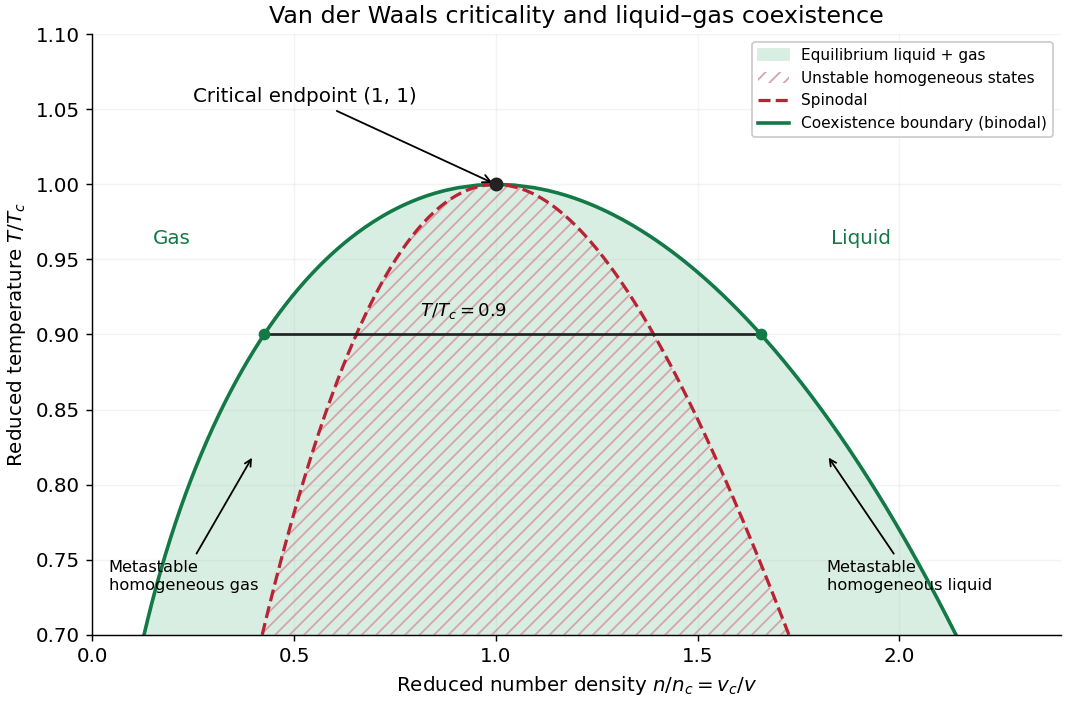
The equilibrium plateau changes the phase fraction rather than the endpoint densities. For a gas particle fraction and mean particle volume , the lever rule readsThus at gives : this is a particle fraction, not the volume fraction occupied by gas. Differentiating equality of chemical potentials along this model's phase coexistence curve yields the same Clapeyron equation explained below, , with latent heat per particle. Both endpoint differences vanish as the Van der Waals critical point is approached; the equation's critical limit must be taken as a ratio.
The 1869 The Bakerian Lecture: On the Continuity of the Gaseous and Liquid States of Matter by Thomas Andrews describes dried carbon dioxide trapped above mercury in a sealed capillary tube. A steel screw pressurized water in a strong copper tube; movable mercury transmitted the load. A second capillary tube held air as a pressure gauge. Flowing water around the visible capillary tubes controlled temperature; a thermometer read the bath. A cathetometer read column positions, converted to volume readings using weighed-mercury calibration.[ref]
The Bakerian Lecture: On the Continuity of the Gaseous and Liquid States of Matter by Thomas Andrews. Andrews, pp. 576–578 and Plate LXIII, figures 3 and 5–7: sample preparation, screw, coupled capillaries, water jackets and optical readout
Below the critical temperature, compression produced a visible liquid–gas boundary; above it, large density changes occurred without that boundary. Three trials gave as his critical temperature. Purity checks detected residual air; mercury height corrections accounted for unequal hydrostatic pressures. He explicitly left air nonideality and pressure-induced tube-capacity corrections unresolved, so his air-gauge pressures were approximate. These readouts support a liquid-gas critical point; they do not measure a homogeneous unstable loop or establish universal quantitative accuracy of the later Van der Waals equation.[ref]
The Bakerian Lecture: On the Continuity of the Gaseous and Liquid States of Matter by Thomas Andrews. Andrews, pp. 576, 578–580 and 583: residual air, approximate air-gauge pressure, hydrostatic corrections and three critical-temperature trials
An adiabatic equation of state relates pressure and volume along a process with no heat transfer. It commonly has the form .
Articles by others on the same topic



Pressure is defined as the force exerted per unit area on a surface. It is a scalar quantity, meaning it has magnitude but no direction. The formula to calculate pressure (P) is: \[ P = \frac{F}{A} \] where: - \( P \) is the pressure, - \( F \) is the force applied, - \( A \) is the area over which the force is distributed.