Compton recoil kinematics
ID: compton-recoil-kinematics

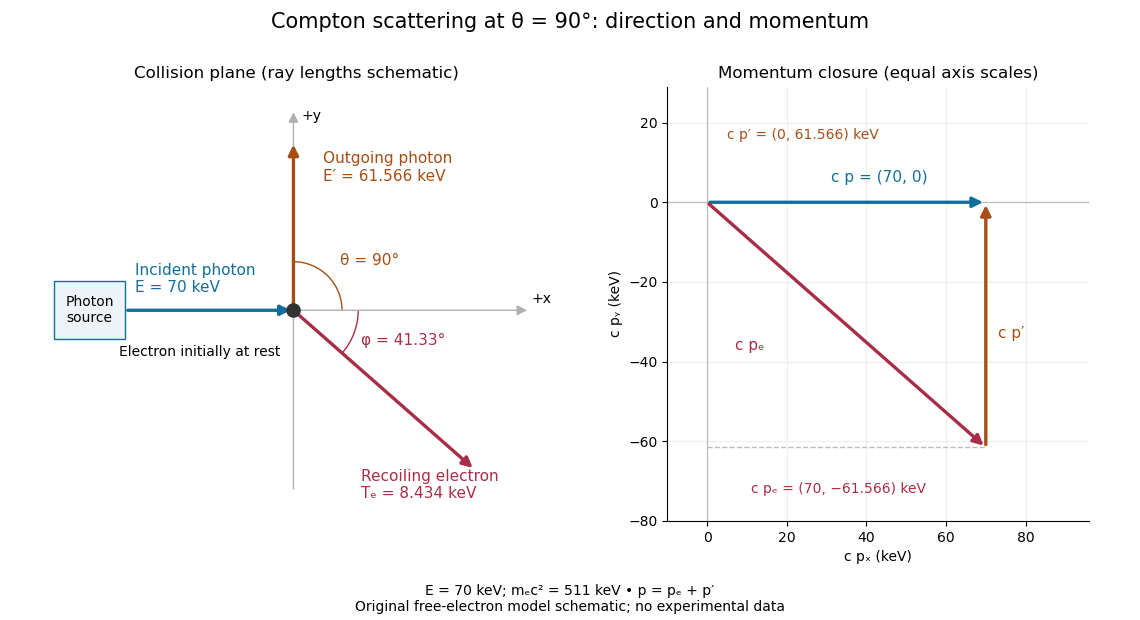
Choose the incident photon direction as and the plane of the collision as the plane, with the outgoing photon above the axis. The Electron initially has zero momentum. Conservation of energy and momentum conservation, using the relativistic energy–momentum relation, giveSquaring the Electron energy and the momentum magnitude in these two equations yieldsCancel common terms to obtain . Division by gives . Substitution of proves both Compton scattering formulas. Using the nonrelativistic approximation here would lose the exact relativistic result.
Let be the nonnegative Electron recoil angle below the incident direction. For , the vector components above implyThis assumes exactly the same initially stationary free Electron and single outgoing photon. At , the Electron moves forward with ; at it stays at rest, so its recoil direction is undefined even though the limiting angle as is . At in the chosen example, and .

New to topics? Read the docs here!