Conditional probability
ID: conditional-probability

For events with , conditional probability isRestrict attention to the outcomes in , then renormalize their probability measure so its total mass becomes one. The resulting rule is itself a probability measure. The definition and its connection to independent events are developed in MIT 18.05, Reading 3: Conditional Probability, Independence and Bayes' Theorem.
For the two-dice model, let mean the sum is at least nine and mean the first result is six. Of the six outcomes in , four belong to : the second die can be 3, 4, 5, or 6. Thus . Reversing the information gives a different answer: four of the ten outcomes in have first result six, so . Both ratios use the same overlap; their denominators describe different information.
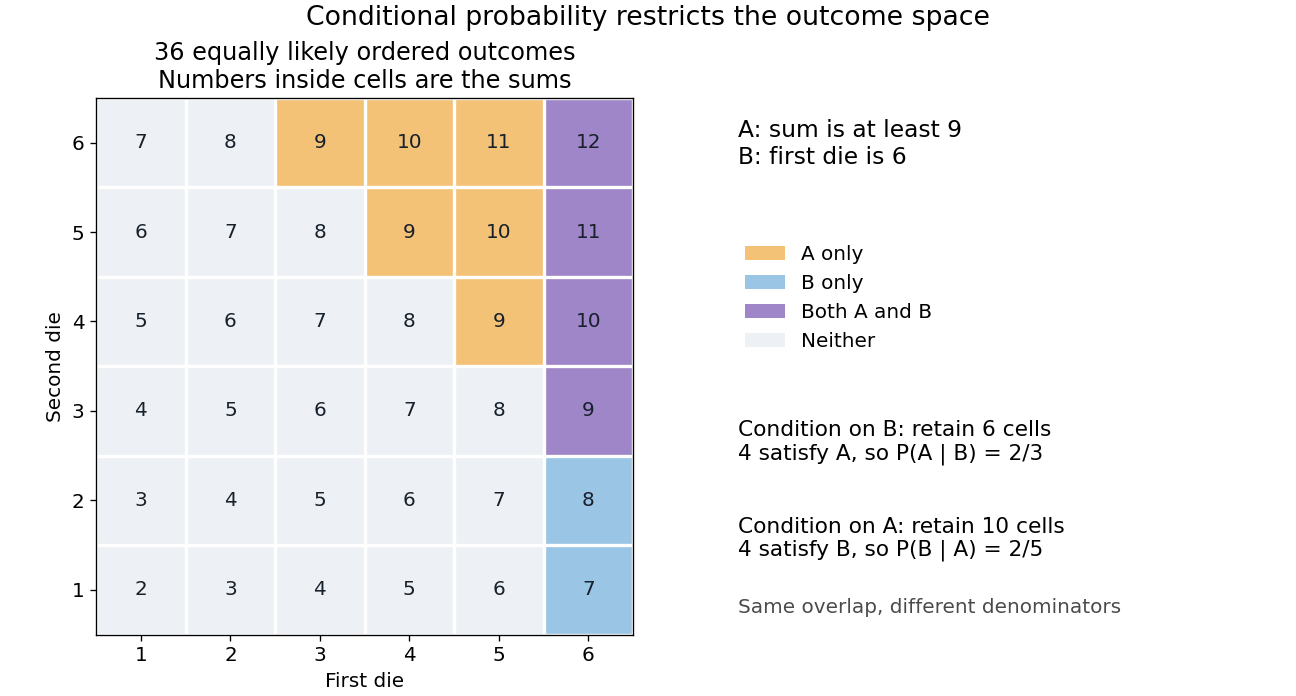
The definition requires positive conditioning mass. For a continuously distributed random variable , it cannot directly define when . A regular conditional distribution or conditional density supplies the appropriate extension, with the usual almost everywhere qualification. Nor does conditioning by itself justify causal inference: changing which outcomes are considered is different from physically changing how the experiment is generated.


Conditional probability is a measure of the likelihood of an event occurring given that another event has already occurred. It is denoted as \( P(A | B) \), which reads "the probability of event A given event B." Mathematically, conditional probability can be defined using the formula: \[ P(A | B) = \frac{P(A \cap B)}{P(B)} \] provided that \( P(B) > 0 \).
New to topics? Read the docs here!