
A conic section is obtained by intersecting a plane with a double circular cone. Cuts away from the vertex produce an ellipse, a parabola or a hyperbola; a perpendicular cut is the circle case of an ellipse. A cut through the vertex can instead produce a degenerate conic. One simple surface therefore connects several familiar plane curves.[ref]
Consider the original familySubstituting the plane equation into the double circular cone equation givesThus gives a circle, an ellipse, a parabola, and a hyperbola. The last cut meets both sheets of the double circular cone, producing its two branches. These parameters specify a mathematical family, rather than measurements of a physical object.
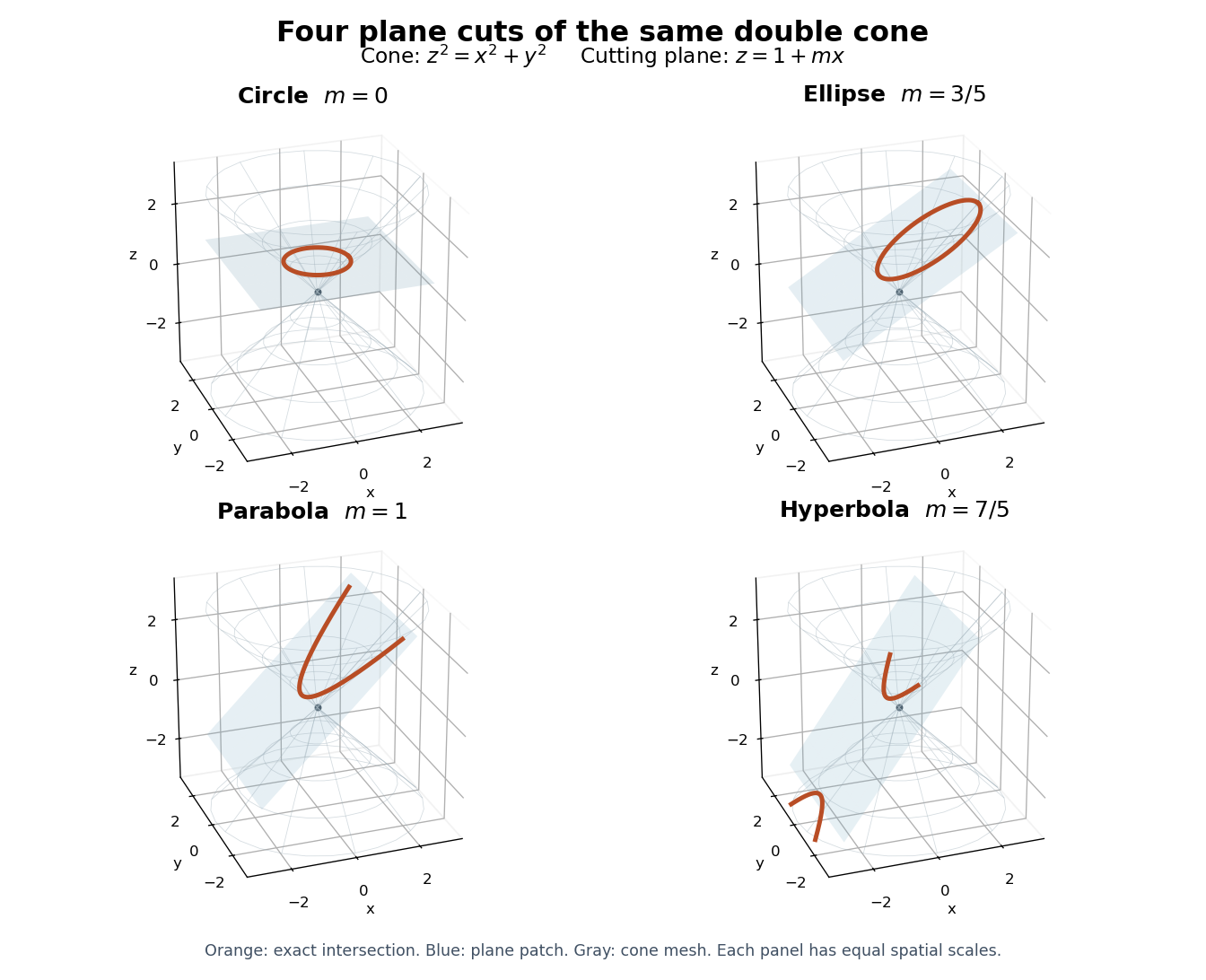
The Cartesian coordinate system descriptions of these curves are second-degree equationsA rotation and a translation expose their principal directions and offsets. The conic type discriminant identifies the ordinary nondegenerate real type, while a separate degenerate conic check prevents confusing two crossing straight lines with a hyperbola.
This is useful because a difficult-looking equation can be understood through a small set of geometric features: foci of a conic, directrices of a conic, eccentricity of a conic and the semi-major and semi-minor axes. The same ellipse can be traced by a constant-length string or parametrized by , . These are different descriptions of one curve, with different advantages for construction and calculation.


A conic section, or simply a conic, is a curve obtained by intersecting a right circular cone with a plane. Depending on the angle and position of the plane relative to the cone, the intersection can generate different types of curves. There are four primary types of conic sections: 1. **Circle**: A circle is formed when the intersecting plane is perpendicular to the axis of the cone. All points on the circle are equidistant from a central point.
New to topics? Read the docs here!