A conic section is obtained by intersecting a plane with a double circular cone. Cuts away from the vertex produce an ellipse, a parabola or a hyperbola; a perpendicular cut is the circle case of an ellipse. A cut through the vertex can instead produce a degenerate conic. One simple surface therefore connects several familiar plane curves.[ref]
Consider the original familySubstituting the plane equation into the double circular cone equation givesThus gives a circle, an ellipse, a parabola, and a hyperbola. The last cut meets both sheets of the double circular cone, producing its two branches. These parameters specify a mathematical family, rather than measurements of a physical object.
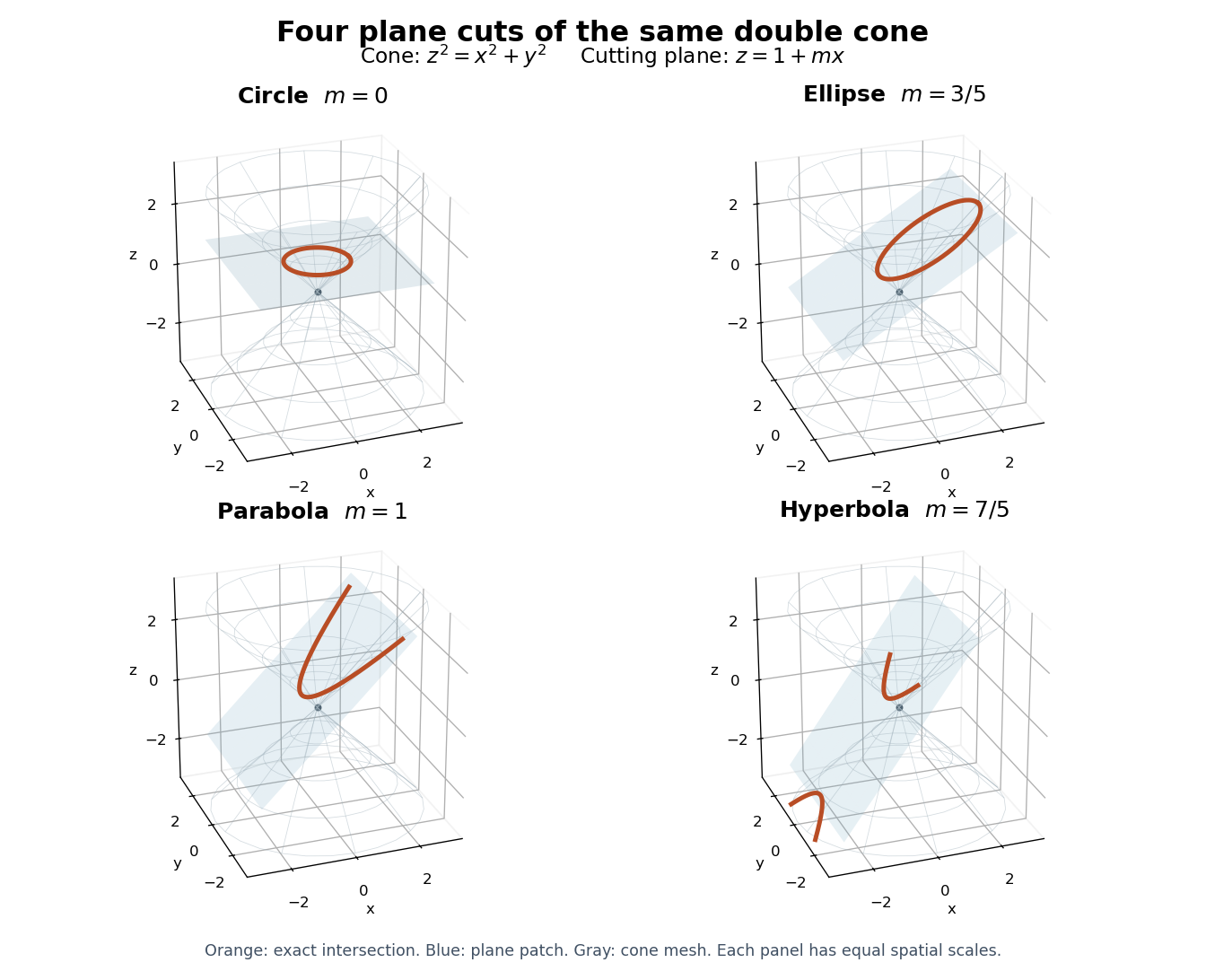
The Cartesian coordinate system descriptions of these curves are second-degree equationsA rotation and a translation expose their principal directions and offsets. The conic type discriminant identifies the ordinary nondegenerate real type, while a separate degenerate conic check prevents confusing two crossing straight lines with a hyperbola.
This is useful because a difficult-looking equation can be understood through a small set of geometric features: foci of a conic, directrices of a conic, eccentricity of a conic and the semi-major and semi-minor axes. The same ellipse can be traced by a constant-length string or parametrized by , . These are different descriptions of one curve, with different advantages for construction and calculation.
A conic section with a focus of a conic at the origin has the polar coordinates equation , where is the semilatus rectum and the eccentricity. The directrix of a conic definition gives the formula with when ; is the circle limit. The cases , , and give an ellipse, parabola, and hyperbola. The physical radius requires a positive denominator. For an attractive inverse-square central force, the Laplace-Runge-Lenz vector gives and .
For a second-degree equation , the number is the discriminant of a binary quadratic form associated with its quadratic part. For a nonempty, nondegenerate real conic section, a negative value gives an ellipse, zero a parabola, and a positive value a hyperbola. It is invariant under a rotation of orthonormal coordinates.[ref]
10.4 Rotation of Axes. Precalculus 2e, §10.4, Identifying Conics without Rotating Axes and Using the Discriminant to Identify a Conic
A short explanation uses the symmetric matrixAn orthogonal matrix changes this matrix to , whose determinant equals . The spectral theorem for real symmetric matrices then removes the mixed term. Equal-sign, opposite-sign and one-zero eigenvalues give the three types after the remaining linear terms and offsets are considered.
The qualification matters. The equations , and describe a point, a repeated straight line, and two crossing straight lines, respectively. Their quadratic discriminants have the signs expected of ellipse, parabola and hyperbola types, but all three are degenerate conics. Also, has an empty set of real solutions despite its negative quadratic discriminant.
For , the homogeneous quadratic coefficient matrix isThe conic is degenerate when is a singular matrix. Examples over the real numbers include the point , the repeated line , and the two straight lines in . The real solution set alone need not reveal the algebraic distinction: has no real points, but its matrix is nonsingular. This determinant test is different from the conic type discriminant, which only uses the quadratic part in .
A directrix of a conic is the fixed line in its focus-directrix description: distance to the focus of a conic is a constant multiple of distance to this line. For a parabola the multiple is one. The directrix of a conic belongs to the geometry of the conic section, rather than being a tangent or an asymptote.
In the focus-directrix description of a noncircular conic section, the focus is the fixed point for which every point of the curve satisfies , where is a directrix of a conic and is the eccentricity of a conic. For with , the focus of a conic is , the directrix of a conic is , and .
The parameter in a focus-centred polar coordinates equation for a conic section. It distinguishes an ellipse (), a parabola (), and a hyperbola ().
For a noncircular conic section, the eccentricity of a conic is the constant ratiowhere is a focus of a conic, the corresponding directrix of a conic, and a point on the curve. For an ellipse with semi-major axis and distance from the focal midpoint to either focus of a conic, . Its circle case has ; a finite directrix does not give that circle through the displayed ratio. The circle is the limit as and its directrices of a conic move arbitrarily far away.
The eccentricity of a conic is intrinsic to the cutting plane, and is not generally its slope in a chosen three-dimensional drawing. For the family in conic section, with , completing the square givesA displacement along this plane has Euclidean norm . Thus the intrinsic semiaxis ratio satisfies , givingFor , this is , rather than . This normalization separates the curve's geometry from a distorted projection of it onto the plane.
The distance from a focus to a conic section along a line perpendicular to its symmetry axis. In focus-centred polar coordinates, an ellipse may be written , where is its eccentricity of a conic.
The distance from a focus of a conic section to the curve measured perpendicular to its principal axis. In the focus-based polar coordinates equation it is the length , where is the eccentricity. For an ellipse, . For a Newtonian Kepler orbit, with the specific angular momentum.
A parabola is a plane curve whose points are equally distant from a focus and a directrix. In suitable coordinates it has equation , with . Its quadratic geometry can also describe a contour deformation through a saddle point.
For example, take a focus of a conic at and a directrix of a conic . Equality of squared Euclidean distances gives , hence . The point has distance to both the focus and the directrix. Its eccentricity of a conic is one. Unlike an ellipse, a parabola is unbounded and has only one matched focus-directrix description.
For a parabola described by the function graph , with nonzero in the real numbers, its vertex of a parabola is the point . This point gives its minimum or maximum value of in these coordinates.
A hyperbola is a conic section with two unbounded branches. In suitable coordinates its equation is with . The unit hyperbola is parametrized by , on its right branch, relating it to the hyperbolic functions.
For example, has foci of a conic at , because . Its focal-distance difference has absolute value , while its eccentricity of a conic is . At the point , the focal distances are and , verifying that difference. The asymptotes are ; a distant point approaches those directions while remaining on one of the two branches. The focal-distance difference, rather than a constant sum, distinguishes this hyperbola from an ellipse.
For the two centred hyperbolas and , with nonzero real , eliminating their quadratic terms givesThus they meet in four real points if both quantities are positive, two if one is zero and the other positive, and none if either is negative. Both quantities cannot vanish when . The choices respectively realize these three counts. This reduction to a linear system in is useful for intersections of axis-aligned conic sections; the independent sign choices must be counted after solving that linear system.
For two distinct intersecting straight lines through the origin, with independent real linear equations and , the nondegenerate centred hyperbolas having exactly those asymptotes areIndeed, the homogeneous quadratic form of a centred hyperbola vanishes in its two asymptotic directions and hence is a nonzero scalar multiple of . Its equation has no linear terms because the origin is its centre, and its constant term is nonzero by nondegeneracy. Conversely, the invertible linear transformation takes the displayed curve to , a hyperbola, and its ends approach or . Distinct values of give disjoint level sets. In particular, the rectangular hyperbolas with asymptotes are , .
A hyperbola whose two asymptotes are perpendicular. After a suitable choice of coordinates it has equation for a nonzero constant . In the form , it is rectangular exactly when .
For nonzero real , the identity eliminates the parameter. The additional condition is essential: the parametrization traces only the branch with the sign of . Every point of that branch is obtained by . Its vertex is and its asymptotes are . An algebraic equation alone would also include the opposite branch, which this real parametrization never reaches.
For , let and place the foci of a conic at . On the right branch write , . Direct expansion givesSince , both square roots are positive and . On the reflected left branch the signed difference reverses, while its absolute value stays . This proves the constant-difference characterization of a hyperbola and keeps track of which branch a hyperbolic function parametrization covers.
An ellipse is the locus of points whose Euclidean distances from two fixed foci of a conic have constant sum . If the distance between the foci of a conic is , the semi-major and semi-minor axes are and . Writing gives the conventional relation .[ref]
10.1 The Ellipse. Precalculus 2e, §10.1, ellipse definition and Deriving the Equation of an Ellipse Centered at the Origin, Figure 5
For an original calculation, choose , , and hence . The ellipsehas foci of a conic and . The point lies on it since . Its focal distances areIts eccentricity of a conic is . The matching directrix of a conic for is , and the perpendicular distance from to that straight line is . Therefore the ratio of focal distance to directrix distance is , agreeing with .
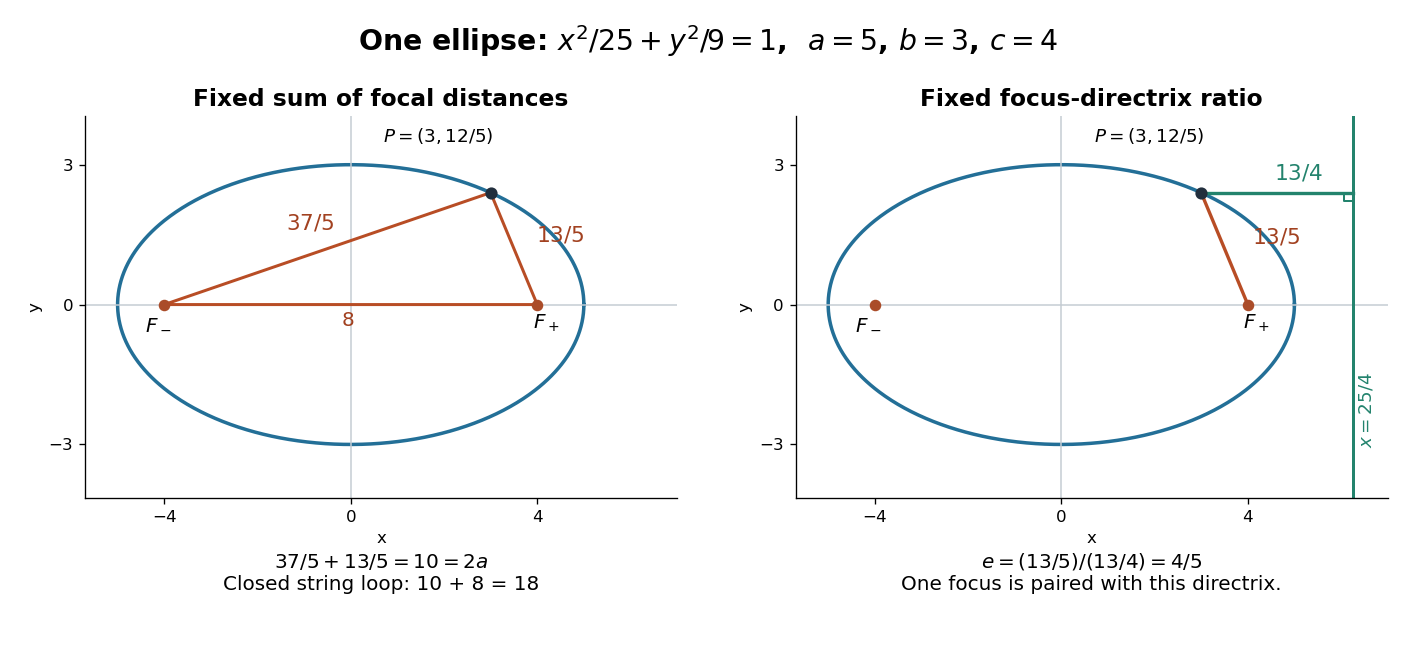
The constant sum can be turned into a construction. Fix a pin at each focus of a conic and pull a closed string loop taut with a pencil. In this example the segment between the pins has length , so a loop of length leaves for the two pencil-to-pin segments. Moving the pencil while keeping that loop taut traces the ellipse. This is a geometric prediction from the length constraint, not an assertion about a measured drawing.
The parametrization , maps the unit circle onto this ellipse. It makes plotting easy, but is an affine map rather than an isometry: horizontal and vertical lengths have different scale factors. An ellipse is not a circle under the original Euclidean metric merely because this map exists. Its two semiaxes and eccentricity of a conic retain the metric information lost by that equivalence.
A useful proof outline begins with . Isolate one square root, square, and then repeat; the resulting quadratic equation is . Since , the quantities isolated before squaring have the required signs, so the reverse implication introduces no extra branch. The condition is essential: at equality the focal-distance locus becomes the line segment between the foci of a conic.
An ellipse is a constant sum of distances to its foci. Its outward normal vector is parallel to the sum of the two unit vectors pointing from the foci to a boundary point. The tangent is therefore equally inclined to the two focal lines. Reflecting an incident unit ray from one focus across this normal gives the direction toward the other focus. Every such one-reflection path has length , giving equal travel time in a homogeneous medium. Finite-wavelength wave focusing is limited by diffraction.
The center of an ellipse is its unique center of symmetry. In the equation , with a symmetric positive-definite matrix and , reflection preserves the ellipse. For , completing the square gives .
For a two-dimensional symmetric positive-definite matrix and , the region is a filled ellipse of area . By the spectral theorem for real symmetric matrices, an orthogonal change of coordinates gives positive eigenvalues and semiaxes and . Their product and the area of an ellipse prove the formula. Translating the center of an ellipse leaves the area unchanged.
The region , , has area . The linear map sends the unit disk onto that region and multiplies area by its Jacobian determinant .
The Steiner inellipse of a nondegenerate triangle is the unique ellipse of largest area contained in the triangle. Its center is the centroid, and it touches each side at its midpoint.
Let a radius- circle have center , and apply the real affine map . If is invertible, substitute into to obtain the displayed ellipse. Its center is and its semiaxes are times the two singular values of , as follows from the singular value decomposition. A rotation or reflection preserves both semiaxes and hence gives another circle. If has rank one, the image is a segment; rank zero gives one point. This real-plane description also handles maps that stretch real and imaginary coordinates differently and are not holomorphic complex maps.
The semi-major and semi-minor axes are the larger and smaller half-axis lengths of an ellipse. In principal-axis coordinates the ellipse has equation with . The same terminology is used for a hyperbola , where is half its transverse axis and half its conjugate axis. Orbital semiaxes apply these geometric quantities to conic sections.
For an ellipse with semiaxes , the perimeter integral has integrand . The uniformly convergent binomial series near permits termwise integration. Integrals of and over a full period give the displayed first corrections. The same coefficients follow from the Frobenius method for the transformed perimeter equation.
A nondegenerate ellipse has two positive semiaxis lengths. It is a smooth closed curve rather than a point or line segment.
Parametrize one ellipse as and substitute it into the quadratic equation of the other. At a transverse intersection, has a simple zero, so its sign changes. Periodicity makes the number of zeros even. The function is a trigonometric polynomial of degree at most two, so multiplication by , with , gives a nonzero polynomial of degree at most four. Hence there are at most four distinct intersection points. Coincident ellipses are excluded by transversality.
The focal line of an ellipse is the straight line through its two foci.
Articles by others on the same topic



A conic section, or simply a conic, is a curve obtained by intersecting a right circular cone with a plane. Depending on the angle and position of the plane relative to the cone, the intersection can generate different types of curves. There are four primary types of conic sections: 1. **Circle**: A circle is formed when the intersecting plane is perpendicular to the axis of the cone. All points on the circle are equidistant from a central point.