Current distortion factor
ID: current-distortion-factor

The current distortion factor is the ratio , where is the root mean square magnitude of the fundamental electric current component and is the root mean square magnitude of the complete electric current. Its square is the fraction of the current's mean square supplied by the fundamental component. This ratio is distinct from displacement power factor, which measures the relative phase of the fundamental potential difference and current.
Use a Fourier series at fundamental frequency :Here is the DC component and the are RMS magnitudes of harmonic components. Averaging over a complete period, orthogonality and the Parseval identity giveFor purely sinusoidal electric potential difference , only the fundamental electric current contributes to active power:Thus a displacement power factor of one can coexist with a lower total power factor.
For , use fundamental-normalized current total harmonic distortion, . The relation between current distortion factor and THD with DC current isWith zero DC component, this reduces to . The definition of RMS here includes the DC component. For example, a 10 ampere fundamental and 3 ampere DC component, with no higher harmonic components, have zero total harmonic distortion but .
For an original zero-mean waveform, take a 230 volt RMS sinusoidal supply, , , and RMS third/fifth harmonic components of 6 and 3 amperes. ThenThe active power is 1840 watts, apparent power is about 2769.57 volt-amperes and total power factor is about 0.6644. This is an illustrative waveform model, not a measurement of a particular rectifier.
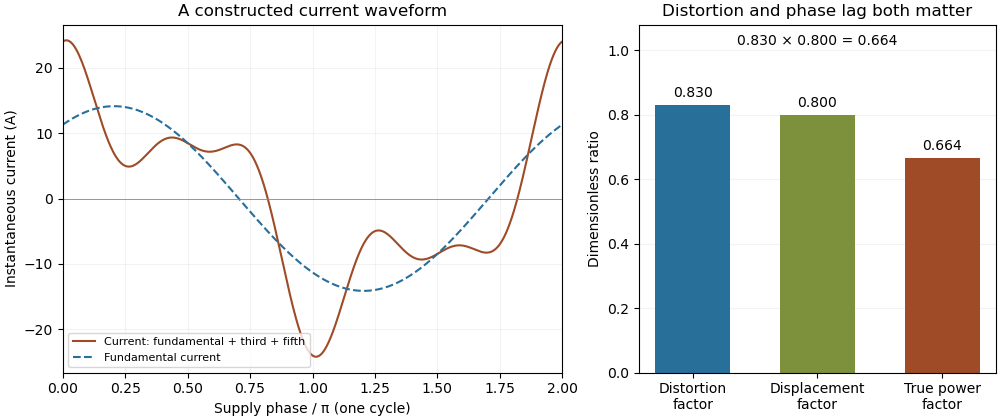

Terminology requires care. Overview of Functions: Harmonic Measurements by Schneider Electric uses distortion factor for the ratio of power factor to the fundamental cosine. Power Quality Considerations by Schneider Electric uses the label for harmonic content relative to the fundamental, or total harmonic distortion. The defining ratio identifies the intended quantity.
If the supply also contains harmonic components, use the harmonic active power sum:with matching voltage/current phase conventions. The fundamental-only factorization above assumes a purely sinusoidal supply.
New to topics? Read the docs here!