Darcy flow through a homogeneous slab
ID: darcy-flow-through-a-homogeneous-slab

Consider a horizontal slab of fully saturated sand with uniform intrinsic permeability of a porous medium , length , total cross-sectional area , and porosity . Use one Newtonian fluid with mass density and dynamic viscosity . Prescribe inlet and outlet gauge fluid pressures and , with no sources or leaks and steady incompressible flow. The two ends have the same elevation, so gravity has no component along the slab. Mass conservation makes the axial Darcy flux constant, and Darcy law then gives a linear fluid pressure profile:The measured volume flux and mean pore velocity areThe slab's total volume is , of which is pore volume. In the ideal uniform advective model, a nonreacting tracer has transit time , consistent with pore volume divided by volume flux, . The incorrect substitution of Darcy velocity for pore velocity would give , four times too long. Real passages have different path lengths and local speeds; these numbers describe a bulk mean rather than every particle's journey.
As an independent check, gravitational acceleration magnitude gives hydraulic conductivity , hydraulic head drop , and again. If a representative pore size is , the Reynolds number convention based on pore velocity gives , supporting neglect of pore inertia. This size is an illustrative extra measurement, not something determined by porosity and intrinsic permeability of a porous medium alone.
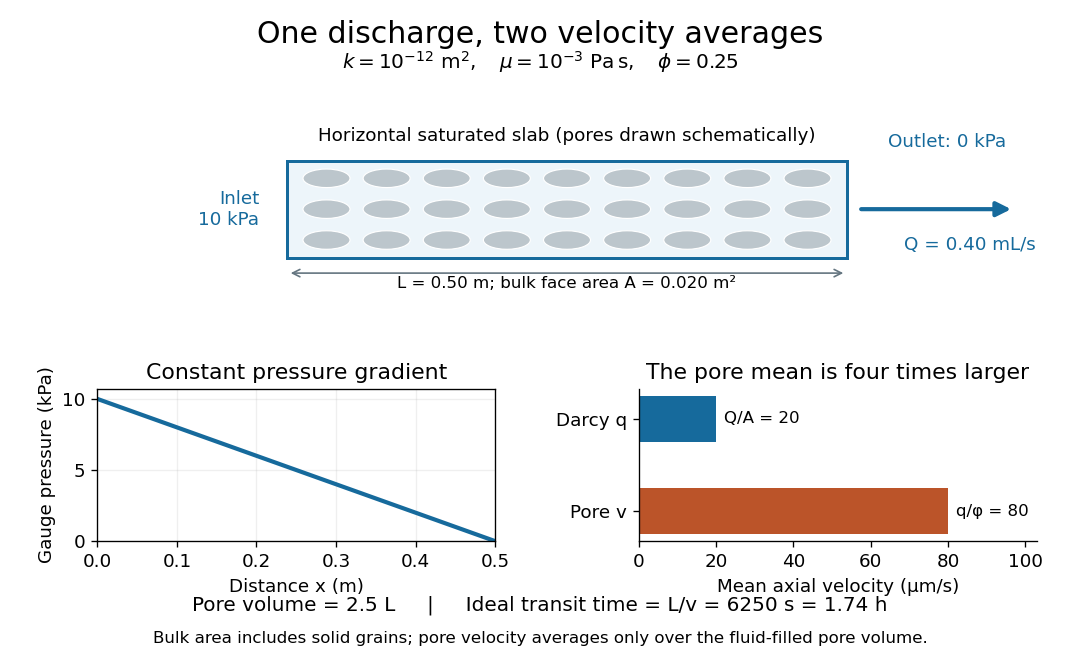
The same discharge gives different Darcy and pore velocities
. Details. 
Regenerate the diagram by running
python ../darcy-flux-and-pore-velocity.py from _media; it writes its PNG into the current directory. New to topics? Read the docs here!