Detector volume averaging
ID: detector-volume-averaging

Detector volume averaging is the spatial averaging of a nonuniform radiation field over a detector's finite sensitive region. A reading associated with the detector centre need not equal the local absorbed dose at that point. This limits spatial resolution even if the detector position and electronic readout are exact.
For an idealized linear response, let be the absorbed dose field in the undisturbed medium and let be a normalized spatial weighting function, with . Model the spatially averaged quantity byThe model separates averaging from the change in the radiation field caused by inserting the detector. A real ionization chamber can require both effects to be considered. The IAEA definition compares a point dose with the average over the detector's sensitive volume, both evaluated in water with the detector absent.[ref]
Dosimetry of Small Static Fields Used in External Beam Radiotherapy by the International Atomic Energy Agency. §3.1.4, printed p. 37, definition and spatial weighting in equation (5)
For an original one-dimensional example, suppose the detector averages uniformly over a full width . ThenAn ideal sharp edge , where is the Heaviside step function, is recorded asThus a detector gives a distance between the 20-percent and 80-percent response points, although the stipulated field edge has zero transition width. A detector gives in the same model.
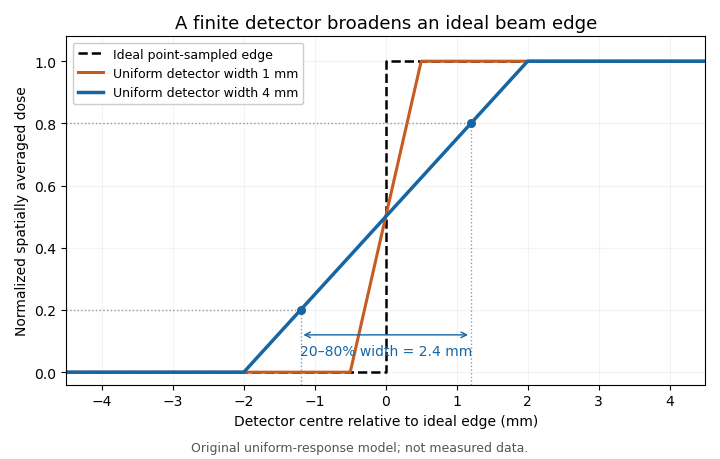
Uniform finite-detector averaging turns a sharp radiation-field edge into a ramp. Original model calculation; the indicated 2.4 mm width belongs to the 4 mm detector, not to an intrinsic field transition.
Details. 
For a smooth field, a Taylor expansion under the symmetric uniform weighting gives . A constant slope averages to its centre value; curvature produces the leading local discrepancy. A detector-volume-averaging correction factor therefore depends on the field shape and detector geometry, rather than only on the detector's nominal volume.
A proposed apparatus test scans a stable radiation field with detectors of different effective widths or orientations, keeping depth and irradiation geometry fixed. Changes in the recorded edge width test spatial response, while a uniform region checks relative sensitivity. The IAEA's geometric weighting examples show why a projected detector area may need nonuniform weighting; finer scan steps alone cannot remove averaging within each reading.[ref]
New to topics? Read the docs here!