Dirichlet convolution
ID: dirichlet-convolution

The Dirichlet convolution of arithmetic functions is the arithmetic functionIn the first sum, runs over the positive integer divisors of ; the second uses ordered pairs of positive integers whose product is . Both sums are finite. Each pair contributes one weight from and one from , so Dirichlet convolution combines information attached to complementary factors. It turns a divisor sum into an operation on arithmetic functions. [ref]
https://darijgrinberg.gitlab.io/floor.pdf. Darij Grinberg, MIT 18.781 lecture notes, Sections 2.3 and 2.4: Dirichlet convolution and examples
For the six ordered pairs are . The constant-one arithmetic function gives one per pair, while the identity arithmetic function weights the first factor by its size:Here is the divisor function and is the sum-of-divisors function. By comparison, the pointwise product of arithmetic functions gives and .
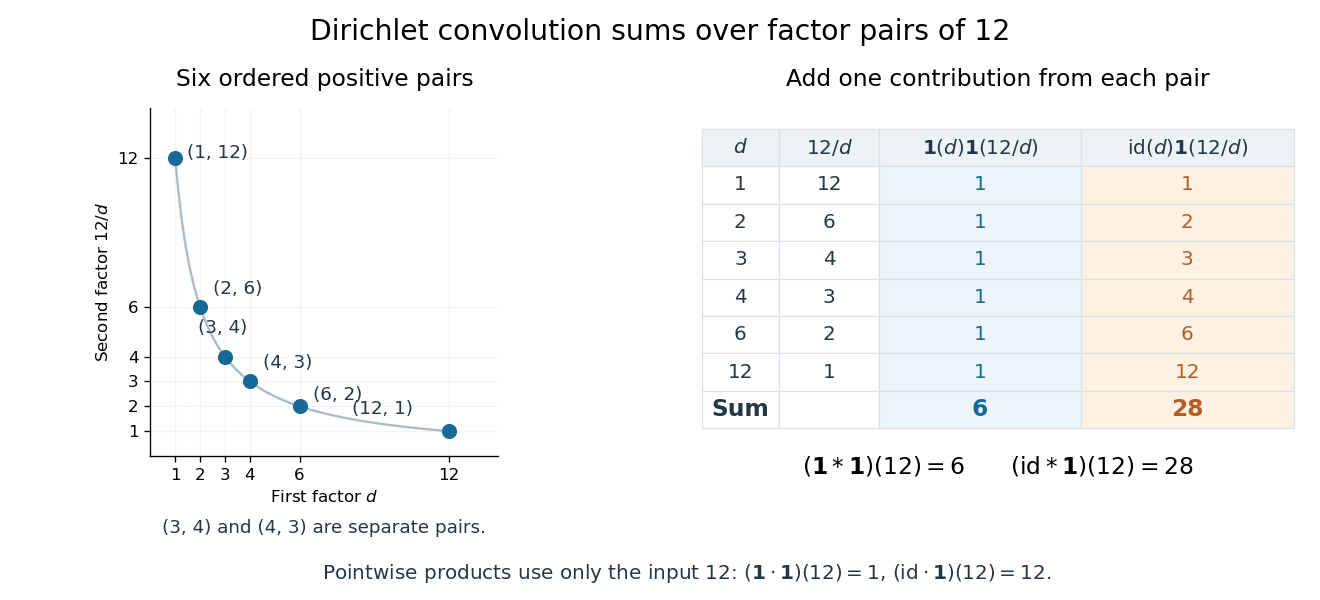
Six ordered pairs of positive integers with product 12 contribute to Dirichlet convolution: one per pair for the divisor function, or the first factor for the sum-of-divisors function
. Details. 
Commutativity follows by swapping the two entries of every ordered pair. Associativity follows by reindexing either grouping over the same ordered tuples of three positive integers:For example, counts ordered tuples of three positive integers with product . Distribute the two occurrences of the prime factor among three entries in ways, and the one occurrence of the prime factor in ways. These binomial coefficients are the stars and bars counts of exponent choices in the nonnegative integers; prime factorization therefore gives such tuples. Directly, the same Dirichlet convolution is .
The Identity for Dirichlet convolution is , and the Möbius function reverses a divisor sum because . This makes Dirichlet convolution useful both for counting factorizations and for recovering an arithmetic function from its divisor sum.
New to topics? Read the docs here!