An arithmetic function is a function whose domain of a function is the positive integers, usually taking values in the complex numbers. Thus are its values; is outside this domain of a function. Examples include the divisor function, with , and the sum-of-divisors function, with . Studying an arithmetic function packages a question about each positive integer into one object whose values can be combined using Dirichlet convolution. [ref]
https://darijgrinberg.gitlab.io/floor.pdf. Darij Grinberg, MIT 18.781 lecture notes, Section 2.1: arithmetic functions
The radical of an integer is the product of its distinct prime factors, each included exactly once. If the prime factorization is with distinct prime numbers and positive integer exponents , thenThus the radical of an integer remembers which prime factors occur and forgets their prime valuations. At , the empty product gives . The domain of a function here is the positive integers; zero is excluded. [ref]
https://pub.math.leidenuniv.nl/~evertsejh/dio12-ex4.pdf. Jan-Hendrik Evertse, Diophantine approximation, Homework IV, Exercise 20: definition of the integer radical
For example, has distinct prime factors , so . Similarly,using the prime factorizations , and . The prime omega function counts the retained prime factors, while the total number of prime factors counts their occurrences before repetitions are removed.
The radical of an integer is its largest squarefree divisor. Indeed, a squarefree divisor chooses at most one copy of each prime factor, so it divides ; the radical of an integer itself is a squarefree divisor. Consequently,The last statement follows because every nonzero prime valuation is then one. It includes , a squarefree integer. Applying the radical of an integer twice also changes nothing: .
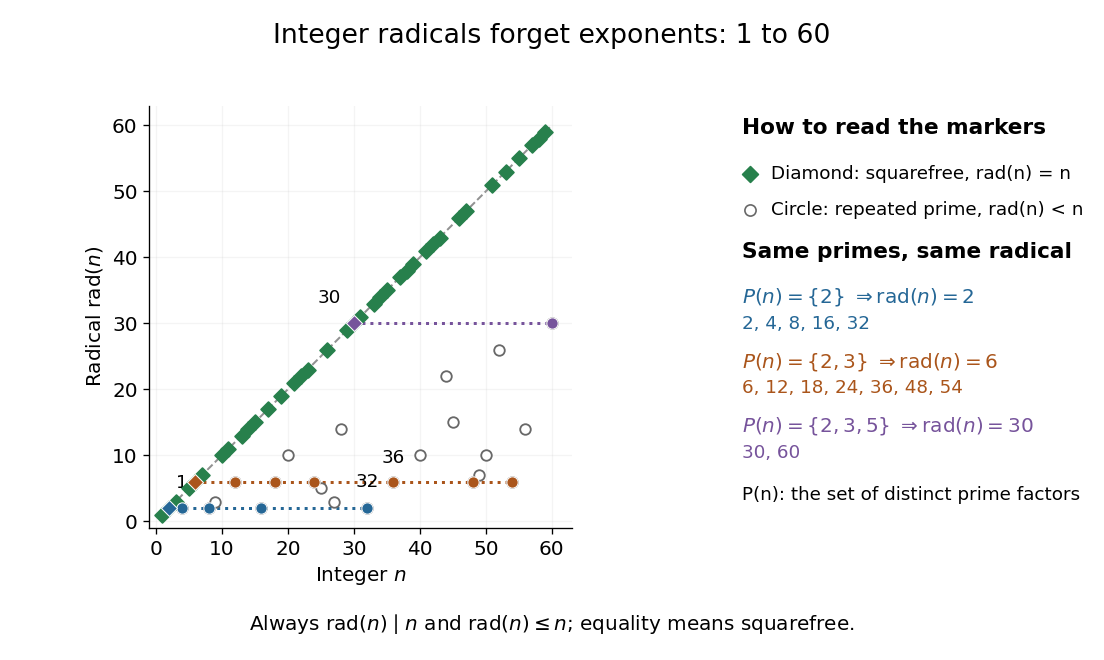
The radical of an integer for : squarefree integers lie on the diagonal, and horizontal families share their prime support of an integer
. Details. For any positive integers , the exact product rule isTo prove it, a prime factor dividing just one input occurs once in the numerator and not in the denominator. A prime factor dividing both occurs twice in the numerator and once in the denominator, since it divides their greatest common divisor. Each prime factor of therefore remains exactly once. For coprime integers, the denominator is , proving the radical of an integer is a multiplicative function. It is not a completely multiplicative function: .
For a worked example with shared prime factors, take and . Their greatest common divisor is , and , soThis explains why prime support of an integer is useful: questions about the presence of prime factors can discard their multiplicities. For example, the squarefree divisors of are exactly the integer divisors of , namely . Also if and only if , because coprimality depends only on shared prime factors.
A further characterization uses mutual divisibility of powers: for positive integers ,If their prime supports of an integer agree, sufficiently large make all the required prime valuations large enough. Conversely, these two divisibility relations force each prime factor of either input to divide the other. For and , one can take and : and .
The prime support of an integer is the finite set of its distinct prime factors. For example, , and is the empty set. Its cardinality is the prime omega function , and the product of its elements is the radical of an integer . These are two different ways to summarize the same finite set: a count and a product.
The total number of prime factors counts every occurrence of a prime factor in the prime factorization of a positive integer . Equivalently, it adds the prime valuations:One may also write over all prime numbers, since only finitely many prime valuations are nonzero. The empty sum gives . By contrast, the prime omega function has and counts distinct prime factors. [ref]
https://darijgrinberg.gitlab.io/floor.pdf. Darij Grinberg, MIT 18.781, Floor and arithmetic functions, Definition 2.1.2: the two prime-factor counts
Expanding into shows , whereas and . The same calculation for the comparison examples givesThe total number of prime factors agrees for and , although their prime supports of an integer differ. Meanwhile and have the same radical of an integer and prime omega function, but different values of the total number of prime factors. These examples show exactly which information each arithmetic function forgets.
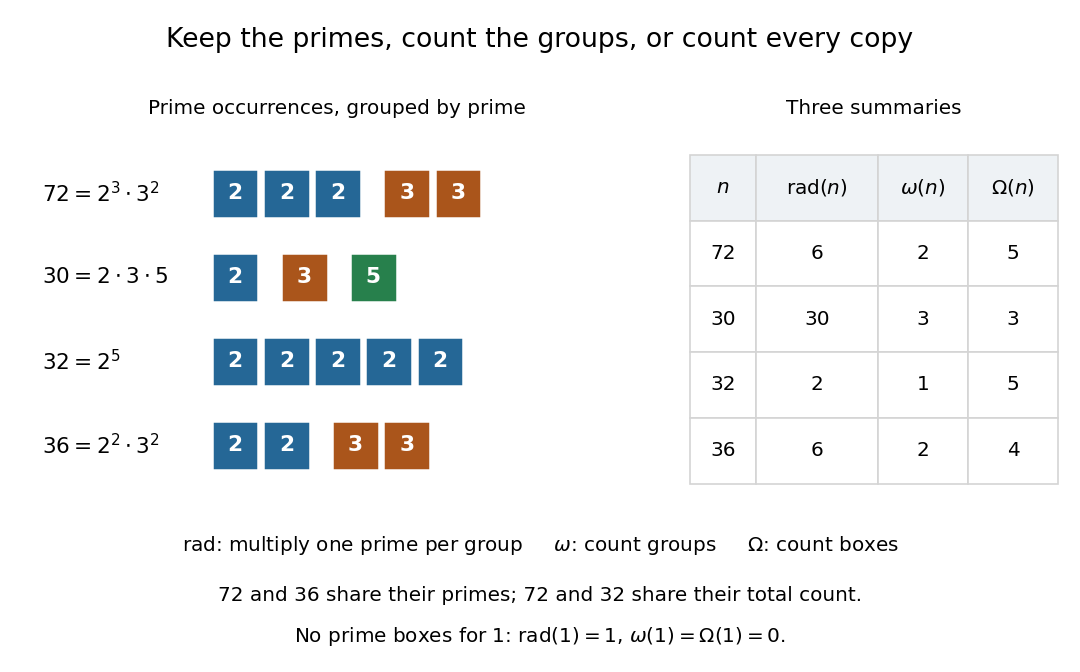
One box per prime factor occurrence: the total number of prime factors counts boxes, the prime omega function counts groups, and the radical of an integer multiplies one prime number from each group
. Details. The total number of prime factors is a completely additive arithmetic function:The proof is that multiplication adds each prime valuation, , and summing preserves that equality. No coprimality condition is needed. For example, and both have total number of prime factors three; their product has six. By comparison, the prime omega function is only an additive arithmetic function: here .
There is a useful way to see the total number of prime factors as a count of elementary building blocks: any expression of as a product of prime numbers has exactly factors, by the fundamental theorem of arithmetic. Equivalently, every factorization tree for has leaves. Repeated prime factors increase this count without introducing new kinds of prime number. The difference is the existing excess prime-factor multiplicity:Every summand is nonnegative, so if and only if is a squarefree integer, including . In particular, a prime power with has , and .
Historically, Hardy and Ramanujan's 1917 paper explicitly separated the prime omega function from the total number of prime factors, writing them as and , respectively. Their example has counts three and six. That distinction let them compare two measures of how an integer is built from prime factors. [ref]
https://ramanujan.sirinudi.org/Volumes/published/ram35.html. G. H. Hardy and S. Ramanujan, The normal number of prime factors of a number n, Quarterly Journal of Mathematics 48 (1917), 76–92, Section 1.2, transcribed original text
The nonnegative arithmetic function counts the repeated occurrences beyond the first of each prime factor. Its expectation under uniform sampling from is bounded by , independently of .
An arithmetic function is additive when for coprime integers . Equivalently, . This concerns multiplication of integers, and differs from an additive function on a vector space.
A strongly additive arithmetic function satisfies for every prime and , so . The prime omega function is an example.
A completely additive arithmetic function satisfies for all positive , equivalently . The total number of prime factors is an example.
An arithmetic function is a multiplicative function when and for all coprime integers , meaning their greatest common divisor is . The condition excludes the identically zero function. This definition makes no assertion about a pair whose greatest common divisor exceeds . [ref]
https://darijgrinberg.gitlab.io/floor.pdf. Darij Grinberg, MIT 18.781 lecture notes, Definition 2.2.1
For the divisor function, the integer divisors of are , those of are , and those of are . HenceHere and are coprime integers. In contrast, , because the integer divisors of are . Thus the divisor function is a multiplicative function but not a completely multiplicative function.
The practical gain is that prime factorization reduces all values to values at prime powers. For distinct prime numbers and positive exponents ,For instance, since and are coprime integers; replacing by additionally requires a completely multiplicative function. The short proof repeatedly applies the defining rule to prime powers belonging to different prime numbers, which are coprime integers.
For an arithmetic function, multiplicativity means and whenever are positive coprime integers. It allows values of an arithmetic function to be assembled from its values on prime powers, as explained under multiplicative function.
An arithmetic function is a completely multiplicative function when and for every pair of positive integers . In particular for every prime number and every nonnegative exponent . Both the constant-one arithmetic function and the identity arithmetic function are completely multiplicative functions: and . The divisor function fails this stronger condition at .
The divisor sum of an arithmetic function assigns to each positive integer the sumOnly positive integer divisors are included, so . The weights can count the integer divisors, measure their sizes, or record other arithmetic information: the constant-one arithmetic function gives the divisor function, whereas the identity arithmetic function gives the sum-of-divisors function.
Equivalently, , where is Dirichlet convolution and is the constant-one arithmetic function. If is a multiplicative function, then is a multiplicative function by Multiplicativity of Dirichlet convolution. [ref]
https://darijgrinberg.gitlab.io/floor.pdf. Darij Grinberg, MIT 18.781 notes on floor and arithmetic functions, Proposition 2.4.2 and Theorem 2.6.1
Here is the mechanism. For positive coprime integers , every positive integer divisor of has a unique form with and ; moreover, are coprime integers. Thus a multiplicative function satisfiesAt a prime power, the divisor sum becomes . This turns a calculation over many integer divisors into short local calculations at prime powers.
The sum-of-divisors function adds all positive integer divisors of a positive integer, including the number itself:It is the divisor sum of the identity arithmetic function , so under Dirichlet convolution. Both factors are multiplicative functions, hence so is the sum-of-divisors function. The notation distinguishes it from other weighted divisor sums. [ref]
https://darijgrinberg.gitlab.io/floor.pdf. Darij Grinberg, MIT 18.781 notes, Definition 2.1.2 and Proposition 2.2.2(e)
For a prime number and a nonnegative exponent , the positive integer divisors of the prime power are precisely . Their finite geometric series givesFor example, . For a prime factorization with distinct prime numbers and positive exponents , multiplicativity givesFor , this is an empty product, equal to . [ref]
https://darijgrinberg.gitlab.io/floor.pdf. Darij Grinberg, MIT 18.781 notes, Theorem 2.1.8 with k equal to one
The distributive property makes the formula especially beautiful: choosing one term from each factor produces each positive integer divisor exactly once, by the fundamental theorem of arithmetic. For , the choices form a three-by-two grid with entries , where and . Adding its rows givesThe divisor function counts six cells; the sum-of-divisors function adds their six values. Once the prime factorization is known, the product formula avoids testing every candidate integer divisor. Shared prime factors require care: , so the sum-of-divisors function is not a completely multiplicative function.
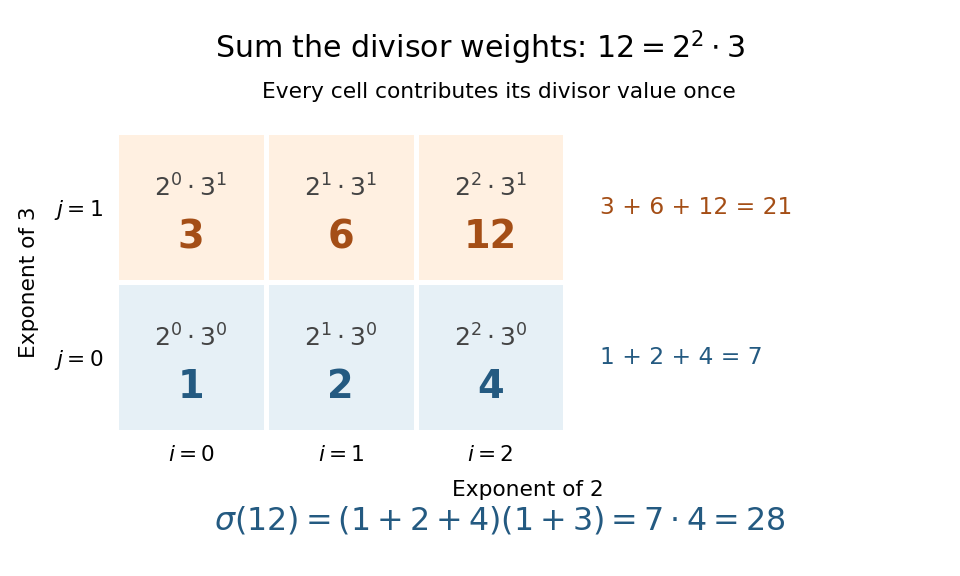
The sum-of-divisors function for : each grid entry is a positive integer divisor, and the weighted total is
. Details. Subtracting the number itself gives the proper-divisor sum . Comparing with distinguishes perfect numbers, deficient numbers, and abundant numbers. For , ; for , . Both are perfect numbers. The calculation makes a deficient number, while makes an abundant number. These comparisons turn the sizes of integer divisors into a classification of positive integers. [ref]
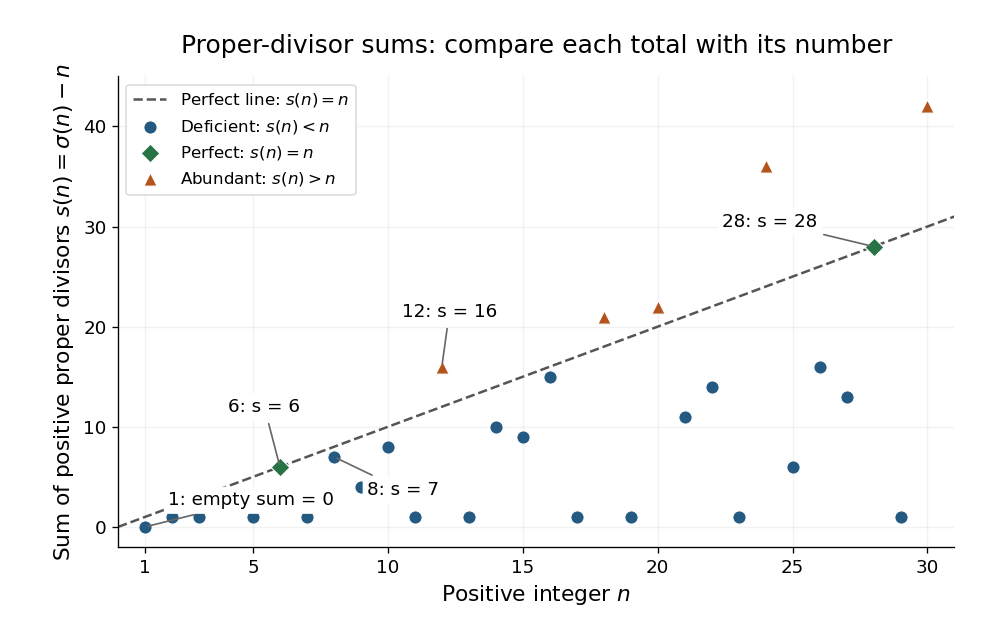
The proper-divisor sum for : perfect numbers lie on , deficient numbers below it, and abundant numbers above it
. Details. This connection is ancient: Euclid's Elements, Book IX, Proposition 36, constructs a perfect number by multiplying the last term of by their sum, when that sum is a prime number. In modern notation, put and , with and a prime number. The sum-of-divisors function proves the construction immediately:Consequently the proper-divisor sum is . Taking produces the perfect numbers . [ref]
Book IX, Proposition 36. Euclid, Elements IX.36, translated text and commentary by David Joyce
The proper-divisor sum, or aliquot sum, adds the positive proper divisors:In particular , an empty sum. Removing from the sum-of-divisors function is essential: , but its proper-divisor sum is .
For multiplicative functions bounded by one, the pretentious distance up to is defined byIt measures how similarly and behave on primes.
Let , and let be a normalized multiplicative arithmetic function supported on squarefree integers, with . Form the finite measure using Dirac measures. Under the transform convention , its Euler product is . Expanding its logarithmic modulus, and replacing the damped prime weights by up to with Mertens first theorem, gives the displayed absolute bound, uniformly in real . Hence forces . The distance expression still defines a nonnegative pretentious score for prime values bounded by one; its actual metric interpretation uses unit-modulus values.
Because , the squared pretentious distance from one to the Möbius function is twice the reciprocal-prime sum. The Mertens second theorem therefore gives . In particular the distance diverges, illustrating that a multiplicative function can be far from the constant function even though both have unit-modulus prime values.
For unit-modulus prime values, pretentious distance is the Euclidean metric on the finite vectors . On whole arithmetic functions it is only a pseudometric: it sees neither values on prime powers nor primes above the cutoff. Even for every cutoff, the functions one and have distance zero but differ on nonsquarefree integers. The norm representation proves the triangle inequality and identifies exactly the quotient on which separation holds.
The pretentious distance obeys
An Archimedean character on the positive integers is the completely multiplicative function for a real parameter .
Halász's theorem bounds the mean of a bounded multiplicative arithmetic function in terms of its least pretentious distance from an Archimedean character. A large mean can occur only when this distance is small.
The Möbius function stays far in pretentious distance from every Archimedean character. One useful uniform form isThis follows by estimating the prime sum .
The pointwise product of arithmetic functions multiplies two arithmetic functions at the same input: . Thus and , using the constant-one arithmetic function and the identity arithmetic function. These differ from the corresponding Dirichlet convolution values and , because Dirichlet convolution sums over every positive integer divisor.
The Dirichlet convolution of arithmetic functions is the arithmetic functionIn the first sum, runs over the positive integer divisors of ; the second uses ordered pairs of positive integers whose product is . Both sums are finite. Each pair contributes one weight from and one from , so Dirichlet convolution combines information attached to complementary factors. It turns a divisor sum into an operation on arithmetic functions. [ref]
https://darijgrinberg.gitlab.io/floor.pdf. Darij Grinberg, MIT 18.781 lecture notes, Sections 2.3 and 2.4: Dirichlet convolution and examples
For the six ordered pairs are . The constant-one arithmetic function gives one per pair, while the identity arithmetic function weights the first factor by its size:Here is the divisor function and is the sum-of-divisors function. By comparison, the pointwise product of arithmetic functions gives and .
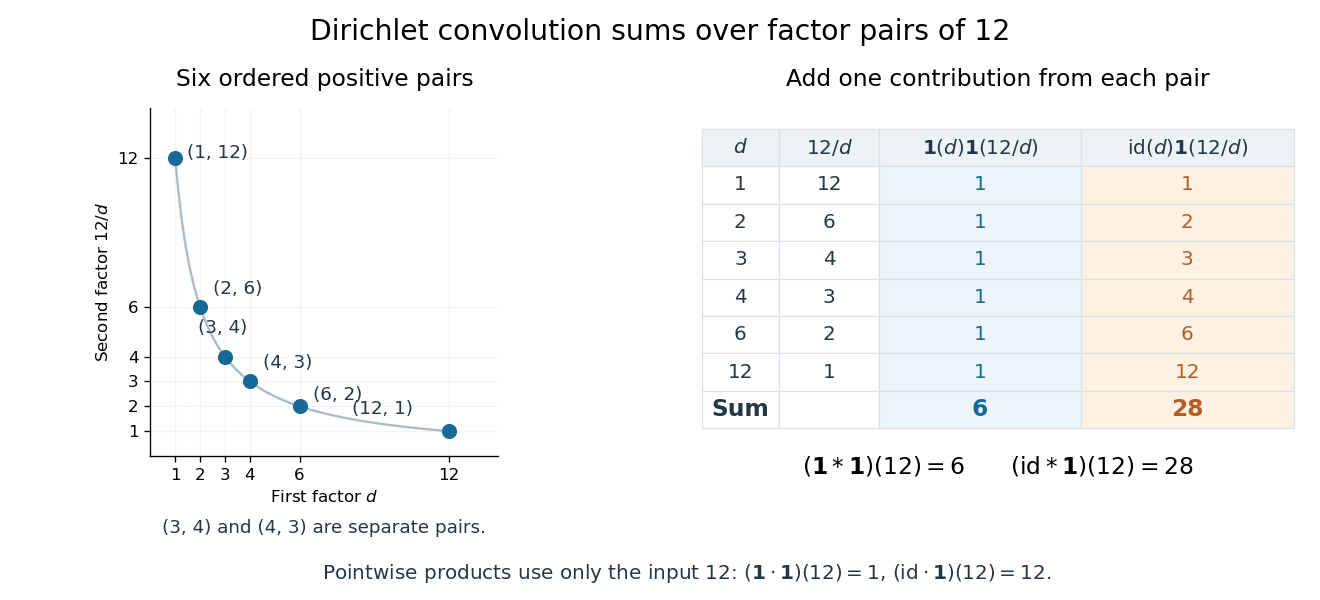
Six ordered pairs of positive integers with product 12 contribute to Dirichlet convolution: one per pair for the divisor function, or the first factor for the sum-of-divisors function
. Details. Commutativity follows by swapping the two entries of every ordered pair. Associativity follows by reindexing either grouping over the same ordered tuples of three positive integers:For example, counts ordered tuples of three positive integers with product . Distribute the two occurrences of the prime factor among three entries in ways, and the one occurrence of the prime factor in ways. These binomial coefficients are the stars and bars counts of exponent choices in the nonnegative integers; prime factorization therefore gives such tuples. Directly, the same Dirichlet convolution is .
The Identity for Dirichlet convolution is , and the Möbius function reverses a divisor sum because . This makes Dirichlet convolution useful both for counting factorizations and for recovering an arithmetic function from its divisor sum.
The Dirichlet convolution of two multiplicative functions is a multiplicative function. For positive coprime integers , every positive integer divisor of has a unique form with and , by prime factorization. The pairs and are each coprime integers, so the defining rules for the two multiplicative functions separate the sum:Also . This short argument proves multiplicativity of both the divisor function and the sum-of-divisors function . The result need not be a completely multiplicative function, even when both inputs are: fails at . [ref]
The constant-one arithmetic function has for every positive integer , including . It is a completely multiplicative function. Its Dirichlet convolution with an arithmetic function is the divisor sum . Thus , the divisor function. Its pointwise product of arithmetic functions with is itself; its Dirichlet convolution with generally is not. The Identity for Dirichlet convolution is instead .
The identity arithmetic function is on the positive integers, for example and . It is a completely multiplicative function and gives the sum-of-divisors function through under Dirichlet convolution. It is distinct from the Identity for Dirichlet convolution . The identity , where is Euler's totient function, is equivalent to .
The Identity for Dirichlet convolution is the arithmetic functionFor every arithmetic function , it satisfies . Indeed, in , only survives. For example,At the sole term is . This gives a useful way to check Dirichlet convolution calculations: inserting leaves every value unchanged. The three arithmetic functions , , and all take value at , but at the constant-one arithmetic function, the identity arithmetic function, and the Identity for Dirichlet convolution take values , , and , respectively. [ref]
The Möbius function is the inverse of the constant-one arithmetic function under Dirichlet convolution, meaning . The Möbius divisor-sum identity gives a short proof: for the nonzero terms expand , while at the sum is . At , the computation isThe zeros occur because and are divisible by the square of the prime number . Consequently, if is a divisor sum, then associativity gives : this is Möbius inversion.
The Dirichlet hyperbola method turns a long summation over a Dirichlet convolution into two short ones by covering the lattice points below a hyperbola with two overlapping strips. Its simplest application is an exact count: for a positive integer , every positive integer divisor of corresponds to the ordered pair . Thus the divisor summatory function counts precisely the ordered pairs of positive integers with :Here is the divisor function, and the floor function gives the number of allowed values of for each . The axes are excluded, while points on are included.
Set , using the floor function and the positive square root. Every counted pair has or . Otherwise . The first strip contains points; swapping the two coordinates gives the same count for the second. Their overlap contains all pairs with , since . The inclusion-exclusion principle therefore gives the exact identityThe subtraction is for the whole overlap square, rather than only the diagonal. The same Dirichlet hyperbola method identity holds for real , with and . [ref]
Multiplicative number theory: The pretentious approach by Andrew Granville and K. Soundararajan. Andrew Granville and K. Soundararajan, Multiplicative number theory: The pretentious approach, §1.1.4, pp. 7–8: divisor pairing and the hyperbola split
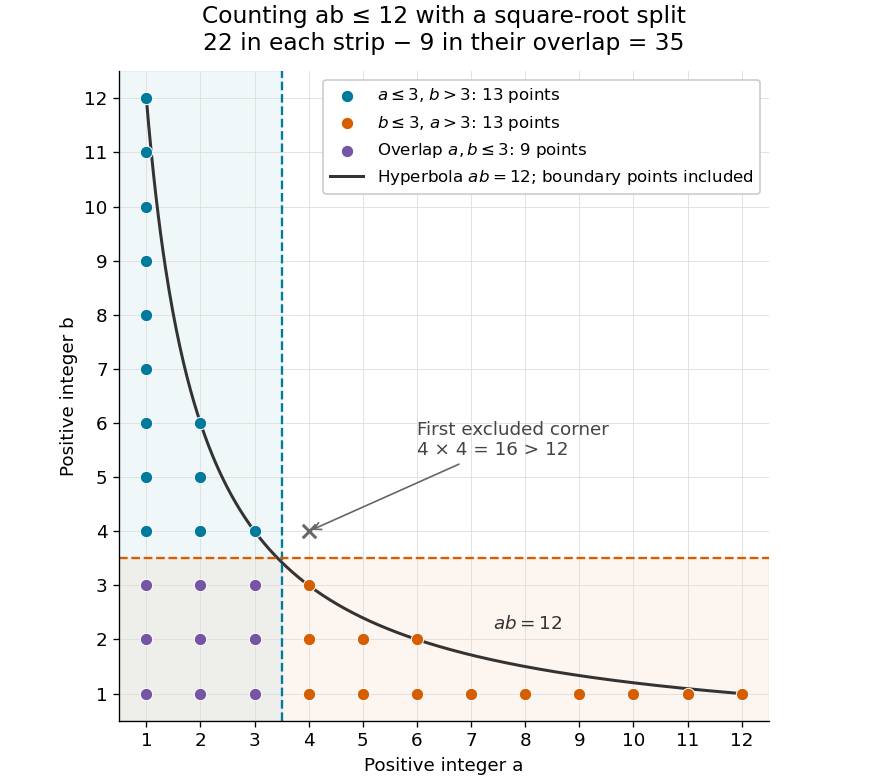
The Dirichlet hyperbola method counts 35 positive lattice points with : two strips of 22 points overlap in a square of nine points
. Details. The divisor summatory function adds the divisor function up to a cutoff . It counts all ordered pairs of positive integers whose product is at most . For , the twelve individual divisor function values areCounting columns of lattice points instead gives . The Dirichlet hyperbola method needs only the first three column counts:The arithmetic work of the Dirichlet hyperbola method is much smaller even though the answer is identical.
This is useful for elementary averages: individual divisor function values fluctuate, but their summation has the regular behavior given by the divisor summatory asymptotic. Dividing that estimate by a positive integer giveswhere is the natural logarithm, is the Euler--Mascheroni constant, and uses big O notation. This describes an average, rather than an estimate for every individual divisor function value. [ref]
A balanced Dirichlet hyperbola method split takes real thresholds . An asymmetric split takes and . Every lattice point with then has or , and every point in their overlap rectangle is allowed because . For arithmetic functions , define their partial sums by and , always over positive integers. The same inclusion-exclusion principle, now with weight , yieldsNo multiplicativity assumption is needed: this is a finite rearrangement of Dirichlet convolution. The constant-one arithmetic function in both positions recovers the divisor summatory function. For , , givesIt uses two columns and six rows, with a twelve-point overlap.
For general positive real thresholds, is sufficient for coverage, since and would imply . If , however, the overlap can include points above the hyperbola. The correct subtraction is then ; the product is justified only when the whole integer rectangle lies below it. For example, , covers every allowed pair, but its rectangle contains the forbidden pair , so subtracting all sixteen points would give instead of .
Conversely, the balanced integer thresholds have and still cover every allowed pair because . More generally, positive integer thresholds give coverage exactly when , and their overlap is a full rectangle exactly when . These discrete conditions explain why the square-root identity works even when .
The direct divisor summatory function formula evaluates floor divisions. Its balanced Dirichlet hyperbola method formula evaluates floor divisions and reuses their sum for the other strip, followed by doubling and square-overlap subtraction. Thus it uses arithmetic operations, with big O notation, in a model that counts each division, addition and multiplication as one operation. At , the division counts for these two formulas are and .
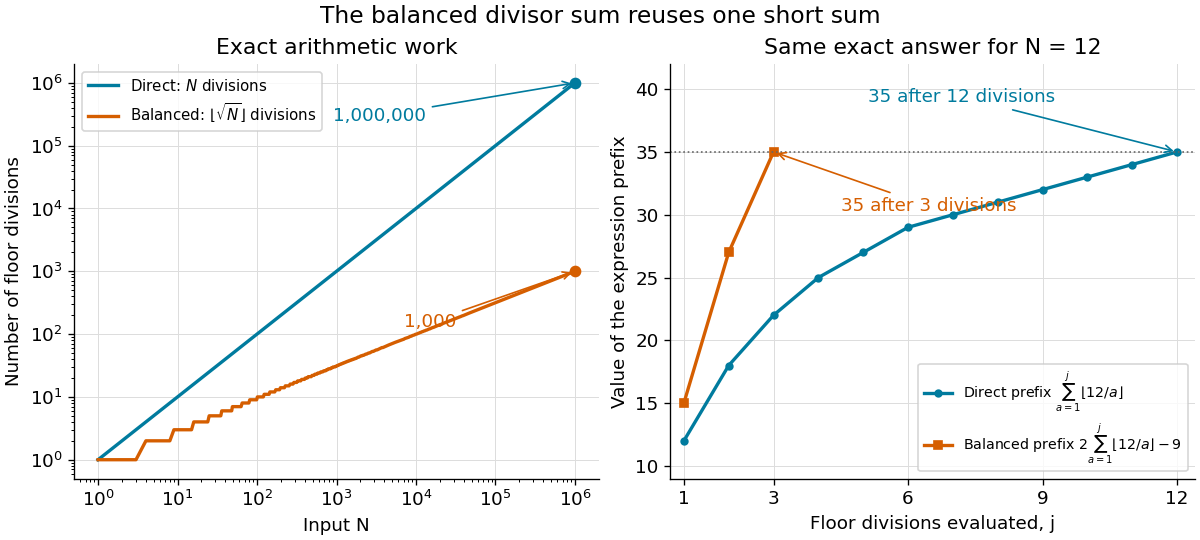
The balanced Dirichlet hyperbola method reduces floor divisions from to ; for , two sequences of partial sums reach the same exact answer 35
. Details. For a general Dirichlet convolution, the asymmetric formula has outer terms; evaluating and has an additional cost. Under , equal thresholds minimize , but an asymmetric split can be useful if the two partial sums have different evaluation costs. The balanced divisor summatory function gains the further reuse because its two arithmetic functions are identical.
These are arithmetic operation counts, rather than counts of elementary operations on binary digits: the integers grow with , and division of longer integers costs more in that model of computational complexity theory. Computing also requires an exact integer square root, or checking and correcting a numerical square root until holds.
The Dirichlet hyperbola method gives , where . The harmonic number estimate , with the Euler's constant, yields . Substitution of gives the displayed asymptotic expansion. Comparison of with its integral consequently gives for integer .
Write and . The weighted Dirichlet hyperbola method givesIndeed, use and . The latter follows by comparing each summand with the integral on its unit interval: the derivative of has an integrable tail. Since , substitution yields the expansion. Here is the harmonic number and the Euler--Mascheroni constant.
The divisor function counts the positive integer divisors of a positive integer . In particular , because has just one positive integer divisor. More generally the notation gives and the sum-of-divisors function . Thus the divisor function counts the positive integer divisors, while adds their sizes. [ref]
https://darijgrinberg.gitlab.io/floor.pdf. Darij Grinberg, MIT 18.781 lecture notes, Definition 2.1.2 and Theorem 2.1.6
If the prime factorization is with distinct prime numbers and positive exponents , thenThe short proof is a count: each positive integer divisor has a unique form , where . There are choices at each prime number, and choosing them gives every positive integer divisor exactly once. For there are no prime factors and the product is .
For , choose and to obtain . The six values are ; sorted, the positive integer divisors are . Therefore . The diagram makes the independent exponent choices visible.
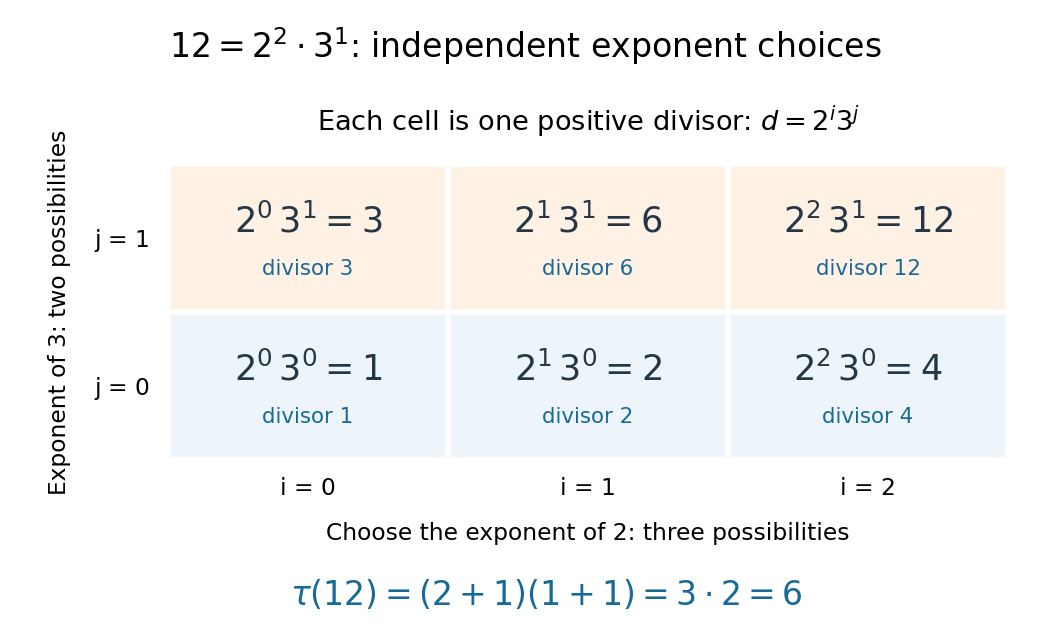
The prime factorization gives a three-by-two array of positive integer divisors , so the divisor function has
. Details. This count is useful because a known prime factorization gives without testing every smaller positive integer for divisibility. It also proves the divisor function is a multiplicative function: coprime integers have disjoint prime factors, so their exponent choices combine. For example , but , so it is not a completely multiplicative function. Equivalently, under Dirichlet convolution, counting ordered pairs of positive integers whose product is .
For each , the divisor function satisfies the displayed bound. Write , so . For all sufficiently large primes, for every . For each of the finitely many smaller primes, is finite. Multiplying these finitely many constants proves the bound. Products of a fixed number of divisor functions obey the same conclusion after reducing .
The Von Mangoldt function assigns a natural logarithm weight to each positive power of a prime number. For a positive integer ,Here and throughout the Chebyshev functions, means the natural logarithm. In particular, : the exponent must be positive, even though the convention in prime power allows exponent zero. The support of a function of therefore consists precisely of the prime powers greater than one. [ref]
For example, and , whereas . A composite number can have a nonzero weight: has just one distinct prime factor. But has two distinct prime factors, so its weight is zero. At the weight is , not . This choice lets successive powers record successive copies of the same prime factor in the Von Mangoldt divisor identity.
The Von Mangoldt function is useful because it connects two views of the prime numbers: the prime factorization of an individual integer, through a divisor sum, and the accumulated weights below a cutoff, through the Second Chebyshev function. The latter turns questions about the distribution of prime numbers into questions about a partial sum of an arithmetic function.
The elementary Selberg symmetry formula can be writtenUse the weights . Their divisor sum is . Apply them to the integrated Chebyshev sum, then use the Möbius harmonic logarithmic moments. The Chebyshev estimate shows this is equivalent, with an error, to .
For every positive integer , the divisor sum of its Von Mangoldt function weights recovers its natural logarithm:The sum runs over the positive integer divisors of . For , its only term is . Equivalently, if and is the constant-one arithmetic function, then , where is Dirichlet convolution. [ref]
For , the positive integer divisors are . Only contribute:Thus the vanishing of loses no information here: the divisor sum retrieves both copies of the prime factor from the integer divisors and .
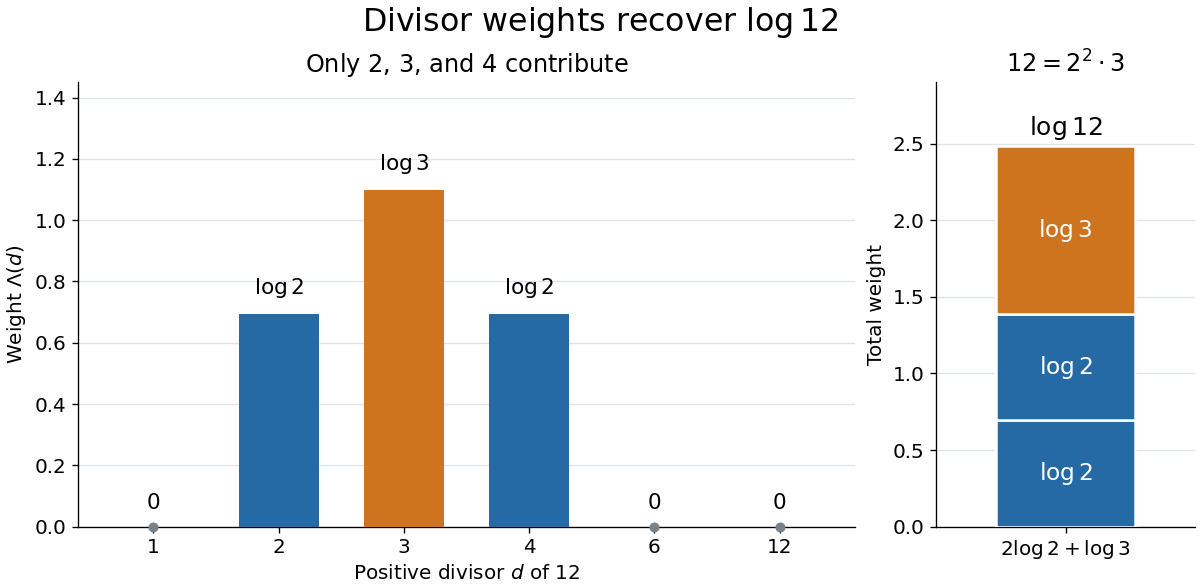
Proof outline: by the fundamental theorem of arithmetic, write with distinct prime numbers and positive exponents . Among the positive integer divisors, the ones with nonzero Von Mangoldt function weights are exactly . ConsequentlyThe natural logarithm turns the prime factorization product into a sum, and the prime powers greater than one supply exactly the required multiplicities.
The two Chebyshev functions measure the total natural logarithm weight of prime numbers or of prime powers greater than one below a real cutoff :Here ranges over prime numbers, over positive integers, and over positive integers. The Chebyshev theta function , also written , weights each prime number once. The Second Chebyshev function weights every positive power of each prime number separately. Both vanish for ; the inclusive cutoff makes them right-continuous functions and nondecreasing functions, constant between their jumps. [ref]
At , the prime numbers are , while the extra prime powers greater than one are . Exactly,At each prime number , both Chebyshev functions jump by . At a prime power with , only the Second Chebyshev function jumps, by . At and neither jumps. Notice that the gap is already positive at and : a shared jump does not remove the earlier contribution from .
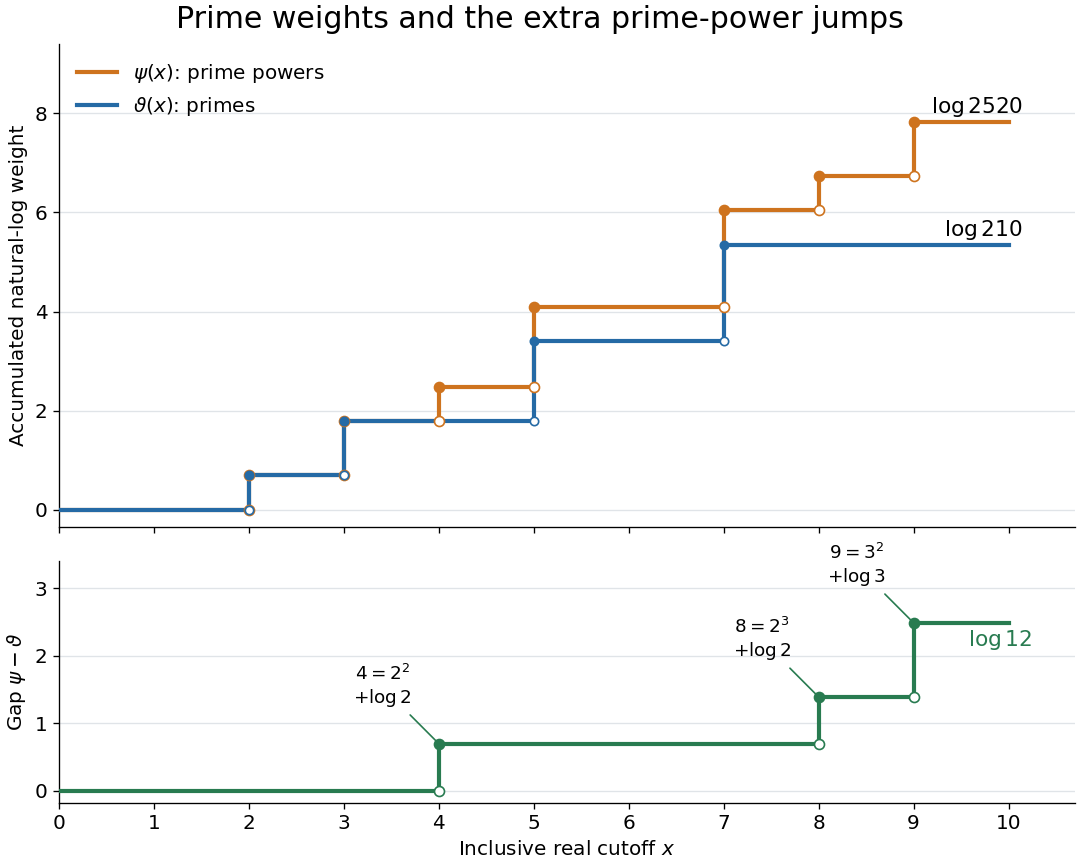
Grouping the prime powers by their exponent gives, for ,The floor function cutoff is exact: forces whenever . For each exponent, is equivalent to . An upper cutoff smaller than the lower one means an empty sum. [ref]
The Second Chebyshev function is the partial sum of the Von Mangoldt function up to a real cutoff :For example, , , and . At the jump has size ; between and no new prime power greater than one enters the sum. In contrast, the Chebyshev theta function stays at .
There is also an exact connection with the least common multiple. For , each prime number occurs to the highest exponent for which , both in that least common multiple and in the accumulated Von Mangoldt function weights. ThusThis explains the value at : the least common multiple is . The Chebyshev theta function instead gives the natural logarithm of the primorial . The additional prime powers retain the highest required multiplicities.
Why is this useful for the distribution of prime numbers? The Prime number theorem has the equivalent formswhere is the prime-counting function and denotes asymptotic equivalence. Thus an arithmetic function defined using prime factorization has average weight tending to one over long initial intervals of the positive integers. These are substantive asymptotic equivalences, not consequences of the definitions or the Von Mangoldt divisor identity alone. [ref]
The elementary reason the two Chebyshev functions have the same leading behavior is that their difference is small compared with . Every additional prime power has base , and for each such prime number its total extra weight is at most . There are at most such bases, soThis transfers to , or conversely, once either is established. Partial summation then relates the Chebyshev theta function to the prime-counting function. The estimate controls the extra prime powers; proving the leading value itself is the harder Prime number theorem problem.
For the Second Chebyshev function, finite summation gives . For , Mellin inversion of the kernel givesThe extra denominator makes this smoothing useful: the resulting sum over Nontrivial zeros of the Riemann zeta function is absolutely convergent. This integral differs from the integrated Chebyshev sum, which denotes a sum of the values .
For , moving the Mellin contour past the pole at one, the Nontrivial zeros of the Riemann zeta function, and the remaining poles givesZeros are included with multiplicity. The Riemann–von Mangoldt formula makes the zero sum absolutely convergent. If every nontrivial zero has real part below one, division by and dominated convergence give . Monotonicity of then recovers by upper and lower difference quotients.
For , finite rearrangement and the Von Mangoldt divisor identity giveThe Stirling formula, or integral comparison for the logarithm, gives for real .
The Chebyshev estimate isIt gives upper and lower bounds of the correct linear order without asserting the Prime number theorem asymptotic .
The central binomial coefficient satisfies . Prime factors between and give a dyadic upper bound for the Chebyshev theta function. The prime-power exponents in the factorial quotient are sums of zeros and ones, so the central coefficient gives a linear lower bound for the Second Chebyshev function. Higher prime powers contribute only ; hence the prime-counting function has upper and lower bounds of order .
For away from a jump of ,where the sum over Nontrivial zeros of the Riemann zeta function is taken symmetrically. A finite-height version has an explicit truncation error controlled by and the distance from to the nearest prime power.
For , the truncated Perron formula and a contour shift give the displayed form of the Riemann–von Mangoldt explicit formula. The pole at one contributes and the Nontrivial zeros of the Riemann zeta function contribute the finite sum. One can choose a separated height in and then restore using the local zero count for the Riemann zeta function. The error absorbs the half-weight discrepancy at a prime power. Outside this range of , one needs the fuller error with the near-integer terms retained.
For thresholds , write and similarly for the other truncations. Vaughan's identity isIt decomposes a sum weighted by into short, Type I, and Type II bilinear sums.
For reduced with and , the displayed bound follows by splitting Vaughan identity with parameters . Type I sums use short geometric-sum bounds; type II sums use the Cauchy-Schwarz inequality and rational spacing to control bilinear cancellation. A badly approximable number has a Dirichlet approximant with , yielding and hence .
// Target: analytic-number-theory.bigb
The Von Mangoldt function is nonnegative and satisfies . Therefore the middle short-divisor coefficient in the Vaughan identity has the displayed pointwise bound. Grouping its long-divisor term as , with , gives . This grouping permits bounded-coefficient Type II sums after division by .
The displayed identity is exact for all positive integers and all positive cutoffs. Expand and use . The two truncated terms are short sums; the negative term is a type I sum over divisors at most ; the last term is a type II sum with both factor variables larger than a cutoff. This form of the Vaughan identity is specific to Möbius weights.
For , if and , the Vaughan identity for the Möbius function gives a type I sum or a type II sum of modulus at least . The first is , with . The second is , with . Both coefficient sequences are bounded by the divisor function. Thus correlation forces either detection by small-modulus periodic indicators or a large multiplicatively organized bilinear sum, without claiming that itself is literally periodic or multiplicative.
For Dirichlet convolution, let and . Prime factorization gives and . With subscripts denoting truncation at ,Rearranging proves the Vaughan identity.
The prime omega function counts the distinct prime factors of a positive integer , so it is the cardinality of the prime support of an integer . For a prime factorization with distinct prime numbers and positive exponents,At there are no prime factors, so the empty sum gives . The total number of prime factors instead gives . [ref]
https://darijgrinberg.gitlab.io/floor.pdf. Darij Grinberg, MIT 18.781, Floor and arithmetic functions, Definition 2.1.2: distinct and repeated prime factors
For , the prime support of an integer is and . The comparison examples give , and . Raising an existing prime factor to a higher power does not affect the prime omega function: for a prime number and . Thus the prime omega function is a strongly additive arithmetic function, withThe reason is that coprime integers have disjoint prime supports of an integer. For arbitrary positive integers, their prime support of an integer combines by set union, and the shared prime factors are exactly those of the greatest common divisor. Counting this set union gives the more general identityFor , , both prime supports of an integer are and , so . In particular : the prime omega function is not a completely additive arithmetic function.
The prime omega function is useful for counting choices involving distinct prime factors. Every squarefree divisor of chooses a subset of its prime support of an integer, so there are squarefree divisors. For , this gives , namely . Also , because the radical of an integer keeps exactly that prime support of an integer. The total number of prime factors records what this count discards, and the two counts agree exactly on squarefree integers.
The multiplicative arithmetic function counts assignments of three labels to each distinct prime factor. It also counts pairs of squarefree divisors whose least common multiple is the radical of an integer .
The Euler product and Mertens second theorem give . The log-weighted convolution bound for three to the prime omega, with the Chebyshev estimate , then gives . A direct bound for the full range follows from , where :
For ,If , its contribution to is . Since , summing over the prime factors proves the bound. Here is Dirichlet convolution and is the Von Mangoldt function.
The Möbius function assigns a cancellation weight to each positive integer:Thus a squarefree integer contributes a sign determined by its number of distinct prime factors; a repeated prime factor makes the weight zero. This packages the alternating signs of inclusion-exclusion into an arithmetic function. [ref]
https://darijgrinberg.gitlab.io/floor.pdf. Darij Grinberg, MIT 18.781 lecture notes, Definition 2.1.2
For example, , , and , since . In contrast, : all three have the square of the prime number as a divisor. On prime powers, and for .
The Möbius function is a multiplicative function: for coprime integers, their prime factors are disjoint, so either a squared prime factor forces both sides of to vanish, or the counts of distinct prime factors add and their signs multiply. It is not a completely multiplicative function, since . Its Möbius divisor-sum identity makes it the inverse of the constant-one arithmetic function under Dirichlet convolution: , the Identity for Dirichlet convolution. This is why the small set of weights can undo an entire divisor sum.
For every positive integer , the divisor sum of the Möbius function isThe sum includes all positive integer divisors, but only squarefree divisors contribute. Equivalently, under Dirichlet convolution, where is the constant-one arithmetic function and is the Identity for Dirichlet convolution. [ref]
https://darijgrinberg.gitlab.io/floor.pdf. Darij Grinberg, MIT 18.781 lecture notes, Propositions 2.4.6 and 2.4.7
Each squarefree divisor chooses a subset of the distinct prime factors of , contributing when that subset has elements. Expanding a product therefore givesFor at least one prime factor occurs, so the product is zero. At it is an empty product, equal to one. This is the same alternating cancellation that drives inclusion-exclusion.
For , all eight positive integer divisors are squarefree integers, givingPair each subset not containing with the subset obtained by inserting : . Each pair cancels. The same nonzero terms occur for , because its squarefree divisors are still the integer divisors of ; its other integer divisors have Möbius function value zero.
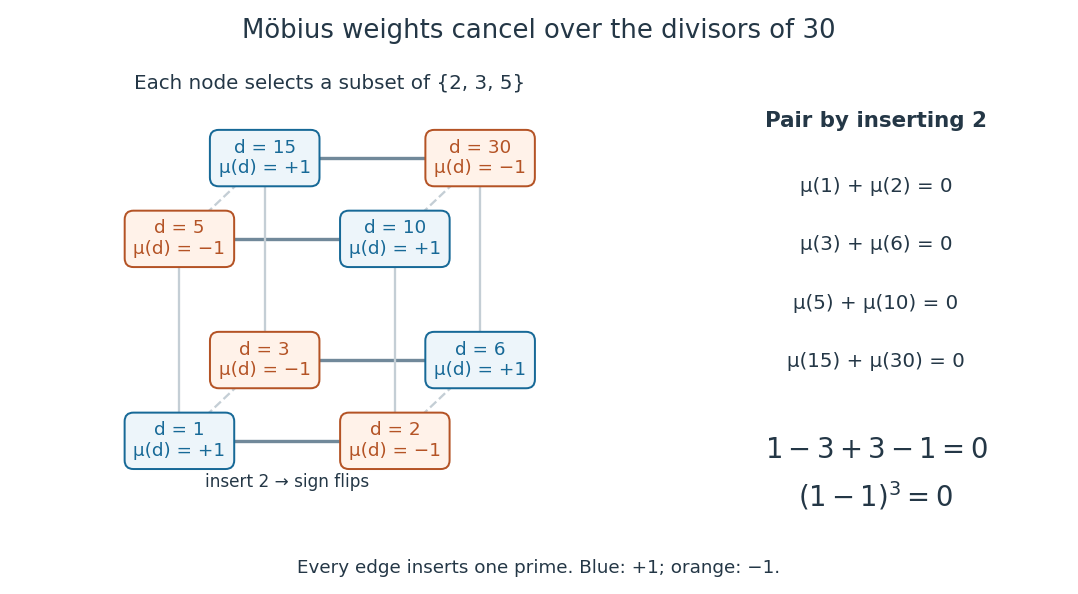
The eight integer divisors of 30 form a cube of subsets of its prime factors; adding one prime factor reverses the Möbius function sign, and all contributions cancel
. Details. The Möbius divisor-sum identity is the cancellation behind Möbius inversion and reciprocal Dirichlet series: aggregation over integer divisors has an exact inverse.
Put . The elementary estimates areThe identities and give the first two bounds. Convolve the harmonic divisor sum with : because , its left side is . Thus . The summed error is .
This elementary smoothing argument is used in Selberg's original proof and Ramaré's sieve lectures, Lemma 4.2.
Möbius inversion recovers an arithmetic function from its divisor sum. For arithmetic functions , the following statements are equivalent, with each equality required for every positive integer :Here ranges over positive integer divisors of and is the Möbius function. No multiplicativity assumption is needed, and both sums are finite. The right side can also be written by exchanging complementary integer divisors. [ref]
https://darijgrinberg.gitlab.io/floor.pdf. Darij Grinberg, MIT 18.781 lecture notes, Theorem 2.5.1 and Proposition 2.5.2
The divisor sum bundles together with values at smaller integer divisors. Möbius inversion subtracts aggregates indexed by one distinct prime factor, adds those indexed by two, and continues with the alternating signs of inclusion-exclusion. A divisor containing a squared prime factor receives weight zero. The Möbius divisor-sum identity ensures that every unwanted contribution cancels exactly.
In Dirichlet convolution notation, and , where is the constant-one arithmetic function and is the Identity for Dirichlet convolution. Associativity and commutativity give the short proof:Convolving with proves the reverse implication. At , the formula reduces to because .
For a worked example, take , Euler's totient function. The totient divisor-sum identity says that , the identity arithmetic function:This identity comes from classifying the integers by their greatest common divisor with : the group with has members, since and are coprime integers. Summing the group sizes gives , as detailed under totient divisor-sum identity.
Now undo this aggregation with the Möbius function:The nonzero terms use ; vanish because they contain the square of the prime number . The four surviving integers coprime to are .
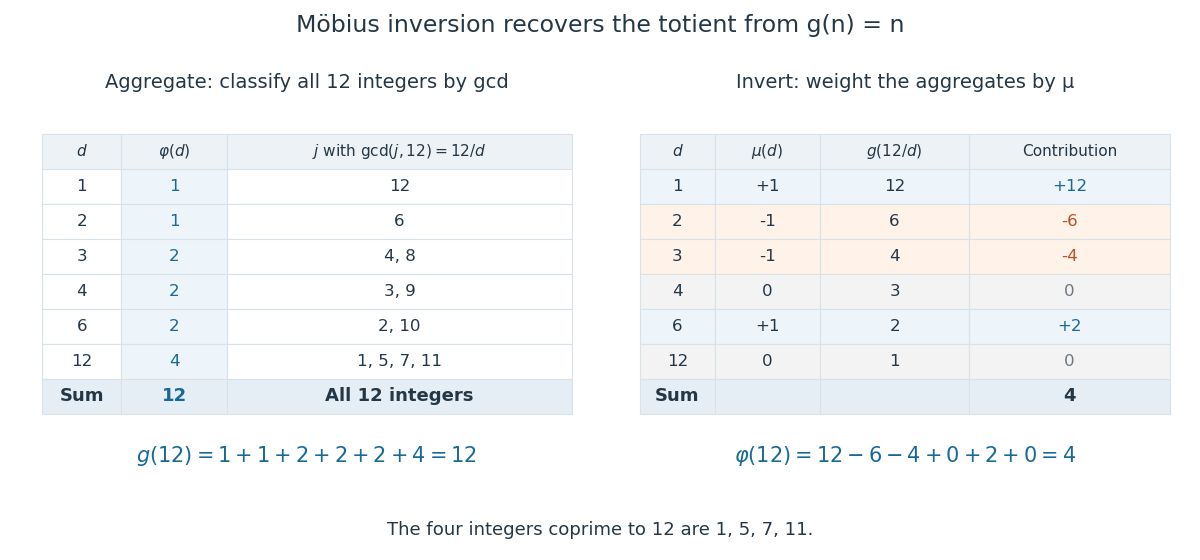
A divisor sum aggregates Euler's totient function values to 12, while Möbius inversion recovers the four integers coprime to 12
. Details. This example also reveals why Möbius inversion is useful: it turns an easy count of all objects into a count satisfying a coprimality restriction. Expanding over subsets of distinct prime factors givesThe product is inclusion-exclusion over multiples of the prime factors. For , it gives . More generally, whenever a counting problem produces a divisor sum, Möbius inversion lets that aggregate be reversed without solving a new system of equations.
Let . The Möbius divisor-sum identity and the Von Mangoldt divisor identity give and , soHere is Dirichlet convolution. The divisor summatory asymptotic bounds the terms with in absolute value by . For , group by : the remaining sum is . First let tend to infinity, then tend to infinity. This proves the Second Chebyshev function asymptotic from cancellation of the Mertens function.
Suppose and . The Möbius divisor-sum identity gives . The exact Dirichlet convolution identity then gives , because its error is a convergent dyadic harmonic sum. Since , the displayed Mertens function bound follows. The classical Prime number theorem error meets the summability condition. This is a deduction from the Chebyshev error itself, without a separate estimate for the reciprocal zeta function.
The classical zero-free region of the Riemann zeta function and a truncated Perron formula givefor some absolute constant . Take contour height and move the Perron contour to .
Articles by others on the same topic



An arithmetic function is a mathematical function defined on the positive integers that takes real or complex values and often has significant implications in number theory. These functions can be classified into different categories based on their properties and applications. ### Key Characteristics: 1. **Domain**: The domain of an arithmetic function is usually the set of positive integers (denoted by \( \mathbb{Z}^+ \)).