
The divisor function counts the positive integer divisors of a positive integer . In particular , because has just one positive integer divisor. More generally the notation gives and the sum-of-divisors function . Thus the divisor function counts the positive integer divisors, while adds their sizes. [ref]
https://darijgrinberg.gitlab.io/floor.pdf. Darij Grinberg, MIT 18.781 lecture notes, Definition 2.1.2 and Theorem 2.1.6
If the prime factorization is with distinct prime numbers and positive exponents , thenThe short proof is a count: each positive integer divisor has a unique form , where . There are choices at each prime number, and choosing them gives every positive integer divisor exactly once. For there are no prime factors and the product is .
For , choose and to obtain . The six values are ; sorted, the positive integer divisors are . Therefore . The diagram makes the independent exponent choices visible.
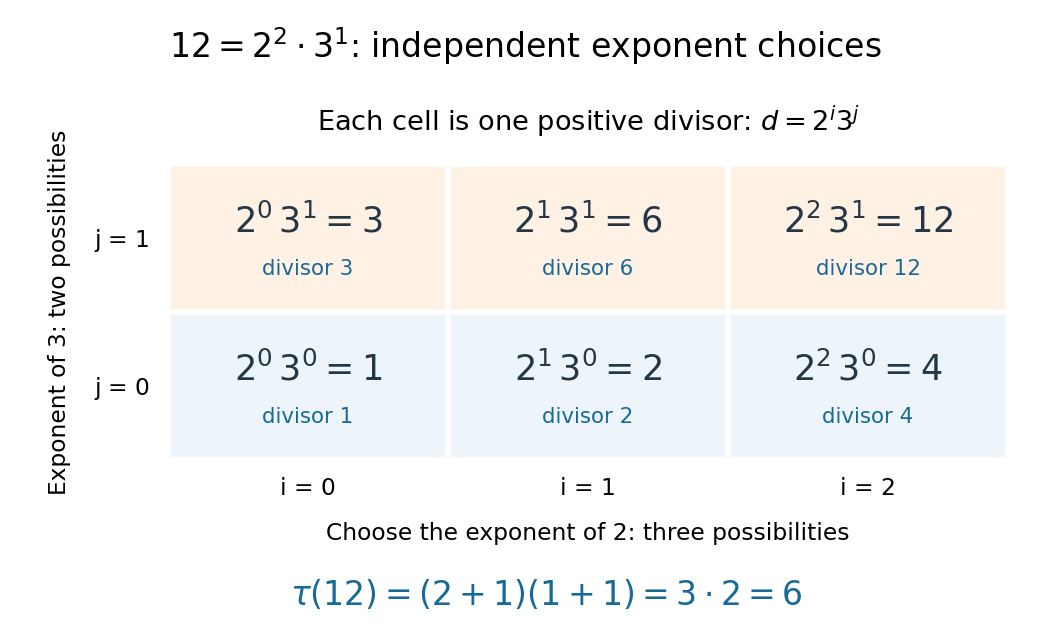
The prime factorization gives a three-by-two array of positive integer divisors , so the divisor function has
. Details. This count is useful because a known prime factorization gives without testing every smaller positive integer for divisibility. It also proves the divisor function is a multiplicative function: coprime integers have disjoint prime factors, so their exponent choices combine. For example , but , so it is not a completely multiplicative function. Equivalently, under Dirichlet convolution, counting ordered pairs of positive integers whose product is .


New to topics? Read the docs here!