An arithmetic function is a multiplicative function when and for all coprime integers , meaning their greatest common divisor is . The condition excludes the identically zero function. This definition makes no assertion about a pair whose greatest common divisor exceeds . [ref]
https://darijgrinberg.gitlab.io/floor.pdf. Darij Grinberg, MIT 18.781 lecture notes, Definition 2.2.1
For the divisor function, the integer divisors of are , those of are , and those of are . HenceHere and are coprime integers. In contrast, , because the integer divisors of are . Thus the divisor function is a multiplicative function but not a completely multiplicative function.
The practical gain is that prime factorization reduces all values to values at prime powers. For distinct prime numbers and positive exponents ,For instance, since and are coprime integers; replacing by additionally requires a completely multiplicative function. The short proof repeatedly applies the defining rule to prime powers belonging to different prime numbers, which are coprime integers.
For an arithmetic function, multiplicativity means and whenever are positive coprime integers. It allows values of an arithmetic function to be assembled from its values on prime powers, as explained under multiplicative function.
An arithmetic function is a completely multiplicative function when and for every pair of positive integers . In particular for every prime number and every nonnegative exponent . Both the constant-one arithmetic function and the identity arithmetic function are completely multiplicative functions: and . The divisor function fails this stronger condition at .
The divisor sum of an arithmetic function assigns to each positive integer the sumOnly positive integer divisors are included, so . The weights can count the integer divisors, measure their sizes, or record other arithmetic information: the constant-one arithmetic function gives the divisor function, whereas the identity arithmetic function gives the sum-of-divisors function.
Equivalently, , where is Dirichlet convolution and is the constant-one arithmetic function. If is a multiplicative function, then is a multiplicative function by Multiplicativity of Dirichlet convolution. [ref]
https://darijgrinberg.gitlab.io/floor.pdf. Darij Grinberg, MIT 18.781 notes on floor and arithmetic functions, Proposition 2.4.2 and Theorem 2.6.1
Here is the mechanism. For positive coprime integers , every positive integer divisor of has a unique form with and ; moreover, are coprime integers. Thus a multiplicative function satisfiesAt a prime power, the divisor sum becomes . This turns a calculation over many integer divisors into short local calculations at prime powers.
The sum-of-divisors function adds all positive integer divisors of a positive integer, including the number itself:It is the divisor sum of the identity arithmetic function , so under Dirichlet convolution. Both factors are multiplicative functions, hence so is the sum-of-divisors function. The notation distinguishes it from other weighted divisor sums. [ref]
https://darijgrinberg.gitlab.io/floor.pdf. Darij Grinberg, MIT 18.781 notes, Definition 2.1.2 and Proposition 2.2.2(e)
For a prime number and a nonnegative exponent , the positive integer divisors of the prime power are precisely . Their finite geometric series givesFor example, . For a prime factorization with distinct prime numbers and positive exponents , multiplicativity givesFor , this is an empty product, equal to . [ref]
https://darijgrinberg.gitlab.io/floor.pdf. Darij Grinberg, MIT 18.781 notes, Theorem 2.1.8 with k equal to one
The distributive property makes the formula especially beautiful: choosing one term from each factor produces each positive integer divisor exactly once, by the fundamental theorem of arithmetic. For , the choices form a three-by-two grid with entries , where and . Adding its rows givesThe divisor function counts six cells; the sum-of-divisors function adds their six values. Once the prime factorization is known, the product formula avoids testing every candidate integer divisor. Shared prime factors require care: , so the sum-of-divisors function is not a completely multiplicative function.
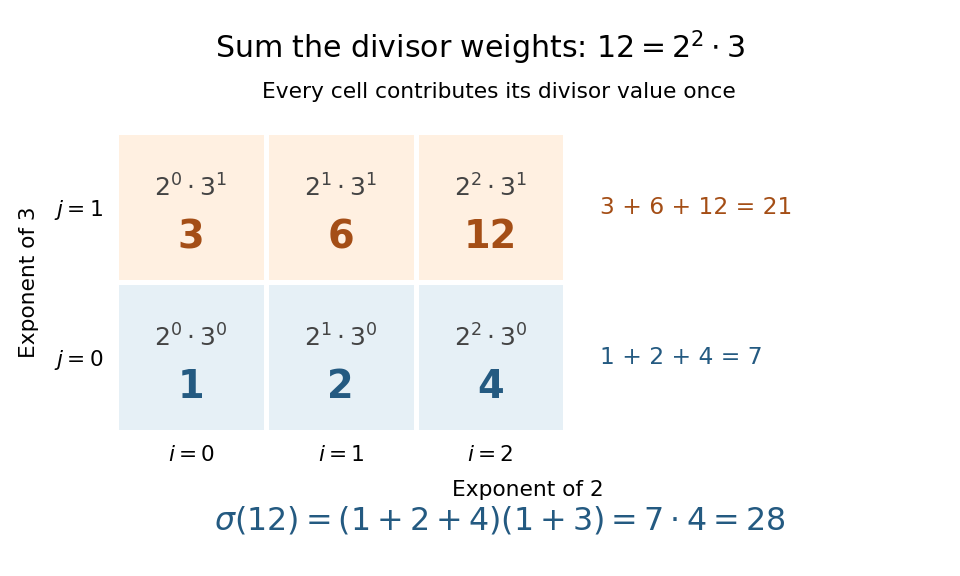
The sum-of-divisors function for : each grid entry is a positive integer divisor, and the weighted total is
. Details. 
Subtracting the number itself gives the proper-divisor sum . Comparing with distinguishes perfect numbers, deficient numbers, and abundant numbers. For , ; for , . Both are perfect numbers. The calculation makes a deficient number, while makes an abundant number. These comparisons turn the sizes of integer divisors into a classification of positive integers. [ref]
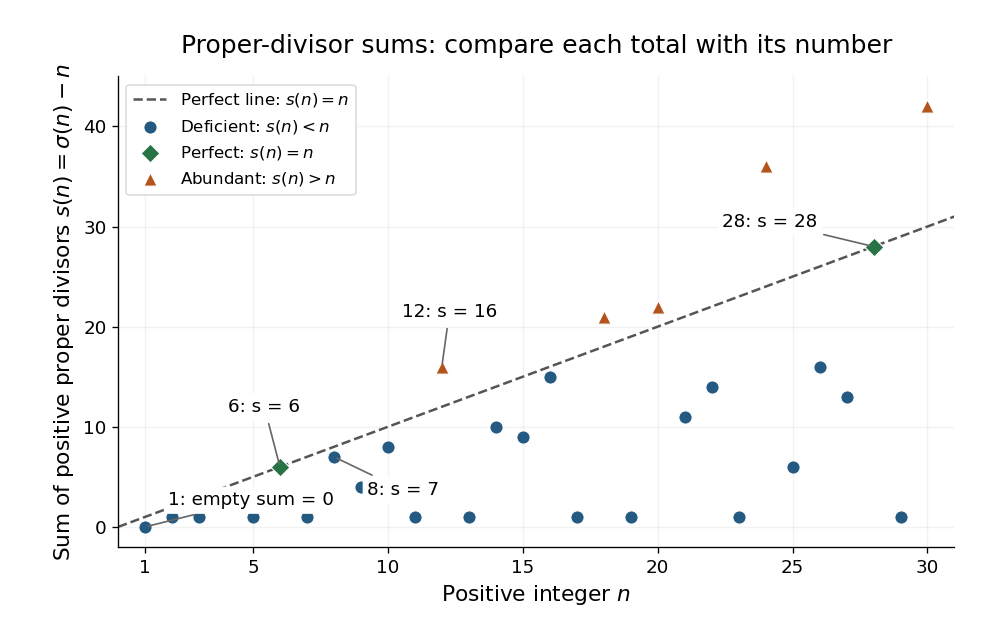
The proper-divisor sum for : perfect numbers lie on , deficient numbers below it, and abundant numbers above it
. Details. 
This connection is ancient: Euclid's Elements, Book IX, Proposition 36, constructs a perfect number by multiplying the last term of by their sum, when that sum is a prime number. In modern notation, put and , with and a prime number. The sum-of-divisors function proves the construction immediately:Consequently the proper-divisor sum is . Taking produces the perfect numbers . [ref]
Book IX, Proposition 36. Euclid, Elements IX.36, translated text and commentary by David Joyce
The proper-divisor sum, or aliquot sum, adds the positive proper divisors:In particular , an empty sum. Removing from the sum-of-divisors function is essential: , but its proper-divisor sum is .
For multiplicative functions bounded by one, the pretentious distance up to is defined byIt measures how similarly and behave on primes.
Let , and let be a normalized multiplicative arithmetic function supported on squarefree integers, with . Form the finite measure using Dirac measures. Under the transform convention , its Euler product is . Expanding its logarithmic modulus, and replacing the damped prime weights by up to with Mertens first theorem, gives the displayed absolute bound, uniformly in real . Hence forces . The distance expression still defines a nonnegative pretentious score for prime values bounded by one; its actual metric interpretation uses unit-modulus values.
Because , the squared pretentious distance from one to the Möbius function is twice the reciprocal-prime sum. The Mertens second theorem therefore gives . In particular the distance diverges, illustrating that a multiplicative function can be far from the constant function even though both have unit-modulus prime values.
For unit-modulus prime values, pretentious distance is the Euclidean metric on the finite vectors . On whole arithmetic functions it is only a pseudometric: it sees neither values on prime powers nor primes above the cutoff. Even for every cutoff, the functions one and have distance zero but differ on nonsquarefree integers. The norm representation proves the triangle inequality and identifies exactly the quotient on which separation holds.
The pretentious distance obeys
An Archimedean character on the positive integers is the completely multiplicative function for a real parameter .
Halász's theorem bounds the mean of a bounded multiplicative arithmetic function in terms of its least pretentious distance from an Archimedean character. A large mean can occur only when this distance is small.
The Möbius function stays far in pretentious distance from every Archimedean character. One useful uniform form isThis follows by estimating the prime sum .
Articles by others on the same topic
There are currently no matching articles.