
For a real angle in radians, Euler's formula stateswhere is the imaginary unit. It connects the complex exponential to the sine and cosine coordinates of the unit circle. In particular, , and multiplying by rotates a complex number through angle without changing its modulus. At it gives ; at , it gives .
The identity makes angle addition algebraic: . Expanding the product and comparing real parts and imaginary parts recovers the sine addition formula and cosine addition formula. Differentiating gives , and differentiating again gives . Its real and imaginary coordinates therefore solve the harmonic oscillator equation. This is why complex exponentials are useful building blocks in Fourier analysis: differentiation acts on each frequency by simple multiplication.
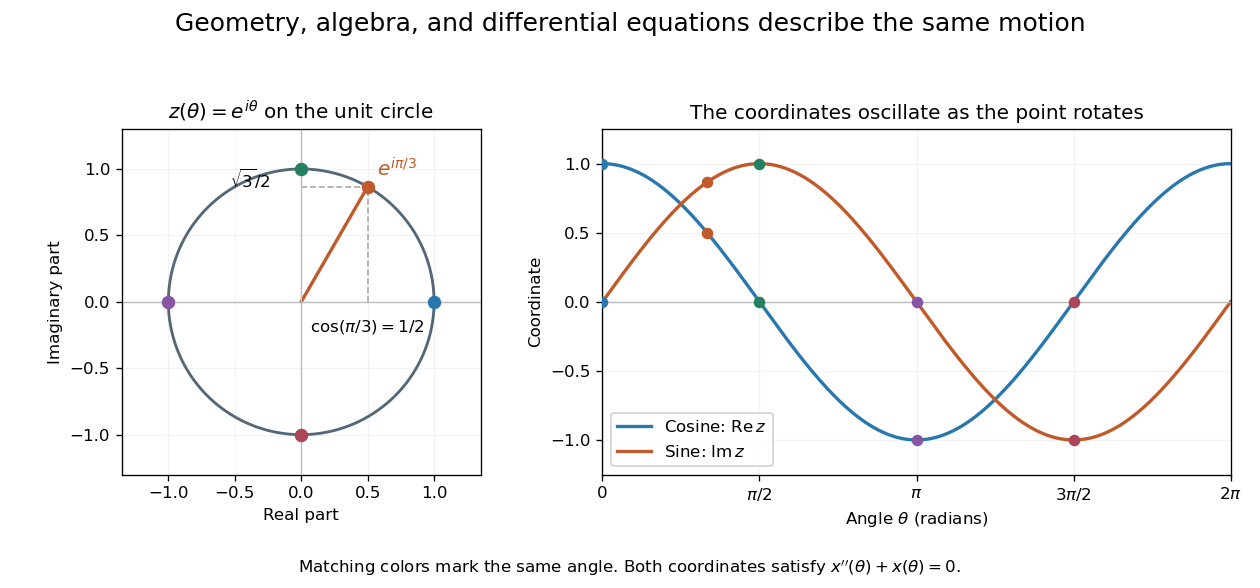
A short justification separates the even and odd powers in the absolutely convergent power series for . The even powers give , and the odd powers give . The absolute convergence permits this regrouping. The formula thus links an analytic definition of the complex exponential to a geometric motion rather than merely introducing a convenient notation.
Leonhard Euler presents the relation between imaginary exponentials and sines and cosines in his 1748 Introductio in analysin infinitorum, volume 1, chapter VIII, section 138. His derivation uses limiting powers after connecting trigonometric addition to algebra. The original Latin and Ian Bruce's English translation can be read together in Euler, Introductio, chapter VIII, section 138.


Euler's formula is a fundamental equation in complex analysis that establishes a deep relationship between complex exponentials and trigonometric functions.
New to topics? Read the docs here!