
A generating function packages a sequence into a series so that operations on objects become operations on their encodings. An ordinary generating function uses the power series ; in counting problems, the coefficient records the number of objects of size . The variable initially marks size: it need not be assigned a numerical value. Coefficient extraction writes this recovery as . One compact expression can therefore answer infinitely many counting questions, while explaining how their answers fit together.
Start with two contributions: choose from and from , with exactly one option at each allowed value. Their individual ordinary generating functions are the polynomials and . To count ordered pairs by total , multiply:The coefficients count the ways to obtain totals zero through three. For total two, the possibilities are and ; the two corresponding monomials both contribute . There are six ordered pairs altogether, agreeing with .
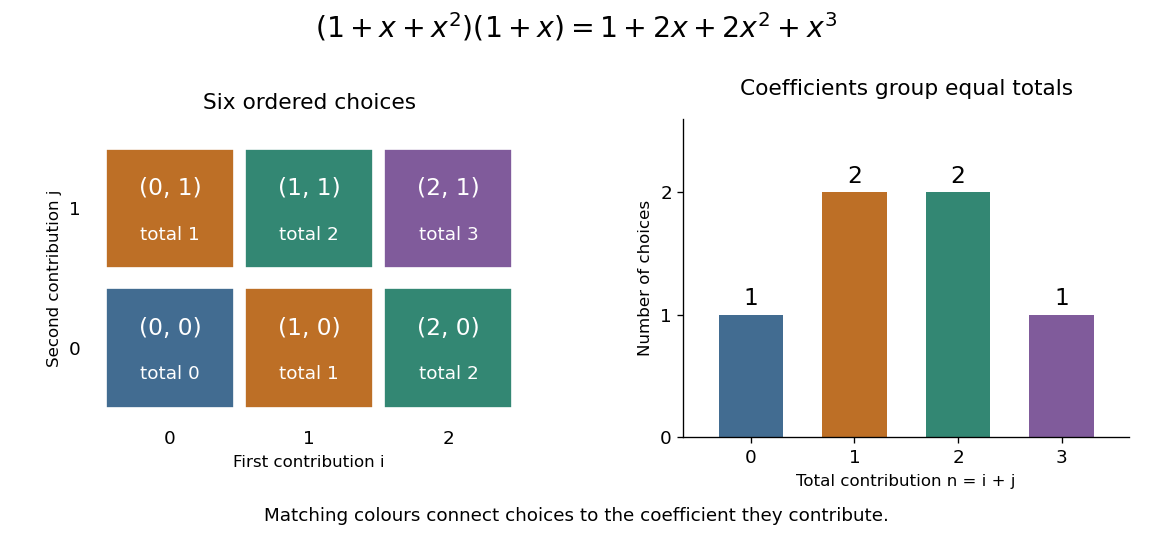
If the first contribution has two distinguishable choices when , replace by . Its product with becomes . The coefficients now carry multiplicities as well as possible totals; the exponent still records cost. This lets the same construction handle several actions with identical costs without losing their separate identities.
In general, the Cauchy product givesFor each split of the total size, the rule of product counts the choices of the two components; summing over those splits counts all possibilities. This requires each combined object to have a unique decomposition into the two components. The same idea works for costs, lengths, or other additive measures, not just the number of pieces. See MIT 18.310, generating functions, sections 1–2.
Now cover a board of length with tiles of lengths one and two, without gaps or overlaps. Let count these tilings. There is exactly one empty tiling, so , and . Removing the first tile leaves a board shorter by one or two, giving the recurrence relationThese are the Fibonacci numbers shifted by one index: under the convention , . Keeping the empty tiling is essential to both the counting rule and the resulting ordinary generating function.
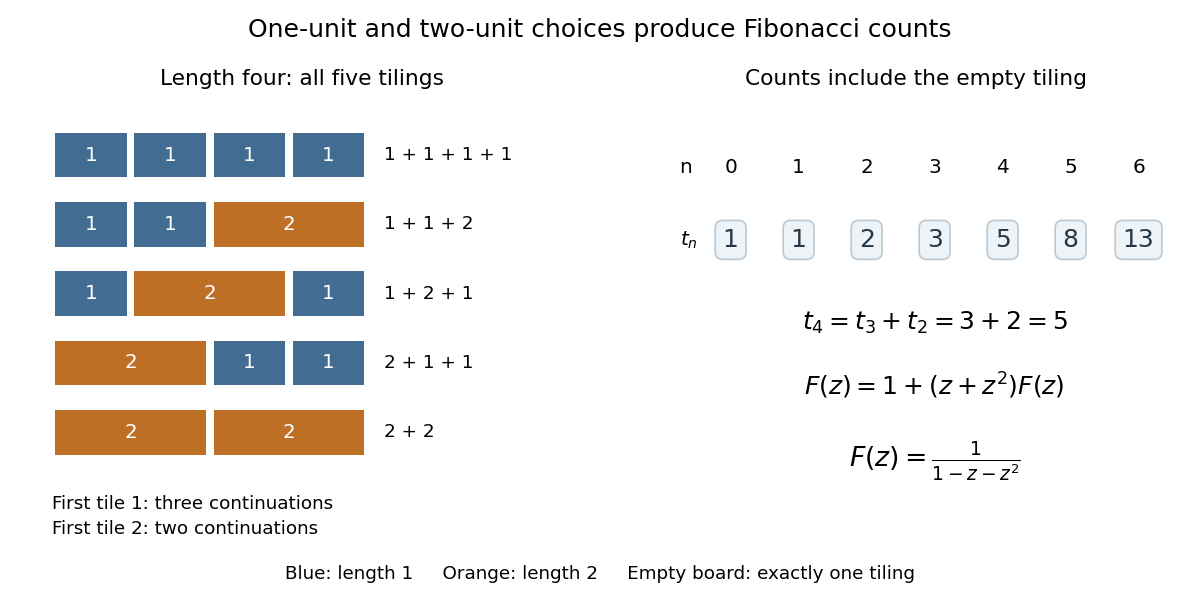
Length-one and length-two tiles give five coverings of a length-four board and the Fibonacci recurrence
. Details. For , the empty board or a first tile followed by a remaining tiling givesEquivalently, : each factor chooses one tile, and counts pieces while the exponent of records total length. The same ordinary generating function counts ordered histories of two repeatable actions costing one and two units. Histories and differ despite having the same total cost. MIT's notes use dots and dashes with these costs, including the empty message. [ref]
These identities hold in formal power series algebra: each requested coefficient uses only finitely many contributions. The repeated-choice expansion is legitimate because has zero constant term; a zero-cost repeatable action would allow infinitely many histories of the same size. Numerical evaluation separately requires a convergent series. Here the radius of convergence is , the reciprocal of the golden ratio. At , the rational function equals , but the counting series diverges: that value cannot represent its sum.
Other generating functions change the encoding: an exponential generating function divides by factorials, while a Dirichlet series uses . A counting generating function also differs from a probability generating function, whose coefficients must be nonnegative and sum to one.



A generating function is a formal power series whose coefficients encode information about a sequence of numbers or combinatorial objects. It is a powerful tool in combinatorics and other fields of mathematics because it provides a way to manipulate sequences algebraically.
New to topics? Read the docs here!