Gravitational time dilation
ID: gravitational-time-dilation

In a static spacetime, a clock held at a fixed position records proper time for metric time component . Two clocks compared over the same coordinate interval have rate ratio . Each clock ticks normally in its own laboratory; the difference appears when their readings or transmitted frequencies are compared. For a weak Newtonian gravitational potential, , so the fractional excess of the upper rate is .
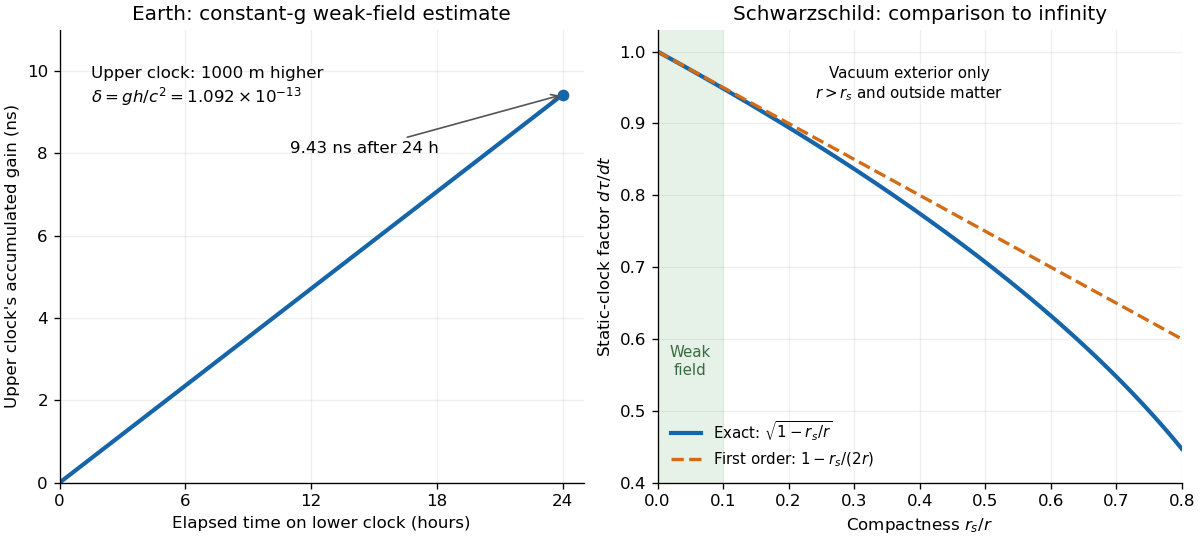
Take two clocks maintained at rest above Earth, separated vertically by . Approximate the local gravitational acceleration as constant, , neglect rotation, and use the exact speed of light from NIST's constants database. Then andThe upper clock gains about nanoseconds during one -second interval on the lower clock. This is a leading weak-field estimate with , not a precision prediction for a particular mountain: Earth's rotation and actual gravitational potential matter in accurate comparisons. The effect is experimentally accessible. Chou, Hume, Rosenband and Wineland raised an optical clock by and measured a fractional rate change ; the same formula with predicts . See their [ref]
https://tsapps.nist.gov/publication/get_pdf.cfm?pub_id=905055. 2010 paper, Optical Clocks and Relativity, equation (2) and figure 3
. Such comparisons make clocks probes of gravitational potential as well as instruments for timekeeping.For the ideal spherical, nonrotating Schwarzschild spacetime, the exact static-clock factor relative to time at infinity is , where is the Schwarzschild radius. Its weak-field expansion is . The figure compares these factors only in a vacuum exterior with ; for a material body, the radius must also exceed its surface radius. It does not extend the exterior formula through the body's interior. See Tong's lecture notes, section 6.1 on Schwarzschild exterior geometry.

New to topics? Read the docs here!