The Newtonian gravitational potential is potential energy per unit mass of a test particle. Its gradient determines the Newtonian gravitational field:In SI, has units , while has units ; its gradient has units of acceleration, not force. Adding a constant to leaves the Newtonian gravitational field unchanged. For an isolated point mass, the convenient reference is . [ref]
https://ocw.mit.edu/courses/16-07-dynamics-fall-2009/0bb19205a6316ba88f88284bf7257ec6_MIT16_07F09_Lec16.pdf. Peraire and Widnall, MIT Dynamics, Lecture 16: potential per unit mass
Increasing the radius from to raises the Newtonian gravitational potential energy:An external agent supplies this positive work if the initial and final kinetic energies agree; gravity does work . For , the required work is . [ref]
The dimensionless coefficient describes the leading axisymmetric departure of a planet's external Newtonian gravitational potential from a monopole: , where is colatitude from the spin axis. An oblate mass distribution has positive . The disturbing function is minus the nonspherical potential term. On a circular inclined Kepler orbit, , so orbit averaging gives . The exact circular nodal rate is ; its small-tilt limit is .
For , a nearly circular equatorial orbit has and azimuthal frequency . The radial epicyclic frequency is , and the vertical epicyclic frequency is . Radial stability requires . The nodal precession rate is negative and the apsidal precession rate positive. These sign statements concern small eccentricity and inclination. For an arbitrary inclined orbit, the averaged argument of periapsis instead evolves as and can regress.
An axisymmetric logarithmic Newtonian gravitational potential has spheroidal equipotential surfaces and a flat galaxy rotation curve: . The singular model is defined away from the origin; a fixed reference length makes the logarithm dimensionless. Its central mass density cusp is locally integrable, but its total mass diverges at large radius.
The Poisson equation for Newtonian gravity givesFor , nonnegative mass density away from the origin is equivalent to . Strict positivity requires . This condition does not by itself guarantee a nonnegative galactic distribution function.
A radial Newtonian gravitational potential produces inward acceleration . The point-mass case has and . Treating the power-law gravitational potential as prescribed does not require it to be sourced by the flowing gas.
For a binary star viewed far from its centre of mass, let be the separation and the reduced mass, the total mass, and . The Taylor expansion of the point-mass Newtonian gravitational potential has zero dipole because . Its second moment is , soThis holds for an instantaneous separation in any orbit, not only a circular orbit. The mass quadrupole moment convention gives .
A flattened power-law Newtonian gravitational potential has equipotential spheroids . For and , its midplane circular orbit angular frequency satisfies .
Applying the Poisson equation for Newtonian gravity to a flattened power-law gravitational potential yieldsFor , nonnegative mass density everywhere outside the origin requires and is ensured by . The central density singularity is locally integrable and carries no point mass, although the total mass diverges at large radius in this scale-free model.
The Newtonian potential of a point mass at the origin isIt is the free-space Green function of the Laplacian with the normalization of the Poisson equation for Newtonian gravity. Differentiating gives inward gravitational acceleration . With , the normalized Newtonian gravitational potential is ; at it equals .
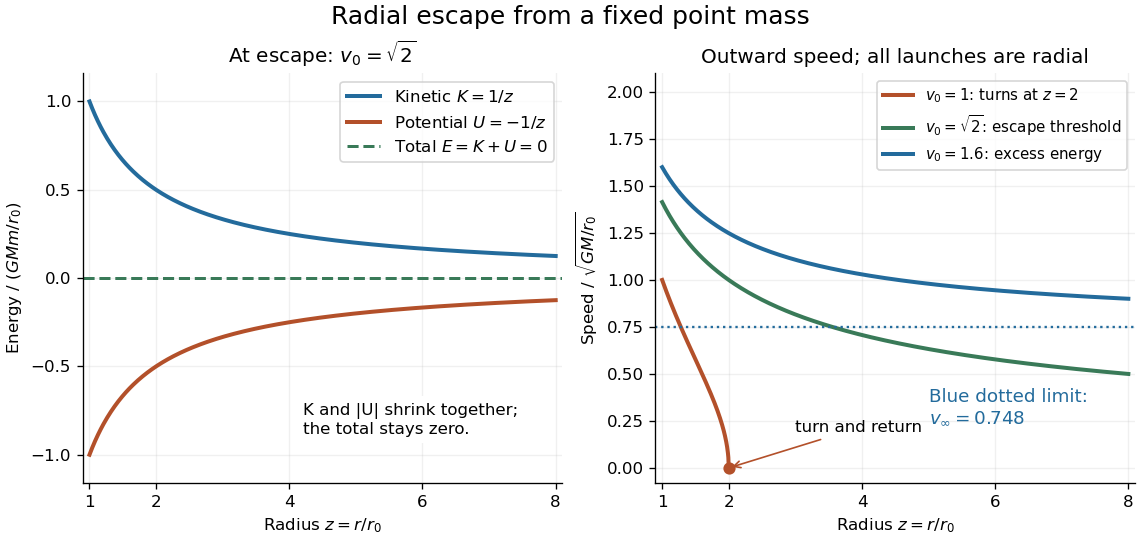
For a radially outward launch from , conservation of mechanical energy in the fixed-source test particle approximation gives the minimum escape velocity:At this threshold the speed tends to zero only at infinite separation. The model neglects air resistance, external tidal forces, and general relativity. [ref]
A circular orbit at instead requires tangential speed . Choosing units with gives , , and . A radial launch at speed reaches and returns; the same speed directed tangentially gives a circular orbit. [ref]

A spherically symmetric potential depends only on distance from one point. Its force is central, so angular momentum is conserved.
Articles by others on the same topic
There are currently no matching articles.