
The Haar projection at level is the orthogonal projection onto the functions constant on level- dyadic intervals. On each cell it replaces by its cell average. This is the closest cellwise-constant approximation in the L2 norm, because choosing a constant on a cell minimizes at its cell average.
On , take the step function with values on successive quarter-intervals. At level zero, its Haar projection is the constant . At level one, it has values and on the two halves. At level two, it recovers the four original values exactly. With normalized Haar wavelets, these approximations areThe coefficients are L2 inner products, so they differ from the discrete vector coefficients by the factor . Their squared sum also has a direct meaning:The approximation errors in squared L2 norm of are respectively : each added detail removes exactly its own squared coefficient from the error.
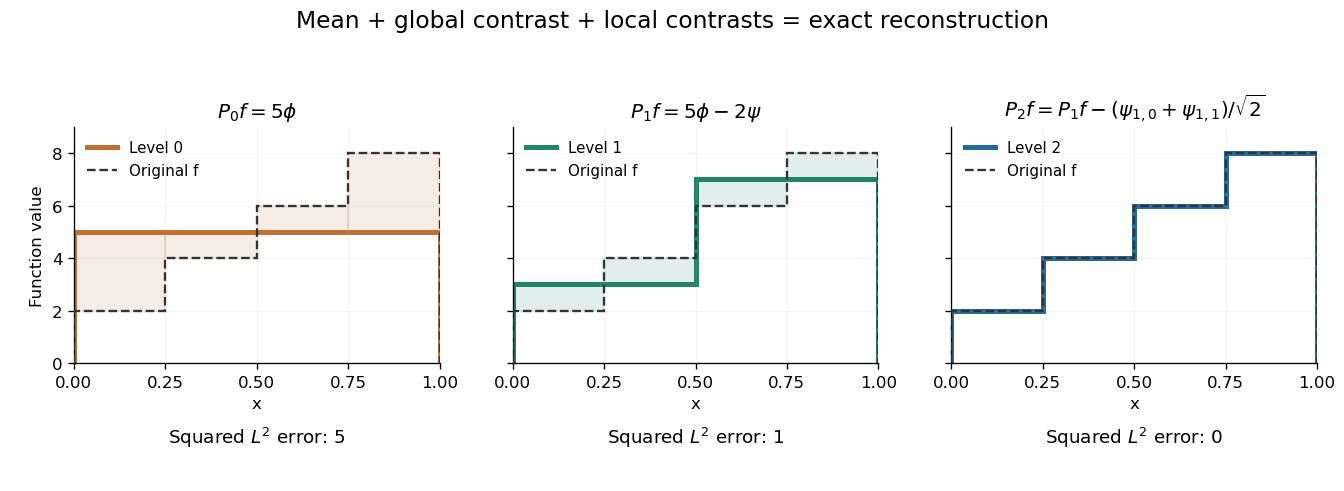
Coarse mean, half-interval contrasts and quarter-interval details reconstruct the same four-step function
. Details. 
The Haar projection can be expressed using level- Haar scaling functions, or through a coarse scaling family and the Haar wavelets at intermediate levels. On with lowest level zero, that coarse family is the single constant function . On the whole real line, use the integer translates of a coarse Haar scaling function instead; one global constant is not square-integrable. Refinement improves the representation while retaining the earlier coefficients.
New to topics? Read the docs here!