The orthogonal projection onto a closed subspace of a Hilbert space sends to its component in the orthogonal decompositionThe residual is orthogonal to every permitted direction. For any , the Pythagorean theorem givesThus uniquely minimizes the distance to . It is a linear map, is idempotent, and is nonexpansive: ; taking gives .
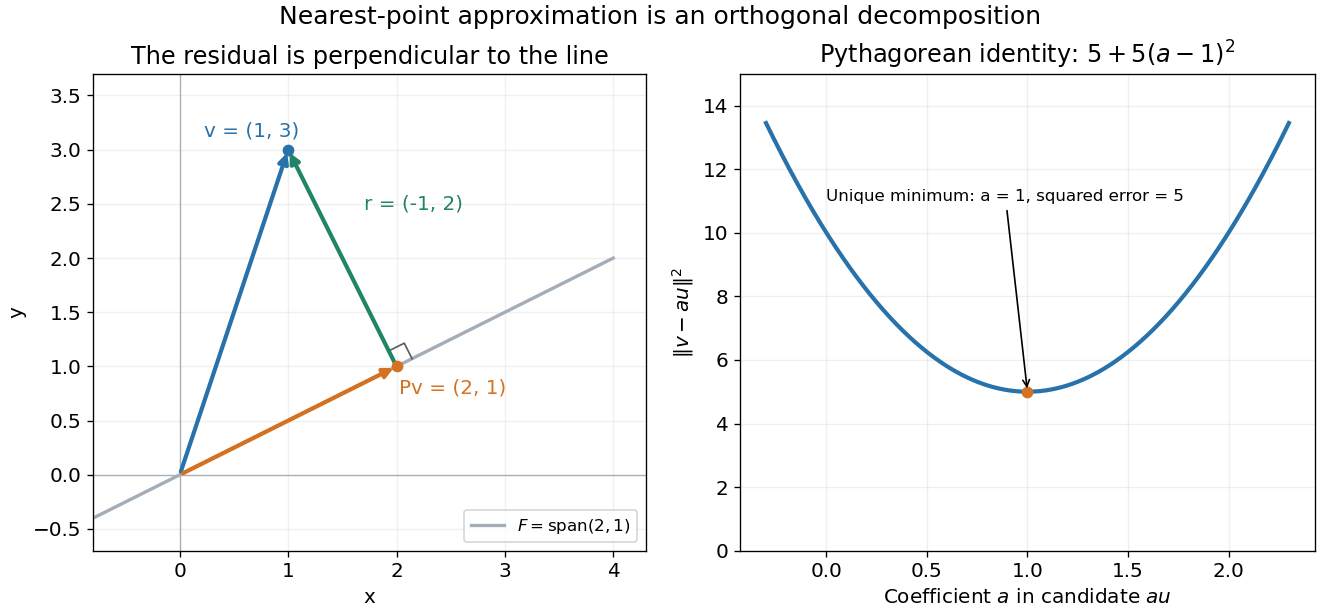
In , project onto the line spanned by . The inner product givesThe check confirms orthogonality, and . Projecting again changes nothing, since the result already lies on the line.

For a finite orthonormal basis of , the same operation is , using the convention linear in the first argument. Replacing coordinate vectors by functions gives exactly the same approximation principle. For in the real L2 space on and , the directions are orthogonal, with squared norms and . Their inner products with are and zero, soDirect integration gives the squared error . For any competing affine polynomial, the orthogonal residual yieldsEvery deviation from , adds a nonnegative error. The best function need not pass through any selected data point: it minimizes an integrated error across the whole interval.
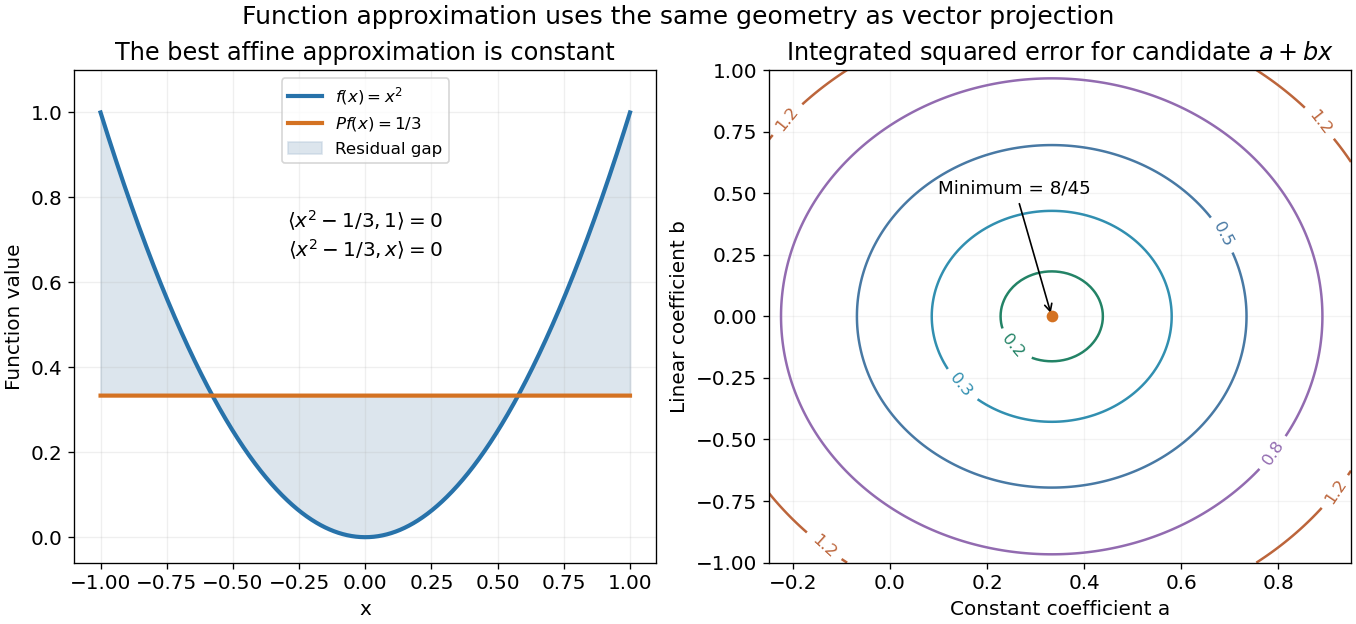
Projecting x squared onto affine functions gives the constant one third and minimum integrated squared error 8/45
. Details. 
For a nonzero closed subspace of a Hilbert space and a closed subspace of a Hilbert space , this angle measures the worst loss under projection from to . Its positive cosine is a uniform lower bound for . The order of the subspaces matters in general. This is distinct from the smallest angle between two subspaces, whose cosine is a supremum. For equal finite dimensions the cosine is the smallest singular value of the cross Gram matrix of orthonormal bases. When is zero, the infimum is over an empty unit sphere and does not define an angle in ; use a lower-bound formulation instead.
For closed subspaces of a Hilbert space, set . The two positive cosines bound and its adjoint operator below. The first bound gives a closed range and injectivity; the second makes the range dense by image-kernel orthogonality for an adjoint. Thus is a bounded bijection, and yields the unique direct sum decomposition . In equal finite dimensions, a lower bound on alone suffices by the rank-nullity theorem.
For two finite-dimensional subspaces with projections , define , with vectors drawn from the respective subspaces. The angle is zero when they intersect nontrivially. To measure separation after removing a common intersection, restrict both subspaces to its orthogonal complement. The resulting angle controls sums of positive operators in the Kitaev geometrical lemma.
Suppose positive operators have positive eigenvalues at least and their nullspaces meet only at zero. If is their smallest angle between two subspaces, then . Indeed , while gives . With a common nullspace, apply the same proof on its orthogonal complement to bound the positive spectral gap.
For orthogonal projections with , the identity and imply for . When the projections have a common fixed subspace, first remove its orthogonal projection. This estimate is stronger than generic submultiplicativity and is useful for alternating local projection layers.
Articles by others on the same topic
There are currently no matching articles.