
The Haar wavelet is a signed contrast between two adjacent half-intervals:It has compact support, zero integral, and unit L2 norm: and . The zero integral is its one vanishing moment. Its Haar scaling function is , which records a coarse value rather than a contrast. Endpoint conventions do not alter the L2 inner products.
The normalized copies compare the halves of the dyadic interval . Narrower copies are taller so that their L2 norms stay one. Thus a coefficient identifies both a location, through , and a scale, through .
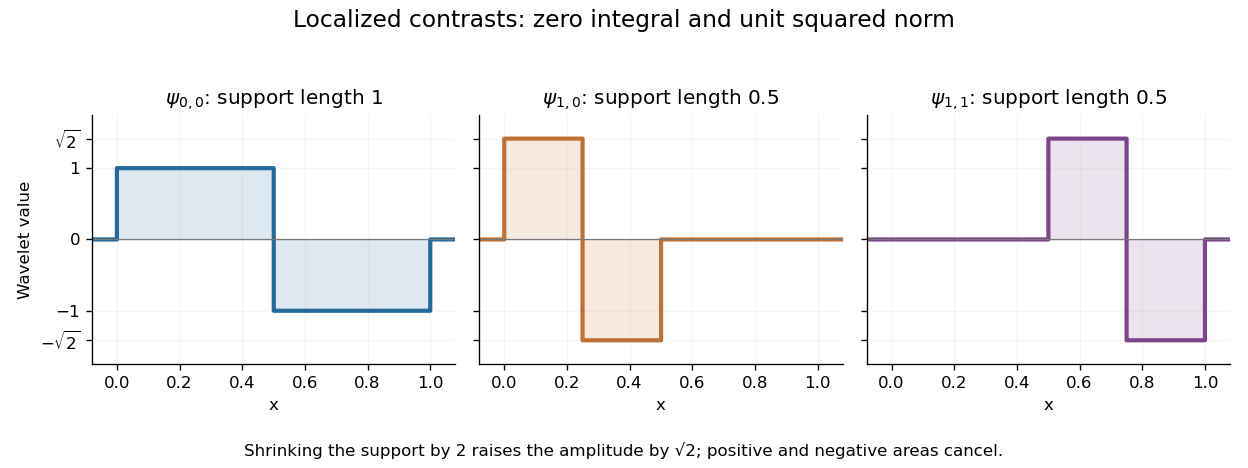

For a simple step function equal to on and on , its coarse coefficient is , while its first contrast is . Thus . The negative coefficient raises the second half and lowers the first. Finer contrasts vanish because is constant on each half. A jump aligned with this dyadic interval boundary therefore needs only two nonzero coefficients; jumps at other positions can require details at many scales.
Its jump discontinuities make the Haar wavelet particularly transparent for changes between neighbouring regions, while limiting approximation of smooth variation. A Daubechies wavelet uses a more elaborate pattern to obtain additional vanishing moments and, at sufficiently high order, smoother basis functions. The elementary Haar refinement identity has coefficients and explains how the coarse and fine descriptions fit together.
The historical source is Alfred Haar's [ref]
https://history-of-approximation-theory.com/fpapers/haar1910.pdf. Zur Theorie der orthogonalen Funktionensysteme, Mathematische Annalen 69 (1910), pp. 331–371
. Chapter III, beginning on page 361, constructs the constant function and these localized piecewise-constant orthogonal functions. Its original endpoint assignments differ from the half-open convention used here, without changing L2 inner products. New to topics? Read the docs here!