A vanishing moment is a cancellation condition: positive and negative parts of an analyzing function balance when weighted by a monomial. Having vanishing moments means that the first such balances hold, starting with the unweighted integral:Consequently a wavelet ignores local polynomial trends of degree of a polynomial less than . A smooth feature is close to its Taylor polynomial, so only the small Taylor remainder contributes to its detail coefficient. A jump discontinuity cannot be approximated this way across its edge; its jump response of a localized analyzing function can remain large relative to details from a smooth region.[ref]
Wavelet Bases. Wavelet Bases, §7.2.1, printed p. 206, equation (7.69) and the paragraph explaining cancellation of Taylor polynomials
These are ordinary absolutely convergent integrals, not a prescription for assigning values to divergent expressions. A sufficient assumption isIt makes and all for integrable functions. Being square-integrable alone does not ensure these weighted integrals exist. For a square-integrable function with compact support, the Cauchy-Schwarz inequality guarantees every such weighted integral is finite. Saying exactly vanishing moments additionally requires an existing, nonzero next integral ; the usual phrase “has ” allows more cancellation.
For and , define the shifted, scaled analyzing function and its coefficient byAssume the product is integrable; for example this holds for a locally integrable function and a bounded analyzing function with compact support. The bar is complex conjugation. This normalization preserves the L2 norm of the analyzing function. If is a polynomial of degree of a polynomial less than , then is a sum of monomials with . Linearity of integration and the vanishing moments give at every position and scale. Nonzero polynomials on the whole real line are not square-integrable, so this cancellation is an integral pairing; it is not a claim that these polynomials are vectors of .
Here is a quantitative reason that smooth regions yield small details. Let have compact support and vanishing moments, and suppose is times continuously differentiable on an interval containing and . Subtract its degree- Taylor polynomial at . If on that interval, the Taylor remainder bound givesThe factor comes from the Taylor remainder; comes from the coefficient normalization. Thus the analyzing function measures the departure from the local polynomial trend, rather than the height of itself. The wavelet coefficient decay for Hölder functions uses the same argument with a Hölder-Taylor remainder bound. These estimates concern regularity of on the analyzing function's entire support of a function; extra vanishing moments alone do not make smooth or establish an orthonormal wavelet construction.[ref]
The Haar wavelet provides an explicit one-vanishing moment comparison:It cancels a constant polynomial, but not a nonconstant affine function. To obtain two vanishing moments by an equally transparent construction, take three adjacent unit intervals with heights proportional to :The L2 norm normalization follows from . Direct integration givesThus has exactly two vanishing moments. In fact its coefficient is a finite difference of adjacent local integrals:The weights are those of the second-order central difference. The first moment balances the centres of the three intervals; it is not enough merely to balance their signed areas.
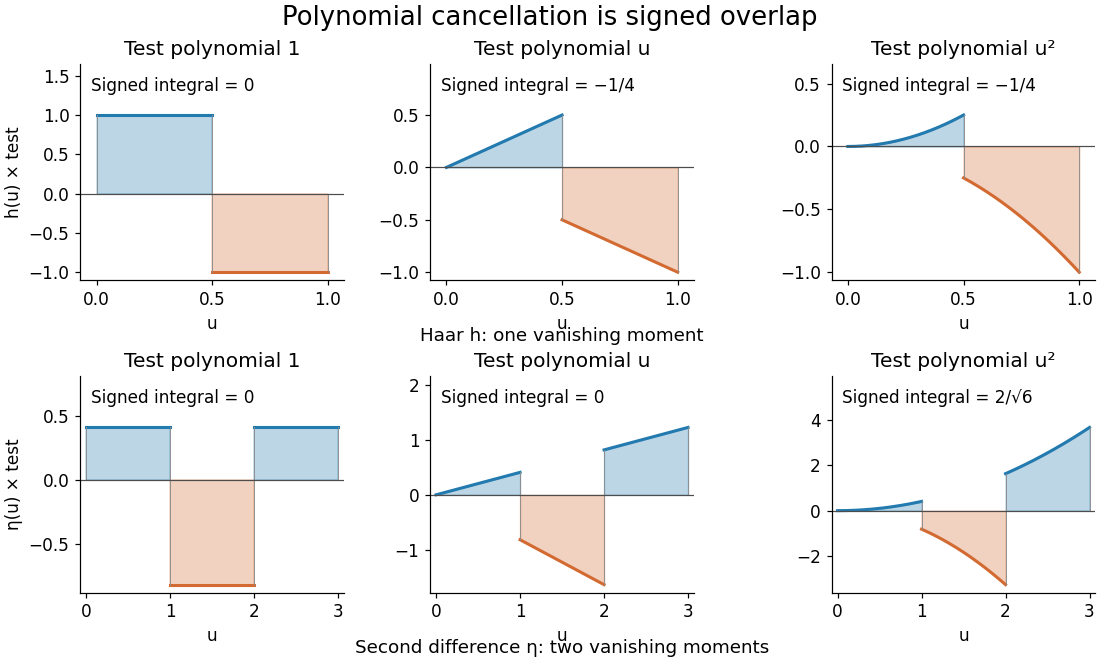
Signed overlaps of the Haar and second-difference analyzing functions with constant, linear, and quadratic test polynomials
. Details. This is a normalized analyzing function, with no orthonormal basis assertion. Indeed, its unit translate has nonzero L2 inner product:Hence these translates already fail orthogonality. The Daubechies wavelet construction imposes additional refinement and orthogonality requirements; two vanishing moments and unit L2 norm by themselves do not supply those requirements.
Let be an integrable function with at least one vanishing moment. For a unit jump discontinuity , where is the Heaviside step function, substitution into the coefficient givesThe signed integral of the whole analyzing function is zero, but the jump discontinuity cuts through its support of a function and usually leaves an unbalanced partial integral. At fixed relative position with nonzero partial integral, the coefficient decays as , slower than the Taylor remainder bound on a smooth region. “Edges survive” means this relative contrast: the normalized coefficients still tend to zero as .
For an original exact comparison, use the smooth polynomial at . The Haar wavelet and the second-difference analyzing function giveThe linear term cancels for ; it remains for . For the fixed unit jump discontinuity , choose so that at every scale. Then
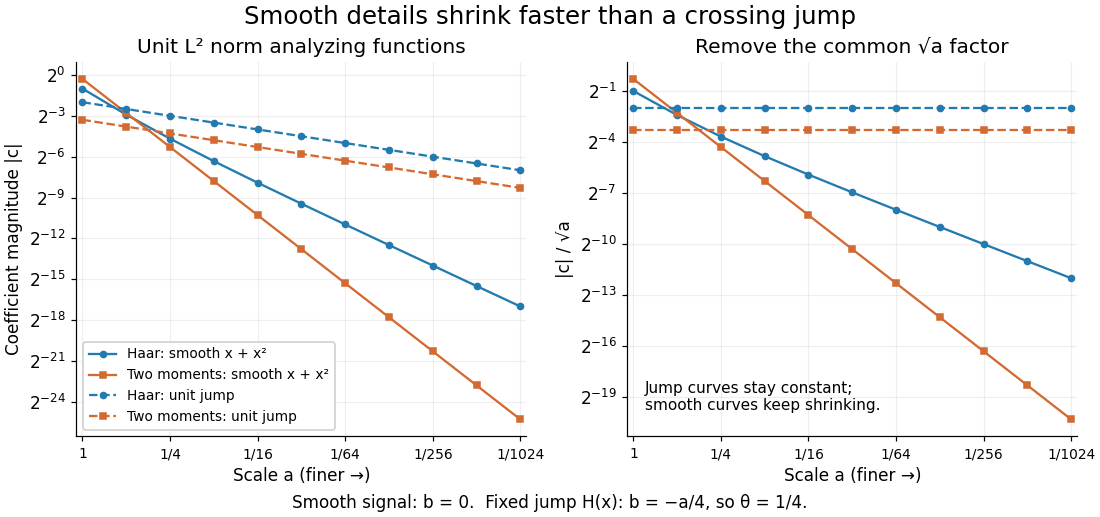


Position matters. If an analyzing function's support of a function lies entirely on one constant side of the jump discontinuity, its coefficient is zero. Even a crossing can cancel: has zero partial integral at . A jump discontinuity on a dyadic interval boundary can likewise escape finer Haar wavelets whose supports do not cross it. These examples describe particular functions and normalizations, not a universal ranking of wavelets for signal processing.
Use the Fourier transform convention . If and for are integrable functions, moment differentiation of the Fourier transform yields a Fourier transform andThe dominated convergence theorem justifies these derivatives. Under these assumptions, vanishing moments are equivalent to vanishing derivatives through order at zero. For this gives a Peano zero ; for it gives . It does not by itself justify a th derivative or an estimate.
If also , subtract the degree- Taylor polynomial of inside the integral. Its Taylor remainder gives the stronger boundFor an integrable function with compact support, every weighted integral exists and its Fourier transform extends to an entire function. The language “zero of order at least ” is then literal analytic function terminology. If the next integral is nonzero, the order is exactly . The smooth-mask vanishing-moment criterion relates these cancellations to a refinement mask under its additional hypotheses.[ref]
Wavelet Bases. Wavelet Bases, §7.2.1, printed p. 206, Theorem 7.4 and proof of (i) ⇔ (ii): decay assumptions and differentiation of the Fourier transform
Suppose an integrable orthonormal scaling function has a low-pass filter of a multiresolution analysis that is near , and its Fourier transform is near zero. If the associated wavelet has integrable vanishing moments, then for . Indeed, moment differentiation of the Fourier transform makes , while . In , division by the nonzero smooth factor proves the conclusion. With only continuity of that factor one still obtains a Peano zero, but not automatically higher ordinary derivatives.
Assume the scaling function Fourier transform and the MRA low-pass filter are , and for . For every nonzero integer , write with odd. Iterating the scaling refinement equation at supplies a factor . All its derivatives of order less than vanish at , by periodicity. The product rule gives for .
Articles by others on the same topic
There are currently no matching articles.