
An original constructed hemocytometer count uses four such squares after mixing the biological cell preparation with the same volume of stain. The dye-excluding counts are ; the dye-stained counts are . The dilution factor is . With the sampled volume per square and the arithmetic mean count per square,Hence the undiluted preparation has dye-excluding number density and total number density . Its dye-excluding fraction is . If the well-mixed preparation contains , it contains an estimated dye-excluding biological cells. The chamber sample itself contains only counted dye-excluding biological cells.
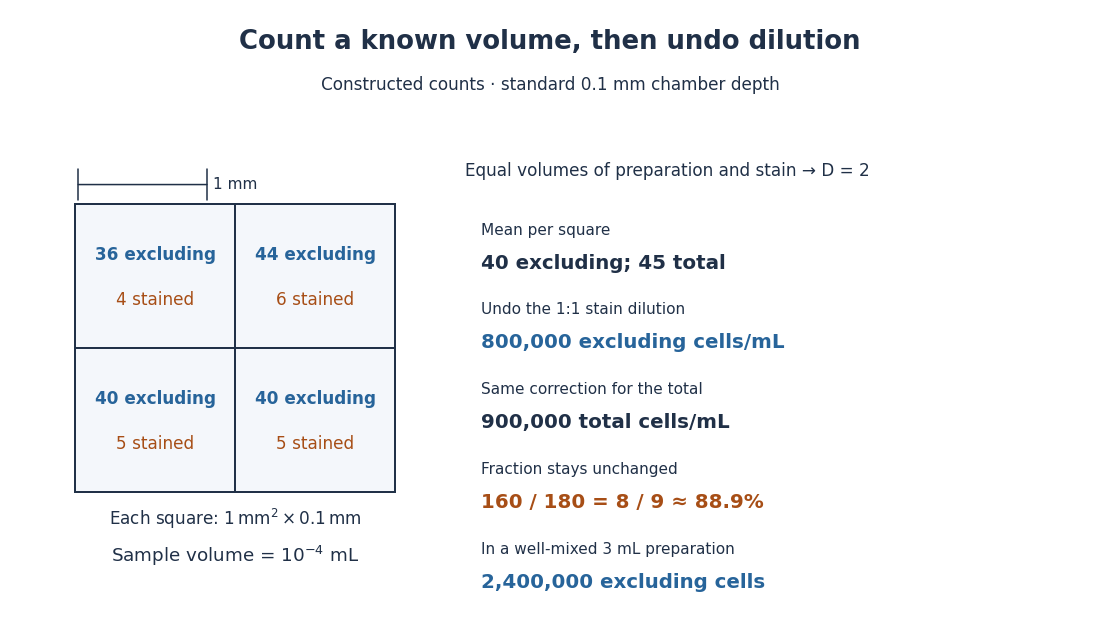

The relation follows from counting material in a known volume, then undoing dilution. It assumes a representative mixed sample and correctly identified single biological cells. Clumps, inconsistent decisions at grid edges, wrong chamber depth and nonrepresentative sampling introduce measurement error. A fixed convention such as including top and left edges while excluding bottom and right edges assigns shared-edge centers to just one square. Adding ten times as much suspension to a correctly filled chamber does not make each square's calibrated volume ten times larger.
New to topics? Read the docs here!