Higgs field potential
ID: higgs-field-potential

For and , the minimum has with . In unitary gauge, gives . The canonically normalized Higgs boson therefore has . The angular modes produce the Goldstone bosons absorbed in the Higgs mechanism.
Set . The same Higgs potential becomesThe origin has negative radial curvature, while minimizes the scalar potential. Changing the field's angular coordinates at fixed costs no potential energy; changing its radial magnitude does. This geometric distinction explains why the surviving physical scalar field has a mass even though the angular directions are flat in the scalar potential. Local angular variations still enter the gauge-covariant kinetic term.
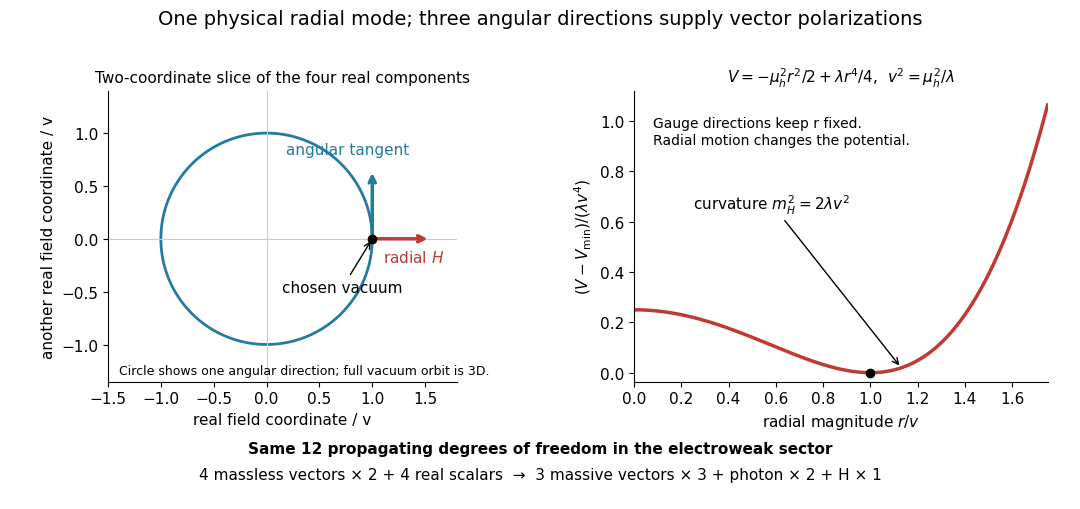
Radial curvature, angular gauge directions and conserved degrees of freedom
. Original two-coordinate slice through the four real Higgs doublet components. The full vacuum orbit has three angular directions. Its points represent gauge-related descriptions; the radial Higgs boson changes the field magnitude. The plotted Higgs potential uses the normalization of this section. Details.
For a chosen model, not fitted physical constants, take and in units . Then and . Direct expansion gives a quadratic coefficient , cubic coefficient and quartic coefficient . The quadratic coefficient is , not . Keeping the same named in the Higgs radial mass for a half-normalized quartic potential would instead give ; these are different potentials. The shifted quartic Higgs potential normalization agrees with this section when .
New to topics? Read the docs here!